
18. Edna Diez, Transformation Leader on Taking Risks
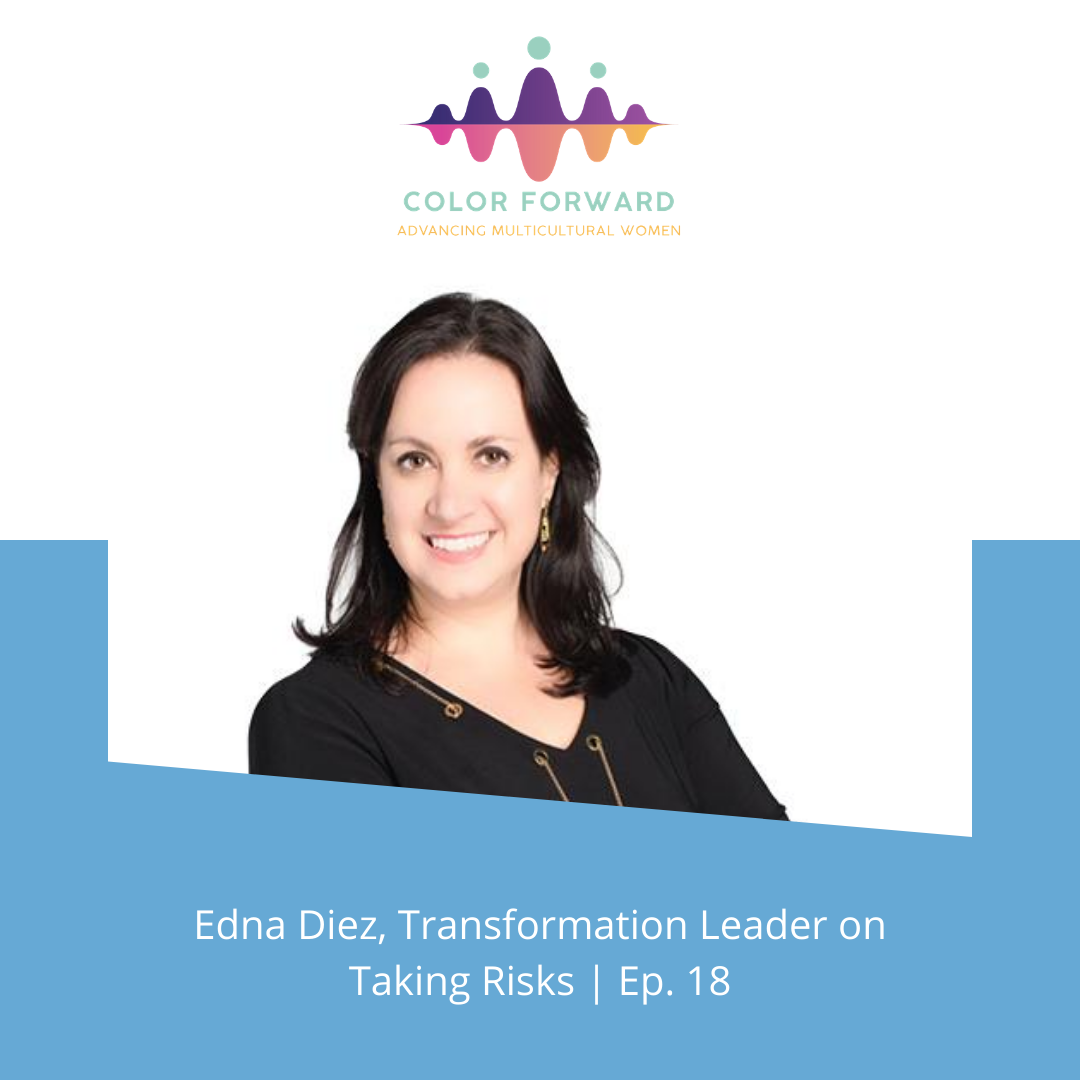
Born in Colombia, to a Chilean expatriate father and a Colombian mother, educated in Belgium, Edna Diez is now a recognized change leader at the World Bank Group. Her “why not” approach to risk-taking brings back memories to the Color Forward team of their own risky adventures and inspires them to live a life of no regret and learn from past mistakes.
Ep 18. Transcript
Alisa Manjarrez: Have you ever just asked yourself, Why not? You know, we have the old term “yolo”, you only live once. Merary, what was a time that you asked yourself, Why not? And just went for it?
Merary Simeon: Wow, I have a lot of examples about that, but I would say the most recent one is pulling together a conference in the middle of a pandemic. I saw an opportunity for women who are hurting any need of healing and personal transformation. And I said, Why not? while getting my doctorate.
Alisa Manjarrez: And having a full time carrier, Why not?
Merary Simeon: Having a full time career and kids and a husband, but…
Alisa Manjarrez: What about you, Rosa?
Rosa Santos: Actually, my Why not? was when I met my husband on an airplane and, and followed him.
Alisa Manjarrez: Where did you follow him?
Rosa Santos: That was a huge Why not? And 22 years later we’re here.
[cue theme music]
Alisa Manjarrez: I was so inspired by our most recent guests, Edna Diez. She’s all about, Why not? It’s interesting when we have these guests, how some make a plan and stick to it, others make a plan and then work around it, and that’s Edna Diez.
Rosa Santos: I know Edna from my time at the Inter-American Development Bank, and she actually took a huge risk on me. ‘Cause she was the one who hired me to lead one of the transformation projects in human resources that she was responsible for. And I have to tell you the one thing that I admire from Edna is her incredible work ethic, her ability to include you and to make sure that you are counted, that what you bring to the table is heard, and that she does all this with incredible optimism, with a fabulous laughter and a capacity to push forward that I haven’t seen in anybody else in all my years of experience. She’s definitely someone who embodies what flexibility, what lessening is and what really, what it is to be someone who believes in something and will get it done.
Edna Diez: I’m one of the directors in the HR function, and I lead one of the centers of expertise in charge of what, what we would call talent management, right? So performance, careers, leadership, learning, et cetera. So it’s a, it’s a really exciting job, because you get to create, new stuff, which is one of the things that I enjoy doing the most, but it’s also the nicest part of HR, right? Because it’s about growth and development. So that’s my, my job, and, yeah, so, I manage a group of, managers and staff that are all creating or delivering services for the world bank.
Alisa Manjarrez: You know, I love talking to Edna because she laughed when I told her she was fun, but she really is. She’s so human. And it’s funny that she talks about bringing humanity to the table in times of change. She is an HR transformation leader. So if anyone knows about becoming a change agent for a world organization, it’s her. But one of the things I really appreciated about her is that she can change the world and change herself. And she’s super self-aware and that’s what fuels her to take risks and ask why not.
Edna Diez: All the big decisions that I’ve made in my life, from the schools I went to, the husband that I married, having a child, all the different jobs, I’ve just said, Why not? right? And then you just take it and live it. What is important is that I’m making a difference, so wherever I go, wherever I can make a contribution that’s what brings me happiness.
Rosa Santos: One of the great qualities about Edna that is hard to find in leaders, and that’s why we have to work with them quite often in the jobs that we perform, is because she is willing to change herself. That’s not easy. And that’s a position that I wish more folks actually would do, especially as going through a pandemic.
It’s important that you, that you think about what other ways that you need to change in order to acclimate to the situation and the context in which you are in. And she does that. She’s really good at doing that.
Merary Simeon: People do not change the goal. They changed the plans. They change their strategy. She’s flexible with how she gets to where she wants to get. We see that in life every day, yet we continue to just give up.
Alisa Manjarrez: Yeah. I think in times of uncertainty, I don’t even think about, Why not? I’m so afraid of, well, what… how’s this gonna affect everything? I don’t even ask myself, Why not?
It’s funny, last episode, we said, What do you want? And this episode we’re saying, Why not? Those are both questions that are very self-empowering and I don’t think that we ask ourselves those enough.
Rosa Santos: It’s important to know what you want, because there’s so much that we go through that is uncertain. Sometimes you create your own possibility. Sometimes the possibilities come to you, you just have to grab them and make the most out of them. I said that I met my husband in an airplane, you know, that came to me.
I could have let it go and then done nothing about it, but I acted on it and I took a risk, huge risk, to actually cross the Atlantic Ocean to follow this man. Airplanes and me have something. But I met an executive on an airplane going from Birmingham to… Birmingham, in the UK, to Barcelona straight out of school, who I spoke to on the plane, as you do, and gave me a business card and said, why don’t you give me a call, Rosa, I might have a job for you. And I didn’t know who he was, or… but as soon as I landed, I called him and I said, Hey, what is that job that you talked about? And that I always remember. That was such a pivotal moment in my life. And I… I’ve always spoken about how did I make that phone call? I don’t think I would have had the career that I’ve had and where I am right now had I missed that opportunity or that possibility.
Edna Diez: Take risks, for crying out loud. We are so risk averse. We are always feeling that if we’re not perfect, we’re not going to get the job or we’re not going to be able… We’re never enough.
So what? Take risks and play it by ear. And the worst thing that can happen, is that you learn something from it and if you fail, pick yourself up.
You’re going to fall many times. And when you fall, you’re going to get up. You’re going to scrape the dust off your knees and I’m going to be there to help you out. So don’t worry.
I’ve fallen and I continued to fall, but I always get up and there’s always somebody there to help me carry on, right? So whether it’s family or it’s friends, or it’s a colleague, or it’s your boss? You will always be able to, to get out. So take the risks, they pay off, personally and professionally.
Merary Simeon: Knowing what you want longterm makes you then say, Why not? I talked about doing the conference, Why not? in the middle of a pandemic, it’s because I know that my purpose is to lift women in every shape way or form. Let’s say I wanted to get married and I met my husband in a different way, we met in a church. Let’s not even go there, you don’t… that’s not why you always go to church.
Rosa Santos: That’s how different you and I are.
Alisa Manjarrez: That’s why I go to church.
Merary Simeon: But I knew I wanted to get married, right? I knew I wanted to get married at some point in my time, in my life. Why not talk to him? Once I know what I want and these opportunities come up, if that is really what I truly want, I got to take some risks. And it’s right in front of me and I’m going to take that chance, because I know this will lead me to where I want.
Edna Diez: He and I, we were both very young and we both wanted to have a, you know, a successful professional life. But I had to move back to Columbia and he was in Belgium and we were separated. And so he said, do you want to get married? And I was like, yeah, why not?
So we were 24 and decided to get married, you know? Like if it doesn’t work out, then, you know, we’ll figure it out.
(thoughtful music starts)
My husband then got very sick and we knew that he was not going to live very long. And so as he was making his bucket list, I added let’s have a child. I knew that I was going to be alone raising this poor kid. But it was something that I really wanted.
And so it was again a like, you know, why not? And a miracle happened. And my healthy boy was born, and thanks God, I have him in my life, because I don’t know what my life would have been otherwise.
(thoughtful music ends)
Alisa Manjarrez: She had a baby all by herself, in a foreign country. I mean, talk about being vulnerable. And then she talks about moving back to DC and she literally had to find people at the gym to say, Hey, I just moved here, I don’t know anyone, can you take care of my child? I mean, talk about vulnerability.
Here’s this power woman who doesn’t have a support system. So she had to create it.
Edna Diez: No family, really no friends. We had just recently moved to Washington. So having always this image of self sufficiency and I don’t need anybody and I can do it myself, I was like, Hell no, I can’t. So whenever people were offering help was like, please help me. Thank you. Yes. Can you take my child, here it is?
Um, can you pick him up? Can you do this? Can you do that? And, and then this started building a network, and realizing the importance of what I call the tribe. You need a tribe to be able to survive. And so I built my own tribe and in Washington DC from everywhere, right? From colleagues, from neighbors, from my friends at the gym, actually, um, and even them, became part of my network of, uh, taking care of myself and family.
Rosa Santos: If you don’t have a support network, if you don’t have a community that can lift you up, go find it, go create it. Find somebody that you can cry your eyes out to, it’s healthy, it’s important, and it’s ever more prevalent today in what were you going through?
Merary Simeon: And it doesn’t have to be perfect. It’s important to have the community and not always be the strong person. You gotta take time to recharge.
Alisa Manjarrez: Recharge, ask for help. Ask strangers for help. I have friends who have moved to other countries or cities, I’ve been there myself. If you continually tell yourself there isn’t anyone available.
That’s how it’s going to be. If it’s the mailman, if it’s your neighbor, and right now we’re in a pandemic. There aren’t very many social opportunities. If that’s all you have, that’s all you have, go for it.
Edna Diez: I’m a gregarious introvert. Going out and asking and talking and initiating something that is not work-related is very difficult, so this building my tribe was out of need of putting down my barriers and my shield, because, I just couldn’t do it alone.
Alisa Manjarrez: You know, I’ve, I’ve recently been thinking a lot about risk taking. I am starting my own entrepreneurial journey and I think a life of risk is looking for risks. And it’s kind of like, instead of seeing risk and resisting it, it’s embracing it. I remember I went skydiving one time, and I went because my friend was turning 30 and she was like, I want to be scared.
And I was like, what, this is dumb. I don’t want to go jump out of a plane just to be scared. And someone told me one of my skydiving friends said, no, you go, you take the plunge because of the adrenaline rush. And I was like, Oh, okay, well now I’m excited. So the whole plane ride, my friend that I was going with, she was like, Oh my gosh, Oh, my gosh, Oh, my gosh…
She’s like super scared the whole time. And I was excited cause I was like, I want that rush. And I think that’s something that I’m starting to adopt now when something is difficult it’s kind of cool to me, and I’m like, that’s how I’m going to grow. That’s how I’m gonna change.
So now I look for it. Of course I still freak out, so…
Merary Simeon: Okay, I was going to say that, ‘cause I jumped out of planes three times. I don’t know why, but I’m still scared the whole ride. I’m super scared. And then once I jump is like, Whoa, this is beautiful. So I can relate so much to you, Alisa, because every time I get up on a plane to jump out, I’m like, why? Why did I do this again?
Alisa Manjarrez: Why not? Edna would say, why not?
Merary Simeon: Why not? Lets do it again.
Edna Diez: I could bash myself forever and think if I… if only I would have done X, Y, and Z. Well I can’t change the past, but what is a tragedy is if I don’t change my future, and I continue to act in the same way.
Merary Simeon: She had the plan, getting to the plan probably went a lot different than what she imagined. I know, even in my life, I knew I wanted to get married one day. I knew I wanted to be an executive. I knew I wanted to get out of poverty. Getting to where I am today was nothing like I imagined it.
There’s a lot of painful moments, but now I look back and I’m like, wow, I would have regretted it if I didn’t take those chances. So from that perspective, I don’t have regrets. Were they painful? Some of them, yes.
Rosa Santos: And I think what we’re saying is, because I’m going back to this idea it’s like, is it okay not to know what you want? And it sounds like what we’re saying is that you have to have some form of an idea of what it is that you want.
Edna Diez: No, I don’t think so. Over time I’ve learned to live with ambiguity. And that’s a tough thing too, because I’m a planner. In my early years I had planned what school I was going to or what job I was gonna have. When I was planning on getting married, in which country I was going to live, I mean, I had 10 years laid out ahead of me.
Nothing worked. I ended up getting married fast. I ended up going and living in Belgium. And so actually what I’ve learned is, I need a plan to structure my, my thinking, but I’ve learned to understand that a plan is… has to change.
Alisa Manjarrez: Merary, something that you said was, As long as you know where you’re heading, you’re more okay with things changing along the way. And one of the things that Edna suggests is having small checkpoints, like, okay, I want to get married.
I met the guy on the plane, and now we actually need to date, and we have to get to know each other. And the way you get to know each other, the way you date, all that might not look according to your plan, but she’s all about checking in with yourself along the journey.
Edna Diez: We can’t plan ahead for three years down the road. We can’t even plan ahead from one month down the road.
So we really need to try to get what is the big objective. And have small checkpoints to get through it. And that’s how I’ve been trying also to manage, you know, my life and this anxiety. You know, it’s like when you go hiking and you get kind of like get lost in the trails, you’re like, okay, I’m just going to follow this trail and see where it’s going to take me. I think that that’s, our life, lately with this, uncertainty.
Merary Simeon: I think it’s different for everybody. I think it takes some people longer than others to know what they want, or sometimes we know what we want all along, but we’re so scared of it. I knew that I didn’t want to be poor. How I got here, I had no idea. It’s okay to not know what you want, but at some point in your life, you have to put the pen to paper and see what makes you happy and what doesn’t.
Rosa Santos: So what do you think helps then for those who do not know? Because I think what we are agreeing to is having some form of goal for your life. Having some form of, map, I guess, loose map, of what may look like. It really is important to carve yourself a path for happiness or fulfillment or however you want to call it. As you said, Merary, it’s different for everybody. And some folks who might be listening might think like, I’ve no clue, I have no clue, and I’m not in a position to even do the, Why not’s? Because I don’t even know where to look. What would you guys say to, What… Where is this start?
Merary Simeon: For me, I could tell you, I started just assessing myself. I would tell you even probably up to two years ago, I didn’t know exactly what my purpose was. I knew that I wanted to be where I am today. I didn’t know what my life purpose was until we started doing this podcast. And I realized that my life purpose is to elevate the voice of women a hundred percent, whether it’s in my job, in my ministry, in my community, in my family, at work, it doesn’t matter, but that is my purpose in life.
And no matter what I do or where I go, that is who I am. And that is what I’m meant to do, but I didn’t find that out until two years ago, and I’m not young.
Alisa Manjarrez: I remember in college knowing that I wanted to impact women in some way. I don’t know how. And then I was mostly coaching men and I realized like, wait a second. I’m coaching men. I’m the only woman at my workplace, literally at the table making decisions. There’s something wrong.
And I think I’ve said this before, why am I helping more men when I’m passionate about women? And so I decided I want to help them make an impact. Today I’m working for myself, that’s because I got laid off from my job. We had budget cuts. Like my plan was never to be an entrepreneur, but I was open to the opportunities, and then I got let go of my job. I think that’s happening to a lot of people right now.
Rosa Santos: I do believe that you need to search and connect and at least be curious so that you can understand what that might be out there that you haven’t even contemplated. I’ve said this before, I remember when I went to college, where I lived we could only afford to go to one school. And so there were only a certain number of, you know, possibilities. Um, you either, you know, be a lawyer, a doctor and maybe a psychologist and a teacher. And I remember when I went, just semi growing up in between the UK and Spain, I remember when I first heard that there was such a job called a food makeup artist, and I thought nobody had told me that that was a possibility.
Alisa Manjarrez: That didn’t come up on my career test.
Rosa Santos: Right? It’s again, it’s about, How do we go after getting more knowledge of what there might be there. And then those possibilities will actually materialize, because, Alisa, you might say that these possibilities are coming and you’re not grabbing them, but you may not even know that there are possibilities.
Merary Simeon: And I love what you’re saying, because I think it, uh, depending on the stage in your life, it changes. Because as I assess myself, right, and I realized this is my purpose, right, to speak to women, I started thinking from where I started. But what I look at now is, I just don’t want to be able to feel good about having material things.
I want to be able to have peace in my life. I want to be able to have joy. So I think a lot of the times we need to think, okay, yes, this is my purpose. Is this bringing me joy? Is this bringing me stress? Is this bringing me… Because I think it starts with ourselves, just like you said, Rosa, you were able to find, Oh, wow, I didn’t even know that was a possibility. There’s many of us that live life knowing, or living and thinking that joy is not even a possibility, because of our day to day life. There are people today because of the way the world is today that, hurt and pain is the norm. So I think it starts with us.
Alisa Manjarrez: Edna takes it to the next level. So she knows basically what she wants. She sees opportunities when she decided to move her and her son to the Philippines, her next level was, Okay, now I need to onboard other people. I’m making huge life changing decisions. I love that she took something organizational, like looking at your stakeholders and decided my son, he’s a stakeholder in my life. And this moving our family to another country is going to impact him. So I’m going to treat him like a stakeholder. I’m not going to make these important decisions without him.
Edna Diez: He was 12 when we moved. So it was also a tough moment for him and leaving his friends and whatnot. But, but he’s for me, I mean, and I can talk about my son forever, so please do shut me up. But, but he’s, uh, he, he’s such a wise and old soul. So when I started considering international posts, uh, he was initially reluctant, but then he actually thought of the idea was something good for him.
And so, at some point when I declined an offer in Luxembourg, he was like, Oh, come on. Now that I’m ready, because I’m a shy person, I need to expand my horizons. I need to expand my culture. I was like, okay, so he’s ready for the Philippines. It’s a partnership, right? You know, you need to bring people along.
Rosa Santos: Even when you do all that due diligence, having the right frame of mind to approach it is important. Because she takes those opportunities in such a, again, positive way even in the language that she uses is very prone to always seeing the positive coming out of every single situation that you might face. And that is, for me, that is the start. Because if you wake up in the morning with that kind of attitude, even though whatever may come your way, is awful, you’re going to be able to bounce back and face a new day very differently.
Alisa Manjarrez: There won’t be a new normal for a while. So we have to be flexible.
Rosa Santos: Yes, we do.
Merary Simeon: And we have to be flexible because we’re going to make mistakes, trying to figure the new normal. And as we make those mistakes, we gotta learn from them to do better the next time.
Edna Diez: Resilience is my word, I think. Life has thrown at me wonderful opportunities and wonderful things and also terrible situations. And when I look back, I always see a learning in each and every one of them. And that’s what I always try to do is to pick. I live my life without regrets, because it doesn’t help you. But I also always look back and see, what did I learn from this?
Alisa Manjarrez: And she’s always asking, Okay, what’s changed? What do you need to change? She even says, she’s not a journaler, but every day at the end of the day, she’s going back and saying, Okay, where are we at now? I mean, I think that is the epitome of being an adaptable person. You’re always welcoming the opportunities, like we said, you’re looking at the issues that have come up because it’s not easy, and then you’re looking at what you can control, what’s solvable, what you’re learning, how we can do things differently. In order to be adaptable, you’re always learning.
Edna Diez: So I’m, I’m not a great journalists, a like a journaler. How do you say that? Um, people that jot down things in journals, keep a journal, but I strongly recommend it for any behavioral change, as well. And so whenever I’ve, I’ve set, a particular behavior that I’d like to change, um, because of my feedback or whatever I do take the time to see at the end of the day, what happened during the day? How did I react? Did I apply this, this new behavior or I didn’t.
And if I didn’t, what was the trigger? And being very purposeful about that, and it has worked, it has worked for a very stubborn person like me, so I’m sure it can work for more flexible people.
Rosa Santos: What does that look like when you say you’re always learning?
Alisa Manjarrez: I think it’s about recognizing yourself in others. So you are changing. You are reacting in different ways, and then other people around you that you’re talking to day in and day out, they’re also changing. And they’re also learning. Maybe they’re not learning, but maybe it’s your job to help them learn. If you’re in a work situation it might be in a meeting where you ask someone how they’re doing, and then you help them to reflect on what’s changing for them.
Merary Simeon: To me, always learning is being open to where the learning comes from. A lot of the times in the workspace, people look to learn from somebody who maybe has more experience or a bigger title. And I could tell you sometimes I may learn more about empathy from my peer. I might learn more about empathy or any particular topic from my child. They teach me a lot. There’s a lot you can learn from children actually. And I think as long as we stay open minded to where learning comes from, it will make us better leaders in the long run.
Edna Diez: When I moved to the multilateral world, it was actually changing completely my way of working. And it was a tremendous cultural shock. I had to adapt my, my working style. The things that had worked very well for me in consulting in the private sector were not meeting the expectations of the culture of the bank, but they hired me to be a change agent, but they didn’t want me to be a change agent.
So it was a very difficult situation. And after a while I decided that I did not want to work in this environment and I left, but now I’m back, happily back. But what was very challenging here was, you know, understanding what were the things that I was doing that were contributing to the issue, right? And at the time I couldn’t see it, right? I was a very stubborn… I am… I’m very stubborn, I continue to be. But I realize, I started getting that self awareness of there things that I need to adjust in my way of working if I want to be successful in working in this environment. And, I am a change agent, and as such, I also need to adapt my style to be able to meet the success of the organizations, right?
So it was a really, really difficult moment in my life, in my professional life, I felt like a failure, right? But I grew so much from it, and it really taught me that I needed it to… you know, I always say that I work with the grain of the organization. I work with the culture. It makes no sense in my job and my role to go against it. I’m never going to be successful. So you work with it, and get the best out of it. And you need to adjust, and you will need to adjust timelines and you will need to adjust timeframes and you need to work with different people of different cultures, and you cannot expect them to adjust to your style.
You need to be able to work with them with their strengths and their kinks and whatnot to be effective. So it’s this adaptability that on the workplace, I’ve learned throughout and everywhere I go, I find the same thing, right? And as I coach and mentor others. But, yeah, I think what I do in those cases is don’t sweat it. Don’t sweat, the big stuff… the little stuff, learn, be adaptable, surround yourself with the resources that are gonna help you, and be very humble and vulnerable. And you know, if you know your limitations you can work, you can identify how to mitigate them, whether it is by learning something new or by bringing somebody that knows it. Because you probably are not going to be able to do it yourself anyways.
Rosa Santos: I think I’ll be a little tactical here.
Alisa Manjarrez: Do it.
Rosa Santos: I think a good practice is to ask ourselves, What did I learn today? Is there anything new that I learned or pushed myself to learn today? Be it from my kid or from my partner, from work, is how do I get into a habit of pushing myself too consume something new that it’s gonna make me grow and something new that also I can discern that is a true learning for me, right? Because in a world in which we live today with so much fake information, you’re learning by being able to discern, you know, what is true from not. And just by doing that and being purposeful every day, I think you, you’re allowing yourself to exercise a muscle that is going to lead you to be more flexible, more adaptable, to be a better listener, to be more empathetic, and to be able to put yourself in somebody else’s shoes.
‘Cause you have, again, I go back to, that mind frame or frame of mind, and you’re going to brace, you’re going to… you’re there to soak up. And so every day, asking yourself, What did I learn today that I didn’t know yesterday?
Merary Simeon: And what am I going to do with what I learned? Because you said something the other day, Rosa, is you can learn empathy based on when you truly listen to other people’s needs and what hurts them.
Rosa Santos: Yeah, we were having this debate the other day about, is empathy a skill or an innate trait that you have because of who you are? And given the times and the call to be more empathetic there were folks who were saying, well, if you’re not empathetic, you’ll never be empathetic. There’s no way around it. And my position is, again, with this attitude of learning and willingness to understand and grow, empathy can be learned. You just have to be open to it.
Merary Simeon: If we can’t learn it, we’re doomed.
Rosa Santos: Yeah.
Merary Simeon: Sorry.
Rosa Santos: We might be doomed already. Anyway, I was getting too serious there.
Alisa Manjarrez: We’re like, the world is falling apart.
Merary Simeon: I’m like, if we cannot learn empathy, we are done. Because there’s too many people walking around without empathy.
Alisa Manjarrez: There is a stereotype about women having more empathy and Edna talks about how some of that comes from the ability to juggle a lot of things.
You have to have understanding of yourself and others to handle everything that comes your way.
Rosa Santos: I think some women are awesome and juggling everything. I think some others are terrible, right? I don’t know if it’s a prerequisite. I think the way that you are positioning it is, it’s prerequisite that you have the ability to juggle everything and just be fantastic and put this output…
Alisa Manjarrez: Maybe it’s… You look at someone like Merary, she’s juggling her career, getting her doctorate, having two young children, running a conference, having a podcast, I’m getting tired just thinking about it, but you know, and maybe she…
Rosa Santos: We all need a Merary in our lives.
Alisa Manjarrez: I know, it’s true. Oh, yeah, and she also looks amazing, P.S.
Rosa Santos: That’s right. Absolutely. Hands down.
Merary Simeon: Oh, you’re too sweet.
Alisa Manjarrez: But, I mean, you know, I don’t know, Merary, if you had a lot of empathy before, or if you’ve developed it along the way. Like, I would guess that you’ve developed a lot of skills because you had to.
Edna Diez: It’s not how I used to be. It was all about me, and what I wanted and what I thought was important and good. And I’ll never forget a conversation that I had with a mentee, that I had very early on, and she was like, Oh, have you noticed that you only talk about yourself and what works for you?
I’m the mentee. What about what works for me? And it was like a huge slap on the face, right? But it was such an important message of awareness that there’s times when people want to hear your experience and your point of view, there’s times when people just want to be heard and listened to. It truly helps the relationships, with whomever you are going to be interacting with. It buys you time to understand individuals and put yourself in their shoes and understand what’s important
[moderate drumbeat starts]
Alisa Manjarrez: So here are three tips that we’ve learned from Edna on how to take risk.
Number one, have a loose idea of where you’re going, focus on what’s important to you.
Number two, create small checkpoints along the way.
And number three, stay in an attitude of continuous learning. What feedback are you getting? How are you reacting and what can you do differently?
[drumbeat ends on a snap]
[outro music starts]
Edna Diez: Really focus on the things that are within your sphere of influence. And whenever you’re feeling lost and overwhelmed go through that list of what are all the things that are bothering you right now. Those things that are solvable, versus the ones that you can’t. Be purposeful, put it aside and then take control of your life.
Alisa Manjarrez: For more inspiring stories, please subscribe on Apple, Spotify or wherever you listen to podcasts. If you have a guest you’d love to hear on the show, send us a DM on Instagram at @colorforwardpod.
I’m Alisa Manjarrez, producer of Color Forward. Thanks for joining us and, please, leave us a review.
[outro music ends]