
19. Sabina Ewing, Tech Exec on Fitting into Your Own Shoes
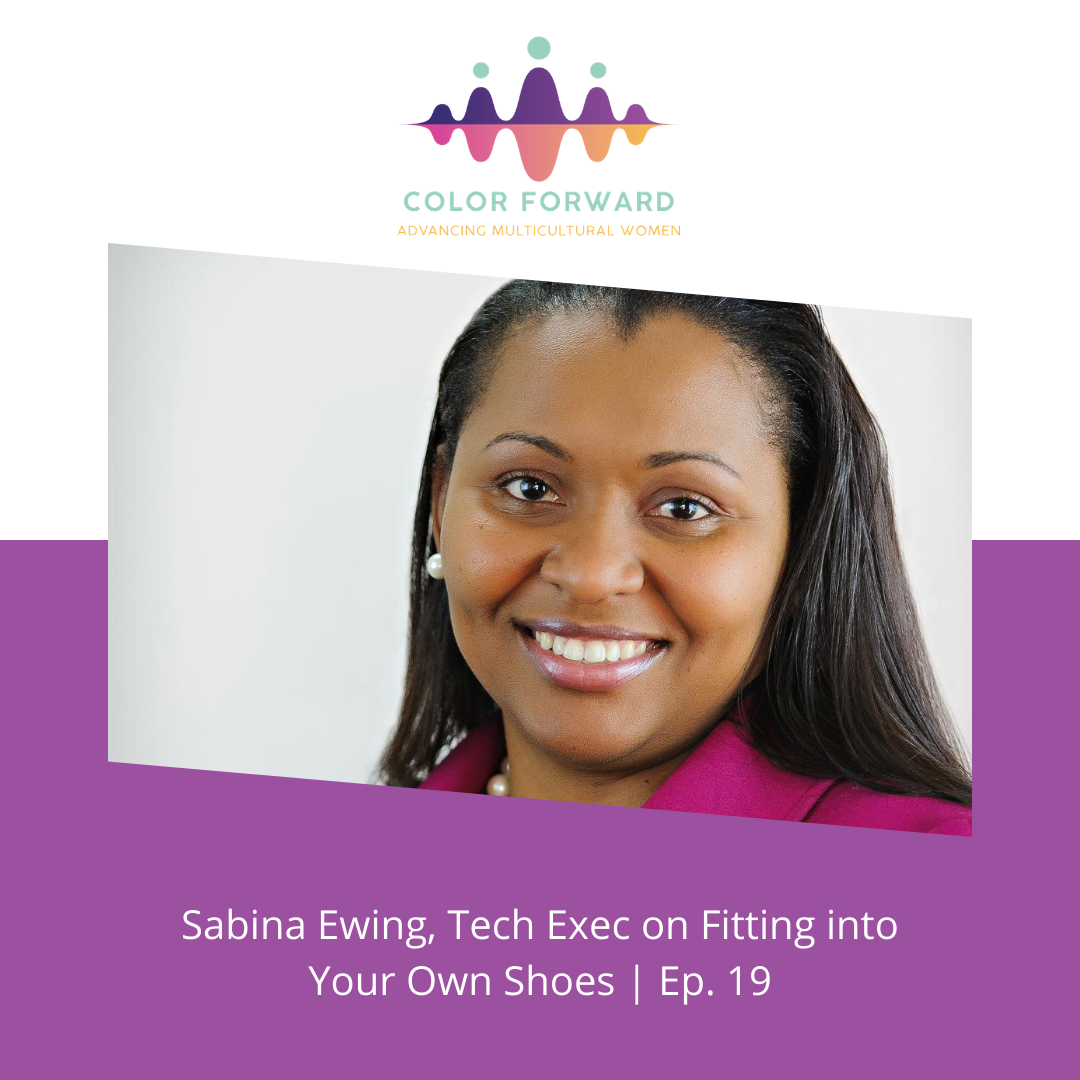
As Chief Information Officer at Pfizer Upjohn, one of the world’s largest biopharmaceutical companies, Sabina Ewing is inspiring the next generation of Black women in STEM. After moving her family from China back to Pennsylvania, she talks to Rosa, Merary and Alisa about the future of work and creating a legacy in her career. Now, more than ever is the time for women of color to embrace their identities and unleash their power within.
Ep 19. Transcript
Sabina Ewing: I believe that COVID-19 and the pandemic has really put a defibrillator to the way we work, and it’s a jolt
And so for me as a CIO, it’s really important for my function and myself to help chart the 21st century version of IT. It’s no longer going to be the folks who are the guys in the rear with the gear that everybody wants to kind of… you know, their eyes hurt at the side of light, let’s just serve them pizza and they’ll get all the work done, to really meaningful partnership where people understand the maturity of technology, the importance of technology, because it is in fact transforming how we work.
All of those companies that effectively said you couldn’t work from home, you needed to physically be in the building. You needed to, operate in a certain way. Well guess what, the pandemic forced us to do something different and you can see whether or not your organization has been able to thrive. Some have to catch up to where others are, but I do believe that it’s really important in this environment for us to recognize that in large measure, we will not go back to what we knew, and that’s a hard thing to accept or acknowledge.
[theme music starts]
Alisa Manjarrez: Welcome to Color Forward. A podcast highlighting successful women who have overcome cultural adversity and mastered the art of resilience. Rosa and Merary, we’ve been talking to so many executives lately about the future of work, and a lot of them are global citizens, and one of the things that I love about Sabina Ewing is that she is so grounded in who she is as the chief information officer at Pfizer. I mean, this is one of the largest pharmaceutical companies in the world and they’re currently working on vaccines for COVID, yet for Sabina, it’s just another day at the office. She understands her value. She understands her own voice and she is all about helping to bring others up along the way.
Sabina Ewing: I anticipate that, you know, figure I’m with Pfizer and we have two candidates for a COVID-19 vaccine that has been fast tracked by the US FDA. So we all want to see a vaccine, right? Vaccines are preventative. Um, and I know there are certainly ones that we’re looking at, antiviral, but regardless, I would say that it is really important for us to recognize going forward, we will have to morph our understanding of what certain in-person experiences look like, how do you move it into a digital world? And I’m not aspiring for us to solely be in a digital space. Because we are human beings that need human contact, it is so difficult for me to see and meet people that I care about and not be able to hug them, not be able to hold hands. And so I do think that going forward, we have to chart our own future around how work gets done, and to… and including physical buildings. Do you still need them to the extent that you have this footprint and how do you adjust for that?
What will be the implications on cities, which have these massive skyscrapers that take up a certain type of space? How do you do that? You know, if you are in retail and you’ve suffered through this particular pandemic, how do you really harness your online persona? What are the innovative opportunities for entrepreneurs to come up with new, meaningful ways?
And I think people of color have extraordinary ingenuity, right? Based on their experiences and what they bring, that it can lend itself quite well to charting forward that future. But the future of work is very different than what it has been in the past. It’s far more digital, requires people to be far more savvy, technically savvy, and at the same time, I think it creates an opportunity for those who want to be more creative and really going after their own dreams in impacting that future, that digital future.
Rosa Santos: I think you mentioned, Alisa, we are having all these amazing women and part of that common denominator that we seem to find is they’re global citizens. They truly believe that they’ve gained certain experience and way of looking at life and facing challenges because of that element. I also think, and Sabina talked about this, is this ability of being comfortable in your own skin. And I think she talks in a way of wearing your own shoes.
Sabina Ewing: Young people and people of color and women as well, and women in particular, because we were both, all of us on this call we’re women of color, I would argue that we need to wear our shoes. And learn how to pour ourselves into our shoes. You know, with each decade that passes by you get more and more confident in who you are and understanding who you are.
But I want everyone to recognize what they do bring to the table. So when you are a person of color in the United States and you bring your background, I want them to see it in action in me as a role model, but also to let them know how they can bring that authenticity that people talk about that really does engender connections with individuals, that plays into some of the informal rules that really help people to advance in their careers.
So it’s around all of the things that they’ve heard about, whether it’s leadership, whether it is strategic thinking, whether it’s the interpersonal aspects of being a professional in the corporate setting and having an ability to really make a difference and advance as well. So that’s what I mean when I talk about really being able to serve as that role model.
Rosa Santos: She’s owning her own success, her own journey, and she’s owning the outcomes that she wants to demonstrate by the way that she’s conducting both her personal and professional life. For women of color it’s an awesome analogy, because I think we’re always trying to wear somebody else’s shoes to be liked, to be taken seriously, to gain credibility with others. As I was driving yesterday, I listened to this piece on the radio and it really saddened me so much to hear.
This interview of this kid, this junior in high school, since COVID started this guy with somebody else with another high schooler has distributed more PPE in that state than FEMA to hospitals. And he’s decided to come out and say who he is and give interviews because he felt the pressure in the high school, ‘cause he wasn’t turning in his school work and he had to say that he was doing this and he had been working under a different name because he’s Hispanic and he didn’t feel that what he has been able to accomplish, that he would have been taken seriously if he had actually shared his last name, it broke my heart.
It really broke my heart.
So I go back to the analogy, the analogy is awesome for women of color, because again like this kid, we always think that either we have to wear somebody else’s shoes to be included and it takes a journey to really wear your own and to be like, this is it.
Sabina Ewing: You know, given the way that things are unfolding, right, right now in the country, I think there’s a whole host of challenges that everyone faces. But I will say this, there are still the foundational problems that everybody has right, which is, for me as a woman, you know, an, a person of color showing up…
And by the way, I believe the research shows that people see your gender first and then your race. You know, it’s a function of showing up and, you know, the… you say something and a man says it five minutes later and it was like an epiphany, right? So those challenges still exist. But actually now I’m more inclined to call it out.
And have others, allies, cognizant of this who will amplify what I’ve said. And I do the same for other women and people of color around that.So you’ve got that, but I’ve also recognized, you know, with the challenges around working and COVID, for me as a technologist, it’s an opportunity to seize and really leverage the platform and the capabilities and the space that I’m in to advance and support the business and to make sure that that can lead to greater success for the folks in my organization as well.
Merary Simeon: I remember when I first started in the corporate world and people would tell you, you have to wear your hair this way, or you have to wear the dark suits. It’s almost the same thing, right? It’s these are the shoes you got to wear, even though you didn’t feel right in them.
So they were not really my shoes. My shoes are very different than what I probably would have chosen back then. Well, definitely what I choose now is very different. It’s so important to be your whole self, yet it’s still difficult.
Alisa Manjarrez: I never thought I’d be a Birkenstocks person because they’re so ugly and frumpy, but I love them because they’re so comfortable, and they’re so like… I wear them almost every day with every outfit with dresses, and it’s weird that it’s taken me so long. I used to make fun of my friends who wore them.
But now I feel like these are me, and I’m so much happier than like wearing heels with my dresses.
Rosa Santos: Literally wearing the cool shoes or your own.
Alisa Manjarrez: I guess the moral of the story is, I’m not that cool. I’m not as cool as I want to be.
Sabina Ewing: You know, I was talking to my sister this morning and I said, Oh my goodness. Look at us. You know, and she reminded me. She’s like, and we’re middle age. I was like, I know. Can you imagine? Right? We see each other… my sister still shows up, you know, she works with Usher, the artist, his new look foundation. She looks like one of the kids still, right? She dresses cool. She’s the cool… my children think she’s the coolest person on the planet. You know, that, that she’s, she is officially just auntie. It doesn’t even have to have her name behind it, like everybody else. She’s just auntie. And she’s just so fabulous and cool.
Alisa Manjarrez: I look at Sabina’s journey of being from the Caribbean. She’s an immigrant. She grew up in the Bronx. She went to Howard University, and now she’s an executive. It’s been an incredible journey for her, and because of where she is, she’s now able to think about her legacy and actually lead a legacy. And she’s a role model to women in STEM, women of color in STEM, women in STEM, black people.
I mean, she’s a role model to everybody.
Rosa Santos: But do you think that you need to have had certain experience or having had a certain journey or being inside certain position in order to think through either being a role model or purposefully think about your legacy?
Alisa Manjarrez: I think the idea of being comfortable in your own shoes, you can be comfortable in your own shoes if you’re 10 years old, 20 years old, 50 years old. I think what creates legacy is owning where you are in your journey and when you say legacy, I think about inspiration. And so you can be inspiring at any age, no matter what your experiences.
And so I think that you can leave a legacy wherever you’re at. It’s a good question. I don’t know. I’m still thinking about it.
Rosa Santos: That’s an interesting distinction, actually, whether it’s about experience or inspiring others. ‘Cause for me it’s actually it’s even further, really… I guess it’s inspiring others and having an impact on others to move forward, and to help them create success for themselves. Or at least that’s a very personal way for me of thinking about legacy and how I think about my legacy, how I maybe walk in life thinking, What is it that I am doing in order to impact positively the folks that are around me in order for them to see new possibilities or to grow out of the exchange?
Alisa Manjarrez: So for you, it’s about impact and impact now.
Rosa Santos: As Sabina says, being a role model, what is it that I am doing with this power that I have? And she specifically chooses to activate that power in a very specific way, which is amplifying the voices of women and women of color that maybe at that moment cannot speak for themselves for many different reasons.
Sabina Ewing: One of my passions is making sure that at this point in my career, it’s about legacy. And so, you know, finding ways to inspire the next generation of people of color, of women, and just in general, relative to what IT leadership can look like. So to the extent that I’ve been able to leverage my position where I currently am, which is at Pfizer, to sponsor Howard University School of Business Honors Program to successfully have more than four, I think it’s six cohorts now, go through girls who code in our summer immersion program that we’ve sponsored in partnership with girls who code, or any of the number of engagements that we have around STEM. So those are two really important aspects of my professional life and personal life that I really am proud of.
Rosa Santos: Do you think it’s important that we consider our legacy?
Merary Simeon: When people think of Merary, I want them to have something positive to think about. I want them to know me for elevating the voice of women. That’s the type of legacy that I want to have.
And I think every move and every impact and every action that we take each day determines what our legacy is going to be. Is my legacy this month going to be, or for this project, or even for this podcast, that I wore my shoes, or did I put on other shoes because that would be the right thing or that would be what people would want to hear?
Rosa Santos: I think sometimes it is okay to wear somebody else’s shoes.
Alisa Manjarrez: How so?
Rosa Santos: I think sometimes one needs to out smart the situation, the person, or the context. And sometimes in order to give yourself a leg up, I think it’s okay to wear somebody else’s shoes. It might be incredibly uncomfortable.
And I think we all have done it, this might be a different way of saying or thinking about the rules that we’ve had to break in order to them being able to wear our own, to be okay with who we are.
Alisa Manjarrez: Is the journey putting on everyone’s shoes until you find your own fit, and is that necessary?
Merary Simeon: Sometimes we may feel uncomfortable in our own shoes and we got to break them in, right? You gotta know the rules and when you do, then you can challenge the rules. If I’m wearing my shoes, but for so long, I’ve been wearing somebody else’s shoes, putting on my own sometimes feels uncomfortable. I could tell you bringing my whole self to work doesn’t feel right in every meeting. It’s just not welcome, not every single time. So I do have to agree that I think sometimes we have to break the shoes in, or sometimes we may have to put on a different size until we’re comfortable putting our own, or maybe the other people are comfortable accepting my stilettos.
Rosa Santos: And I wonder, how this goes with the “fake it till you make it” approach, put yourself out there and just pretend that you can do it and you’ll end up doing it. And I think there’s a lot of women and especially women of color that are trying to break through certain stereotypes. That “fake it till you make it” is painful. It’s very painful. And I think that is what we are trying to push through the fact that we don’t want to fake it. We just want to be it.
Sabina Ewing: You know, I could wear men’s shoes, but they weren’t really be my shoes. Even if it’s the size, right? I can fit in a man’s nine, but that was necessarily be the style that I want. And so it’s learning to come to the table in the style that I want in the way that I want, um, the way that that allows me, and I was intentional selecting the word unleash, right, I think there are a lot of us who go to work and we get things done and we’re successful at what we do. But when you really get to the point where you feel like, you know, those days that you were on and you’re doing a fantastic job, that’s you.
That’s your authentic self and the ability to constantly bring that to the workplace and then unleash all of that in a positive way to generate not only performance results in the organization, but that fulfillment for you and your career. I think that’s really the aspiration of articulating, making sure people know to bring themselves and not a fabrication that they think people want to see.
‘Cause people can pick up when you’re not authentic.
Merary Simeon: I think that also goes to where she said something about, you still got to raise your hand. You still got to take the chances. You still gotta be a risk taker. But I think at the end of the day, in order to move up in order to make an impact in life, you have to take the risk.
And maybe you do have to fake it a little bit, or maybe you just have to work harder.
Alisa Manjarrez: Or maybe taking the risk is just being yourself even if you don’t think you’re going to be accepted.
Rosa Santos: But it’s about knowing when to take the risk as well, right? I think you have to be mindful of when and how to take the risk and with what purpose and how deliberate you can be.
Alisa Manjarrez: Well and you don’t want to be rude, being yourself doesn’t mean speaking up and offending everybody. It could mean just using your voice in general, instead of assuming that no one wants to hear you or no one’s going to listen to you or no one is going to believe you. It might be saying what you think no matter what.
Merary Simeon: And I think about when you define what are the things that. You are willing to do and the things that you may not be willing to do. So for example, for me, I am very clear on my values and I will not wear somebody else’s shoes when it comes to, you know, putting my values at risk. I am open to other people and I have empathy but at the end of the day, my values are my values and I will not change my value shoes, if we’re thinking about it from that perspective, uh, because putting that at risk is something that I will not be able to sleep at night. And that to me is not worth it. So I think it goes to defining what are those things that are important to you and those things that you’re willing to brush off. And what are those things that you are absolutely not willing to let pass?
Sabina Ewing: You know, early in my career, I was risk averse. As a person of color I had to be thorough. I had to be on point, to use certain terms and, you know, make sure that my work was exceptional. And I did all of that following the rules and being risk averse as the daughter of an accountant, I would have still been successful, but I would have played within the lines a frame, if you will, on what success looks like.
Alisa Manjarrez: She’s a rule breaker through and through, but it always comes back to her moral compass. And that’s what guides her along the way.
Rosa Santos: And the one thing that she said that very much resonated with me, and we’ve asked this off other guests, it’s not about just breaking the rules for the sake of breaking the rules. It’s about knowing the rules that are there exist so you choose which ones to break. That’s very insightful, because I think it goes back to that point of, is it worth it? Actually, is it worth it that I’m going to be breaking this rule? Is it gonna pay off, right?
So that I’ll take the risk. So looking at it through that lens is definitely very, very insightful. And she mentioned how, especially for certain communities, what you were told when you were little was “everything will be okay if you work hard”, “you’ll be successful if you work hard.” And we know that in corporate America, that is not enough. You might be the hardest worker that there is, but if nobody knows the work that you’re doing, and how you’re doing it, and the outcomes that you’re demonstrating, then you only get to certain point.
That is the “and” for me. So what is the “and” that you’re adding to all of that hard work, because you don’t want all of that hard work to be just throwing out, right? Or feel frustrated because you know, maybe you’re being passed up for a promotion or for a job because, you know, you see other people taking it on when you know that you’ve worked so hard. Part of that strategy is, I’ve worked so hard and I am owning my success.
I am owning the positive outcomes that I’m having on my business. And I am going to tell a least three people every day, or and I am going to make sure that I engage in whatever best practice that I’m putting out there. And I’m going to teach others to do it this way. That is the “and” that is going to take you further.
Again, as we always say, if that’s what you want, but sometimes, many times, just working hard is in fact not enough.
Merary Simeon: I do think that there will always continue to be stereotypes and working hard is not going to be enough. So we need to be comfortable in knowing that we’re going to have to work harder and do something else, because knowing the rules or breaking the rules may not be enough when you’re a woman of color, you always have to do that extra mile.
Sabina Ewing: But that experience actually, because I became less risk averse allows me to put my hand up. So when I talk about being a rule breaker, it’s because I followed all the rules and realized that you can actually get even more, once you understand the rules and then, you know, raise your hand to really challenge those rules.
And it varies in how that challenge occurs. But like I said, you want to do that with savvy.
Alisa Manjarrez: Sabina and gives us a playbook. She calls it initiatory reciprocity. And she says, look, if you’re in middle of management, you’re never going to get to the executive role. Someone has to pull you up, but you have to lay a foundation first.
And so those are those “ands” that you’re talking about, Rosa. So you have to work really hard and you also might have to, like Sabina says, you might have to raise your hand for things that people don’t want to do. You might have to volunteer to move to another country when no one else wants to. You might have to go and make a connection or serve somebody in a different way and show you your value and prove your value so that you build those relationships across the organization. She says it’s not enough. It’s not enough to just do hard work.
Sabina Ewing: And so in order to support those relationships, there’s a principle I learned a long time ago. That’s coined as initiatory reciprocity and it is what it states, which is essentially, how I’ve built quality relationships and how, you know, you build relationships to experiences, you build relationships, working on projects together, working together for a long time. Really it’s those experiences and moments. But if right instance, I initiate, and I know that you just started a new role, or I know that you expressed an interest in something, and I see that what a piece of information or something that I think will be helpful to you, and I initiate that unrequested not asking for anything, just send it over to you, you know, ’cause I recognize it will be of value to you, then by human nature, you generally find people who want to reciprocate something back to you at some point in time.
A lot of companies are built off of relationships, but people have to realize when you’re in a corporate setting and an environment, what do those relationships look like? It’s the ability of that person to call on you when they need something and for you to be able to deliver. And so knowing that you can trust the person, knowing that a person gets things done, being able to, as I say, cut through the mulberry bush, whatever your corporate culture is that you might have to cycle around the mulberry bush, talk to Henrietta, talk to John, talk to Eric, talk to, you know, to Tanya, whomever, you know, to cut through the mulberry bush, that’s another valuable asset, right? For me, mine is always being a connector. Because I’m an extrovert I get a lot of folks that I meet, and I will know from different parts of the organization. And I will, see a moment where it’s beneficial for one person to know another person.
Rosa Santos: I think for me, what stood out from Sabina is being very strategic as to how you leverage your relationships and your network. How you’re able to optimize that in the best interest of, again, a little bit, and I say this quite often, of being selfish. We forget sometimes of being selfish and, and really take care of yourself first, in order to then be able to take care of others, leveraging your network and your relationships. I think it’s a spot on.
Sabina Ewing: So when I talk about initiatory reciprocity, I recently met a CIO, he was new to the area. I know how it is for me where I am in South Pennsylvania to sort of get infiltrated into the environment, the culture, because folks have been here for a very long time, large families.
So they’re, they’re kind of set. And so when you come from out of town, how do you get it? I decided, okay, so you’ve got young kids. I know where you live in a certain area. I’m going to connect you with three people personally. I don’t need anything. I’m just going to literally connect you with these three families, and hopefully they can help you get more acclimated. I reached out to the CIO group that I’m a part of, and I asked, is this person part of the group? They were like, Oh, we didn’t know he was here. No, he’s not.
Okay. So I’ll just connect you guys. Again, I don’t need anything from that CIO. I don’t. I just simply feel like it’s good energy I’m pushing out into the universe that good energy comes back to me, tenfold. And I know in the moment I’m helping that person.
So that’s what I mean by that other principle of initiatory reciprocity, because it does come back to you so you don’t have to be selfish. So hopefully those are just a few tidbits that might be helpful to your listenership to think about as they navigate their careers.
[uptempo music starts]
Alisa Manjarrez: I learned three things from Sabina in this episode, one, wear your own shoes. Be proud of them. Two, recognize when they don’t fit. It’s okay to grow into them. It’s okay to grow into yourself. We’re always moving. We’re always changing every day, even today. And three, show up and leverage your relationships. Sabina is all about playing to win, raising your hand and being present so that they don’t pass you by.
[outro music starts]
Sabina Ewing: The days are long, but the years go by so fast. I realized I’m not guaranteed to have the years ahead of me, that I have behind me. And you kind of just keep going through those days in life and you go through the paces and you realize every once in a while you might look back.
But for me that whole process of looking through the pictures also made me feel like, Wow, I’ve really had a wonderful life lived. And so now I really want to make sure that I am mindful of being present in all those moments, because I think in some of those instances, I don’t know that I was as present in those moments if I had taken the intentional posture of savoring, versus, getting through it or doing it. You know, Serena doesn’t win every match, so you don’t win it all every time, but you play to win.
Alisa Manjarrez: For more inspiring stories, please subscribe on Apple, Spotify or wherever you listen to podcasts. If you have a guest you’d love to hear on the show, send us a DM on Instagram at @colorforwardpod.
I’m Alisa Manjarrez, producer of Color Forward. Thanks for joining us and, please, leave us a review.
[outro music ends]