
21. From Difficult to Meaningful: How to Reframe Your Conversations
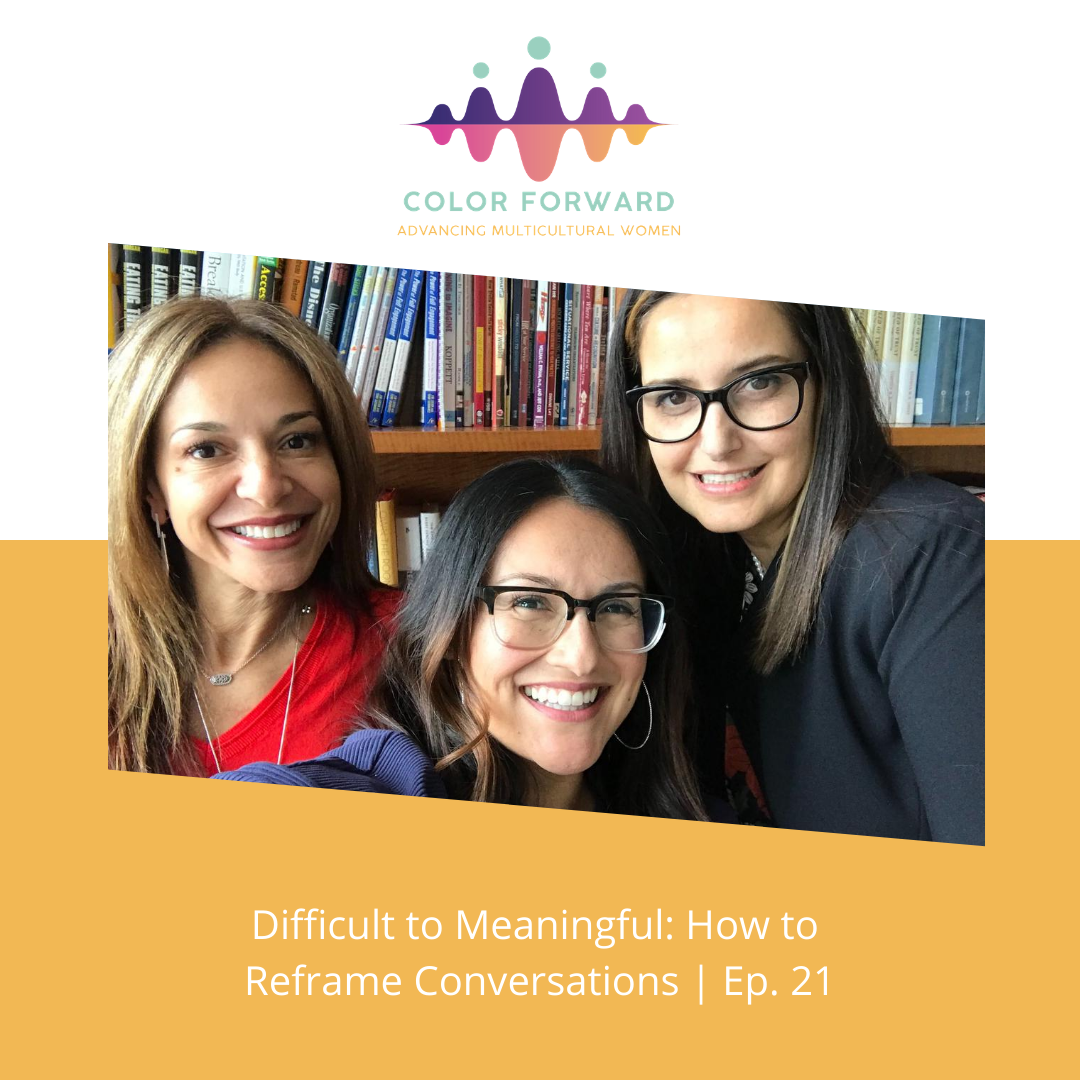
In one of our recent episodes, Alisa, Rosa, and Merary touched briefly on the idea of reframing conversations from being difficult to being meaningful. But what does that really mean and how do you make a habit of it? We’re living in unprecedented times and with so many essential conversations happening every day, now is the time to start.
Ep 21. Transcript
Alisa Manjarrez: Rosa and Merary, in light of the pandemic we’re in, civil unrest, there are so many conversations happening in our own homes, and in a previous episode we talked about the idea of having meaningful conversations and reframing the idea of difficult conversations to meaningful, specifically talking about race.
So I wanted to talk about how that happens, what are the challenges and how do we make our conversations meaningful?
[theme music]
Rosa Santos: What you’re asking is, how can we utilize our voice in a purposeful way to enter meaningful conversations, or enter into meaningful conversation? So we can actually start making changes from where we’re at with our families, with our friends, at work, it doesn’t matter. How do we start moving the needle so this conversation actually takes place? Because I think we’re at a moment where all this is happening and, So what? We’ve been talking about, Oh, we want to be heard. People want to be listened to. People want to understand. So what? What can we do? What would that look like if we were to start having this conversation?
Alisa Manjarrez: Yeah, and how do we do it?
Merary Simeon: We have to be resilient. We gotta be the ones to carry the burden, but also to be the ones to educate others. As an individual it’s gonna take a lot of optimism, resiliency, and it takes endurance. It’s a journey. It’s definitely not going to be something that’s going to be done overnight and we need to stay strong.
Rosa Santos: I think endurance is the word, right? ‘Cause I can see how many can actually throw in the towel and say, you know, I’m tired. Why me? Why do I have to bring this up? Why do I need to start talking about, you know, what you just did or how you did it, actually. For some that might be offensive.
What you’re doing is a micro aggression. You might not be aware, but this is the impact that it has, right? This is hard. In my line of work folks would ask me, can I get a toolkit for the white man who might be feeling really uncomfortable to be having these conversations. And I have to tell you, at first I was like, Oh my God, really? I would react really poorly about it. And then in the end I thought like, you know what, if it’s a toolkit, what is needed, I’ll create it. As long as these conversations actually do happen and take place, the excuse to even enter into that conversation, so be it. I’ll be the queen of toolkits.
Merary Simeon: It’s going to take all of us. It’s not only going to take people that are not diverse. It’s going to take every single person. It’s going to take Black, White, Asian, women, men. It’s going to take everyone for us to ever be able to see the light at the end of the tunnel.
Alisa Manjarrez: There are all these memes right now saying, well, how long is this conversation gonna last? Are we almost done? This is a lifetime conversation when you’re talking about systemic racism.
[upbeat music]
Rosa Santos: My son, a couple of weeks ago, I can’t remember how we started to talk about this, I mean, this is present all the time, right, it’s present, and he said, but mommy, all lives matter. And I got really angry. And at the beginning I thought like, No, I challenged me. Because for him, things at his level where he’s at in his cognitive development process as a teenager, is that, but it is true all lives matter. And I gave him something that is basic, which is, we forget that words and sentences have meaning In certain contexts.
[music stops]
I was applying my own, bias towards it. I wasn’t expecting that he was going to come from my own son. So having that conversation and really challenge him to do his own research. And to find out more about what significant that kinds of language has. It’s part of getting folks into what we’re referring to as having this meaningful conversation, because otherwise in another time with a colleague, for instance, that would be a difficult conversation and we would shy away from having it.
Merary Simeon: And maybe that’s what it is, is bringing the truth to light so that people could really understand what’s behind everything that’s going on. And I think that’s what’s happening to some people as light bulb is coming on, like, Wow, I didn’t realize that it’s critical for us to be able to have those. And it’s critical for other people to just continue to educate themselves. Because I think a lot of the times they’re expecting somebody else to educate them. And in the era of so much, technology we need to look at credible research, not just what the media is saying.
Rosa Santos: History’s so important, and maybe it’s ‘cause I grew up in a different country and, you know, in order to progress in education you couldn’t move on unless you had all these credits in history and all these things, right? I was surprised to hear someone who said that he hadn’t realized that his senior daughter, who just graduated and he’s heading into college, had not studied the civil rights movement and had no idea what it meant when all this happened. I just could not comprehend that someone going through high school would not have had the bare basic minimum how we got here as a country and especially certain pivotal moments like the civil rights movement.
Alisa Manjarrez: If someone does not have the same amount of knowledge that you do, or the same historical context, at what point do you make a decision to either say, Go research it, or tell them right then and there?
Merary Simeon: I think anytime you have the opportunity to educate right there you take advantage of that, otherwise it’s an opportunity lost. If you can, never miss the opportunity to bring an ally along.
Rosa Santos: I always think in terms of, What is it that I am doing in this conversation that is going to help others move forward? And in doing so, what are the different elements that I am adding into that dialogue or that conversation that will allow for that? Could be work, friendship, at home, it doesn’t matter. It’s really hard to suspend judgment and truly just listen and try to then offer a perspective that could potentially be listened to. Because it’s very much aligned with who they are, how they’ve grown up, who’s taught them in school, what history and what story they’ve been told and how they formed their view of the world. And that is challenging. I’ve recently had a conversation with a good friend of mine that said to me, I feel I was cheated out of my education going through school because there are so many historical events that nobody told me.
And now I’m in my mid forties and I’m learning all these things that I did not know had happened. And she felt really sad and frustrated because it had to come to this to be able to even consider, What else am I missing that I need to go learn at this moment, so my kids don’t go through the same things, and then they grow up with a completely different outlook and perspective of how we became to be the country that we are today? Hearing that coming out of, again, a meaningful conversation that we were having, was very powerful and was very inspiring and was very humbling to hear how folks are really taking that extra step in, trying to see and trying to see from a different angle that they hadn’t considered before now.
Alisa Manjarrez: You have to suspend judgment of the other person, because you have no idea where they’re coming from, what they’ve learned, what their experience is. And I think you have to have empathy for others, but then you also have to have empathy for yourself. And for people who are learning, this is a time to really sit back and be okay with where you are and then move forward.
I feel like there’s a better way of saying that, but, yeah, how would you describe having empathy for yourself in that situation?
Merary Simeon: It’s about owning it and knowing, Hey, I may have been cheated of history. I have a lot to learn, let’s move forward. I want to make sure that people don’t fall into the victim mentality. Yes, this was horrible, but what am I going to do?
I dunno, I always concentrate on, this is my today here and now. I can’t do anything about the past, but I can certainly impact the future. And whatever I choose to do, whether it’s educate myself on all the things that I missed on, whether it is to intentionally use my voice to elevate women, whether it’s intentionally find somebody that’s different than me and authentically ask questions because I want to learn. I truly believe that it’s about owning it, but let me go forward.
What am I going to do? And I think that’s the best thing that we could do right now. It’s just really figuring out how are we going to be part of the change? Because it is going to take each and every one of us, but we can’t stay too long thinking about it. Otherwise we will never see the change, not even in us, not even in our close families.
So if we want to see the change in the future, we have to start with us and that’s realizing that, okay, what am I going to do tomorrow? What am I going to do today, to make a difference?
Rosa Santos: It starts by also raising our own self awareness. I mean, the example that I gave you about how my son came up with that expression and how badly and all of my biases went into it without even considering and giving an opportunity for him to explain himself. That happens all the time, every time something like this within your social circle or your colleagues at work, you automatically have this visceral reaction because no matter who you are, you are bound to have also very strong opinions and biases around this subject. And I think that’s part of that ability of suspending judgment is also trying to recognize your own biases around the subject and not trying to then necessarily impose your own perspective into the conversation or your own interlocutor, who might be that white man who’s for the first time even considering the possibility of like, have I missed all this? Where was I? Everybody has relationships and everybody’s bound continue the knock of getting into it with just one small change every day. It’s going to make a difference in the long run.
Merary Simeon: A way to check yourself to see if you’re making progress is to check if you’re uncomfortable. The minute you are comfortable, then you’re not pushing yourself hard enough to learn more. Being able to know and understand that it is going to be uncomfortable to have meaningful conversations and know that that’s okay. The other person’s probably uncomfortable too, but it’s gonna take feeling comfortable in the uncomfortable in order to make progress personally, and in the community.
Alisa Manjarrez: I’ve always had Black people in my life, but a year ago I became friends with a Black woman, and we developed such a close relationship that I started to get more comfortable talking about race with her and really asking her questions and bringing up my concerns.
And it started out with me saying things like Black people have it all together. Like you guys are so united and Latinos aren’t. And she would say things like, well, actually we think that about you guys, those are not conversations that I’m used to having, because it’s vulnerable for me to say, like, this is what I think to another person.
And from that point our conversations have gotten deeper and deeper and deeper. And I really think that there’s value in having true meaningful relationships with the people that you want to learn from, grow from. This is the first time in my life I have ever viewed myself as an ally to Black people, and I’m in the thick of that. So, I guess for me, How do I have meaningful conversations? It’s really about having meaningful relationships with people who are not like me.
Rosa Santos: This reminded me to the conversation that we had with Reesheda when she challenged us to push the boundaries and she had that expression around working in the fringes.
[upbeat music]
Reesheda Washington: The margin, or the fringe, is the place and the people who are least like what I have experienced by way of placing people. I grew up in Austin, it’s a predominantly Black community. Most of the people there look and sound like me. And socioeconomically we had humble starts. So for me to set up a coffee shop there is not to go to my margin. That’s my center actually, I feel very comfortable in that space, and I can be completely immersed in a culture that’s very familiar to me.
But if I’m going to go to my margin, if the margin is the place and the people who at least like my life experience and my familial composition and my value system, Oak Park is that place for me. There’s a lot of opportunity there for me to be intersectional, because there are a lot of people there who don’t live their lives similarly to me.
So I think it’s been kind of a misnomer to think that every time we say fringe or margin we’re talking about people of color, we’re talking about people who come from a more meager socioeconomic situations. Because if that’s where you’re from that’s not your margin, and I think the only way to achieve intersectionality is for us to be more honest about where our margin is and to stop making margin synonymous with some negative connotation.
It’s not the poor people or the Black people or the Brown people or the women or the people who are experienced in life with some kind of a difference. But really it’s who are the people whose life experiences are least like mine? How can I go find them and be in real and right relationship with them? Planting the coffee shop at Oak Park gave me that experience but it also gives Oak Park that experience in a way that I think has been quite transformative for all of us.
[music stops]
Rosa Santos: It’d be interesting for us to even think, Where are our fringes? What would that mean working in the fringes for us when it comes to this conversation?
Because I bet even for the three of us here it’s very different. The fringes are very different. I think we will be pushing forward when we are doing that kind of work in the same way as Reesheda conceived it.
Merary Simeon: I think it’s important that we give the other person room to be authentic and talk about how they’re feeling, the same way that we’re talking about how we’re feeling without getting too emotional about it. I think once the emotions get involved, we stop thinking clearly. And there’s a different reaction to that.
Rosa Santos: And I think one of the things to consider is, are all parties ready to have the conversation?
Merary Simeon: I love that.
Rosa Santos: ’Cause you might, but that doesn’t mean the other party is.
Merary Simeon: I agree.
Rosa Santos: And even just checking, in my jargon we’d say, like the contracting, right, at the beginning? What are some of the things that you might want to say in order to really check in whether all parties involved are ready to have that conversation?
And I tell you, because I have various different groups of friends. And I have friends who were on and ready and, what can we do? And we had really good meaningful, interesting conversation with parents of kids who are mixed race and were very much just sharing, even like what our own kids could do when things could escalate at school for instance, or outside the school. If they happen to, you know, encounter police or things like that that I hadn’t even thought about what to tell my son what to do when he’s with one of his friends.
And then I have the other group who, to this day, this is a very uncomfortable conversation and they’re not ready to talk about it. I have to tell you, I don’t know why you guys, but I kind of tried to open up and it really feels it’s a Pandora box a little bit that folks don’t want to jump into. So it’s really just being mindful and checking how ready are all my parties here to have this conversation? How ready are you to have it? Are you also ready to share even your own biases? You might think like, yeah, this is the right thing to do. And then when it comes to the moment you feel like, Oh, I need to backtrack because I’m not sure I’m ready just to be fully open and transparent about some of these feelings that have been bubbling up for a long, long time that were very much inherent to how I was brought up.
Merary Simeon: I think it’s also important that we are careful to speak about our experiences and not speak on behalf of other races. I mean, I take that very seriously. I know what it is to be a Latina. I know what it is to be a mom. I don’t know what it is to be a Black woman or a single woman or Afro Latina.
I have some learnings, because I have very close friends who are diverse but when we’re having those meaningful conversations, if somebody really wants to know about what it is to be a Black woman, I would love to introduce them to one of my Black friends so that they can really have an authentic, true conversation. Because it may be that they don’t have any.
Alisa Manjarrez: Yeah, and there’s so many nuances between every individual. I mean, I can’t even speak up for all Latinas, and our experiences are so different from each other. We could come into a meaningful conversations about even what that means, to be a Latina. Is this okay to have this conversation? And are we in a relationship where we can feel safe to do that? But then there’s another side of just like taking a risk when you’re not sure and trying it out, and that’s, the scariest part for me.
Rosa Santos: This is about jumping into the pool and learning how to swim. If you don’t do that, then you know, you’ll never get to have the conversation or explore, or even find out that you have friends that you can put me in touch with so I can learn more, or who would be willing to share their experience? I won’t know that unless, you know, I jump into it and playing blank, say, Hey, I don’t know anyone, that I could learn from.
Merary Simeon: And that right there is a meaningful conversation to have the courage to do that.
Alisa Manjarrez: What do you guys think is the most important thing for people when it comes to having meaningful conversations? We talked about contracting, and having empathy, a level of appropriateness and not speaking on behalf of others and only speaking from our own experiences. If you could sum all that up, like…
Rosa Santos: Yeah, so you want a little bit of a toolkit?
Alisa Manjarrez: Yeah, I do. I want a toolkit.
Merary Simeon: Come on, you’re the queen of toolkits.
[upbeat music]
Rosa Santos: I think by starting, is it okay if we talk about X. From there you can start with an open ended question, How would you feel about it If we talked about X?
Alisa Manjarrez: So it’s about asking permission to have meaningful conversations?
Rosa Santos: Exactly, so that’s a way of opening up the conversation. I think when it comes to sharing from your perspective, there’s anything that you can share it’s all about, like, This is my point of view. What is yours? How do you see that?
If at all possible, don’t ask why, ‘cause why questions, when it comes to having these meaningful conversations, could potentially imply that you’re already diminishing the other person’s perspective and point of view. You’re kind of already judging.
Alisa Manjarrez: You’re saying, You’re wrong. You’re asking the person to justify.
Rosa Santos: Yeah, that’s not good. But try to ask it in a different way. What makes you think that way? Where did you get that from so I can go and search for it? How you are engaging in the actual conversation that you’re being very purposeful in the way that you utilize in your language and your words can be very, powerful.
Merary Simeon: If I said something that wasn’t appropriate, how would you address that?
Rosa Santos: What I’ll say helps me is, what do you think I should say in this situation? What would be a better way for me to address X? And you just say, Hey, in the spirit of learning that from this moment on, I check in myself as to how I’m asking the questions. What would be the right way for me to say X, to ask X, just doing it from a really humble, genuine learning way. If you position it that way, folks just want to help.
[music stops]
Merary Simeon: When you’re having a conversation and somebody says something that, you know, it’s a micro aggression or could be perceived as that, I have to be comfortable having a meaningful conversation afterwards. I feel that a lot of the times when we encountered these situations it may be in a group meeting, it may be, in a conversation. Maybe you have to call it out right there and then. Maybe you do have to say, Hey, that wasn’t appropriate. That’s okay, but you have to be comfortable with doing that. We have a responsibility to have that meaningful conversation.
[outro music]
Alisa Manjarrez: Having a meaningful conversation really means an open dialogue. It’s not about convincing each other. It’s about creating a space where you can even just talk and if they have an opinion or perspective that is so different from yours, you are giving them the gift of allowing them to express themselves. And you have to be okay if it’s not what you think.
Rosa Santos: Yeah, and that’s probably part of your contracting. When you enter into that conversation this will be an opportunity for us just to share how we feel about the subject or what’s going through our minds or how we’ve arrived to here having this conversation with no judgment and share it that way.
Alisa Manjarrez: For more inspiring stories, please subscribe on Apple, Spotify or wherever you listen to podcasts. If you have a guest you’d love to hear on the show, send us a DM on Instagram at @colorforwardpod.
I’m Alisa Manjarrez, producer of Color Forward. Thanks for joining us and, please, leave us a review.
[background music ends]