
22. Leanne Robers, Tech Founder on Overcoming Imposter Syndrome
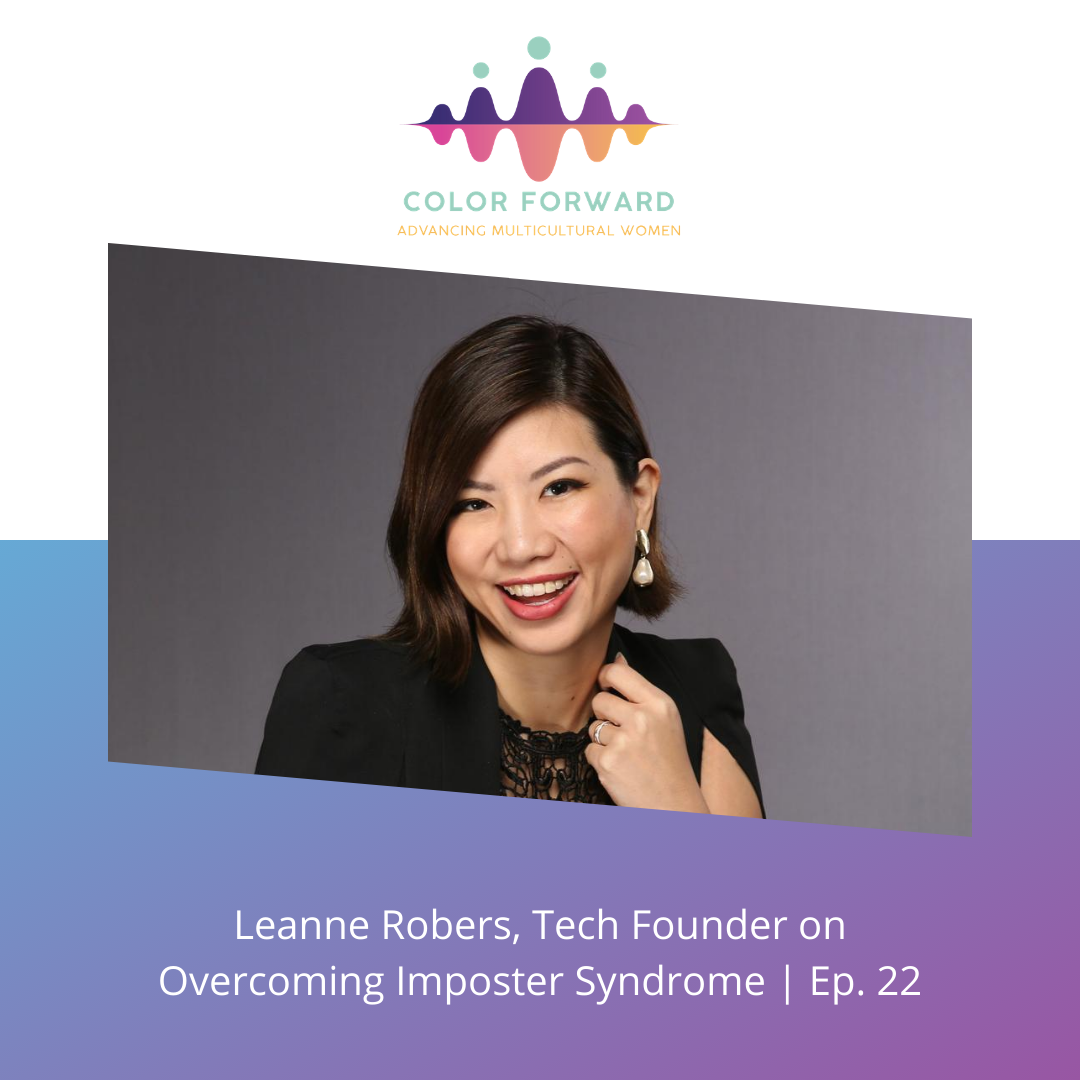
Imagine founding the world’s largest startup competition for women and technology and still feeling like an imposter. For Leanne Robers, that was just the case until psychology helped her overcome those feelings and open new doors. Listen as she talks with Alisa and Merary about her secrets to overcoming fear and turning negative thoughts into positive empowerment.
Ep 22. Transcript
Alisa Manjarrez: Merary, I never felt like I was one of those people that dealt with imposter syndrome until I left my last job and I realized that for four years, even though I was succeeding, I always thought that someone was going to figure out that I didn’t know what I was doing. For four years I felt like that and I didn’t know it in the moment.
Merary Simeon: I still feel that imposter syndrome. There was a time in my past life where I would be bringing up suggestions, talking about things that needed to be done in the workplace, and the leadership was not taking it seriously. And I started feeling like, Oh my God, I don’t know what I’m talking about. And it wasn’t until I was part of another meeting and somebody else brought up the same idea and they were like, That is great.
That made me think like, wait, I am smart. I know what I’m talking about. And all this time I’ve been stressing and not knowing. And that’s the reason why I asked that, because a lot of the times we feel that we don’t know what we’re talking about because somebody else made us feel that way. And we don’t have enough confidence in ourselves to know like, No, I know what I’m talking about, and you’re just not ready to listen to that.
Alisa Manjarrez: It’s like we have these literally impossible standards that we’re trying to meet, either set by ourselves or others.
Merary Simeon: Why do we think that? That’s the great part, it’s like, we worked so hard, we have the education, we had the experience, but yet we let either other people, society, or even ourselves make us believe that we don’t know.
Alisa Manjarrez: And it’s almost embarrassing for me to share because I know I’m confident and I know I have gifts, but it’s like those little doubts in my head sometimes have megaphones and they’re just so loud. And I don’t want anyone to know. I don’t want anyone to know that I have those moments.
Merary Simeon: Maybe that is what people need to hear is that people like you and me who are successful, that we continue to have those doubts. And it’s important to recognize that they’re there, but how do we keep moving forward? Because I don’t think they’re going to go away. I mean, they’ve been in my life for a very long time and they’re not trying to break up with me.
Alisa Manjarrez: Yeah, we have to break up with them. That’s the hard part.
Merary Simeon: I know. No, I already told you, you and I are not together anymore, but they keep coming back, these limits and beliefs.
(cue theme)
(pause a beat)
(cue upbeat latin music)
Alisa Manjarrez: Today’s guest, we learned a lot from, Leanne Robers.
Leanne Robers: Hi everyone. I am Leanne.
Alisa Manjarrez: She has a background in psychology and technology.
Leanne Robers: I’m the cofounder of She Loves Tech, and I’ve been in technology for over a decade now and have cofounded four companies. I am also a psychologist, and in fact, I come from a whole family of psychologists.
Alisa Manjarrez: And she taught us something really interesting about imposter syndrome.
Leanne Robers: Imposter syndrome really is something that affects so many women. Going back two studies it was looking at job descriptions, and let’s say, if you have job description with 10 points, women look at this and if they can tick eight of those items, but they can’t do, or they have not done before the last two, while they say, Oh, well, I don’t think I can do this. I’m not qualified to do this.
Alisa Manjarrez: They freeze up essentially, but when men deal with it…
Leanne Robers: It actually drives them to step into those opportunities even more. They look at six and if they can do six out of ten in that list, they say, Oh, this job is for me. I got this.
[upbeat latin music fades]
Alisa Manjarrez: It fuels them to move forward. Men push through, women freeze.
Merary Simeon: I’ve done a lot of things where, and we talked about this before, where we do it afraid, but that takes so much courage that there are times where you spend so much time thinking it over that I feel, maybe I may have missed some opportunities through the process of thinking and getting the courage to do it afraid. Because when you do it afraid it doesn’t mean you just jump right to it.
Alisa Manjarrez: It’s a process getting there.
Merary Simeon: Yes, it’s a process.
Leanne Robers: And for those who don’t know what imposter syndrome is, it’s really feeling like a fraud, feeling like you are not good enough. And they look at that and they don’t feel good enough. So they end up stepping away from those opportunities, just like the job description they say, Well, no, I can’t do that. I’m not going to apply.
Alisa Manjarrez: Women play a crucial role in other women’s success. Because if you think about how women stop or shrink back, it takes another woman to bring them out and to help them succeed. What has been happening in technology, especially with women in tech, is they’re not getting showcased, so She Loves Tech created an entire company to help bring women up.
Leanne Robers: At that time there were a lot of different pitch competitions, but none of them we’re organized by women, and also none of them had that many women on stage, out of probably 20 men there would be one or two women on stage.
We were told constantly that women did not like technology and they didn’t build good technology businesses. And actually from our own circles, we found that to be extremely untrue.
There were amazing women building amazing technologies, but they were really not getting showcased. They were not getting the kind of limelight that their male counterparts were getting. And so we started She Loves Tech to really change that equation, to really empower women technologists, women tech founders, and people building technologies that empower women. And since then, it really has just grown way beyond us.
Alisa Manjarrez: And now it’s the largest startup competition and accelerator program. It’s in 30 countries, it’s on six continents.
Leanne Robers: Minus Antarctica.
(chilly sfx)
Until lady penguins learn how to build businesses, then we’ll end up being in all seven continents.
Merary Simeon: Kind of what we’re trying to do here, right, with Color Forward. We want to showcase the amazing women talent that’s out there. And people like Leanne who are impacting other women. So I love that about her, because she’s taking her platform to elevate women in tech.
Alisa Manjarrez: I think her role in literally the world of technology is so important, because she really understands people and emotions and how to address our whole selves versus just what she calls our cognitive selves.
Leanne Robers: Sometimes we see this as a dichotomy. We think of it as one or the other, but actually the way I see it is actually a very integrated whole. Our brain has two separate sides of it. It has the cognitive side, so the prefrontal cortex, and it also has the emotional side, the limbic area.
And when we integrate these two wholes together, then we’re able to bring our whole selves and to bring actually our best possible selves.
Alisa Manjarrez: She says that women should really integrate their emotions into their work. And if we can find the best of both worlds, we’re going to perform better, our productivity is going to increase. We’re going to encourage each other and do more, and that’s what this is all about.
[cue music transition]
I love the saying that, it’s not bragging if it’s true.
Merary Simeon: Yes.
Alisa Manjarrez: And it’s funny how uncomfortable we get when we’re listing our achievements, because we feel like it’s bragging, but it’s really just facts.
Merary Simeon: That’s the biggest hurdle. I think we got to make sure that we recognize that when you speak from pride, it hurts other people, right? But if you’re speaking to your capability, you got to believe in yourself.
That’s something that, I even struggled with.
Alisa Manjarrez: I actually think that it takes practice acknowledging your achievements out loud.
Merary Simeon: I love that, because that’s what the world wants us to think. Oh, you’re just bragging. No, these are the achievements. Like how many times did we talk about it, right, how some women don’t want to call themselves doctors. That’s not bragging, you worked hard for that. Be recognized.
Alisa Manjarrez: You earned that degree.
Merary Simeon: Yes.
Leanne Robers: I believe very much in not letting other people’s perception of what women should be or what I should be hold me back. It is for me to define, and I’m constantly asking myself, What is that ideal self that I want to grow into?
Merary Simeon: For a long time people would always say, Merary, what do you do? And I would always say HR, I never would give my title, ever.
My husband always says, he’s like, why don’t you tell him what you do?
I’m like, No, I don’t want to feel like I’m bragging.
And now that I say that I’m a vice president, and this is what I’m doing I get people saying, Hey, stay humble, Merary. I’m like, uh… you know, you can’t win. So those are the…
Alisa Manjarrez: You’re like, This is literally the facts.
Merary Simeon: We’re not used to that. In our culture, that’s not what we’re told to do, and it’s not until now that I’ve realized I need to say my accomplishments so that all the women that are trying to get where I am today can see the possibility, can see the hope and can see that it can be done.
Leanne Robers: I really have been victim to imposter syndrome at so many points in my life. And there was a time when I was so hard on myself and I was my biggest critic. But a friend once asked me, Leanne, until you learn to love and respect yourself, how do you expect others to love and respect you?
And wow, that really got me.
Merary Simeon: You have to be confident enough to know, This is my mission to help other women. This is how I’m doing it. This is what I’ve been through, and stay vulnerable and speak the truth. Because otherwise, we could get distracted.
Leanne Robers: I learned to love myself. I learned to respect myself. I learned to celebrate my successes and to be kinder to myself when I stumbled. And I learned to define success for myself and not let others define success for me.
And there’s this great kind of analogy that I use to help women get through what I call self limiting beliefs. And these are the beliefs that hold them back. So some of these beliefs are things like, well, because I’ve made a mistake on this project I am always going to fail at it. I’m never going to be good at this. And I am a failure and we see them internalize this so much.
Merary Simeon: It’s interesting, because limited beliefs can come in from anywhere and people could place them in your life without you even thinking about it.
Alisa Manjarrez: Oh, yeah, and Leanne gives us language around that. She calls it…
Leanne Robers: The ants.
(cue ominous beat)
The automatic negative thoughts.
Thoughts and belief systems that we immediately feel. I mean, so many of us can relate to that feeling. I’m not good enough. I am a failure. I am so weird compared to everybody else.
Alisa Manjarrez: I love that she said that, because that is what happens. It’s literally like someone says something or you start to think something and then and automatic negative thoughts like kick in so fast.
Leanne Robers: But what I do is that I help women to turn those ants into what I call pets. Positive empowering thoughts. Yes, we’ve made a mistake, but, wow, the amount that we’ve learned from this. Yes, we’re not feeling good enough, but, Hey, we’ve done all these amazing things in the past. We know that even if we didn’t make it this time, we will make it if we keep trying.
Alisa Manjarrez: If we can turn those automatic negative thoughts into positive empowering thoughts, the whole world opens up to us. And I mean, we can see in this episode that it is still a challenge for you and me to turn those automatic negative thoughts into pets.
But we have to, and it takes work and it’s worth putting in the effort to change how you think, and be kinder to yourself.
Leanne Robers: Because those ants are what way us down. Those ants are what keeps us from reaching our goals.
Merary Simeon: I was thinking from a leadership perspective and being able to empower somebody to be themselves, it starts with creating a safe space. And that even goes with friendships, especially with everything that’s going on around us. How many of our friends even feel comfortable talking to us about anything that’s going on in the world today?
Alisa Manjarrez: Or about their emotions too.
Merary Simeon: Yes, or their emotions.
Alisa Manjarrez: Just like it’s not normal to talk about your accomplishments. It’s still not very normalized to talk about your emotions.
Leanne Robers: We think of emotions as bad, but emotions drive us. Without passion we would not have been able to do She Loves Tech. Without bringing that kind of drive, which is based very much in emotions, I would not have been able to succeed or stand here today.
Alisa Manjarrez: I don’t know about you, but when those automatic negative thoughts come in, I just like swim in them for a little bit.
Merary Simeon: That’s the key. We have to give ourselves grace and know that these things are going to happen and it’s okay. But we have to be able to also get out. We can’t stay too long swimming in those thoughts. We gotta be able to move along. Confidence in our talents, it’s critical to making sure that we stop those limiting beliefs from freezing us in fear.
Alisa Manjarrez: It reminds me of the idea of fight or flight. It’s almost like there’s a fear that can creep in as a result. When we want to just shrink back and stop, how do we then turn them into positive, empowering thoughts, even when we’re afraid?
Leanne Robers: I used to be really scared of just asking. If I saw somebody that I really admired, I didn’t feel like I was good enough to go out and talk to that person.
But what I realized was, You know what, just ask. What is the worst that can happen? The most he or she could say is no. And then actually I’m just in the same place as I started off.
And I think when people stop seeing this as a cognitive or emotion and really see this as an integrated self, then they also start learning as well that this integrated whole is what can help with a lot of regulation. Because sometimes what we see is our emotions tend to take over. Our emotions, you know, hijack us.
And then we respond in a way that it’s not ideal. We respond in a way that we regret after that.
Merary Simeon: We know what that feels like.
It’s hard to describe, but I’ll take a stab at it. Like for me, I start shrinking. I stay quiet and I just automatically start having all these thoughts, like, Whoa…
(musical tension builds)
What did I say? Did I not say it right? Did I not communicate correctly?
Alisa Manjarrez: I feel paralyzed. That’s what I feel. So maybe your mind like goes in circles, but for me, I just stop.
(tension breaks)
Leanne Robers: I think we don’t have enough of a vocabulary around emotions.
Brené Brown did this fantastic study where she asked people to name emotions that they felt or that they could recognize in other people. The mean number of emotions that people can recognize was three.
Merary Simeon: Wow, how many other more emotions are out there, right, that we just don’t recognize, but yet we don’t even know what they are.
People are afraid to show that they’re sad, that they have anxiety, that they’re tired, that maybe they want to cry that day.
Leanne Robers: We’re not taught about emotions. We’re not taught this very humanistic approach, right? We’re taught science, we’re taught math, we’re taught English, but we don’t learn about emotional vocabulary. And because of that we can’t even name our emotions, let alone learn how to integrate them.
Merary Simeon: I was on a call and my son went to school and my daughter started virtual school and it was a rough morning, because I had to work and I had to deal with all the craziness that virtual school comes with, and it wasn’t very easy. And I was like, well, I’m good now, I already cried this morning. It was already stressful, and they were thanking me for being so honest. And I was like, well, I literally did.
Alisa Manjarrez: Yeah, you were modeling the way. You were saying, like, I cried and now I’m here to work. It’s okay. Yes, I have emotions. That is a perfect way of integrating both sides.
Leanne Robers: It really comes to building that culture around inclusivity, around acceptance and around authenticity. When you have managers that are, emotionally intelligent, it leads to burnout rates that are three times less.
It leads to higher revenue. It leads to greater motivation. It leads to more meaning and purpose that then leads to less attrition in the company.
Alisa Manjarrez: There would have been nothing wrong if you had said, I’m having a really rough day, can we move this meeting? Or, excuse me if I’m not myself it was a rough morning. So it’s not that you have to put it aside or be over it, it’s about just bringing it to the table. When we talk about authenticity, that’s authentic and being real.
Merary Simeon: And those are just not things that people talk about, but we have to, to show them that it is normal, that it’s okay to go through those feelings. Because they’re happening to us right now, in the moment. And if, as leaders, we can’t show that we’re vulnerable it’s going to be very hard for somebody else to feel that that’s a safe space for them to tell us what they’re going through.
Leanne Robers: So it really needs to start from the top. It needs to come with firstly, building that culture around it. But even if, let’s say, at the top, you don’t have that infrastructure, well then it comes down to the teams, and it really is that responsibility of the managers to create that culture in your team. And sometimes it’s just having real conversations with them, understanding what they’re struggling with, understanding the different challenges that they have both at work, but also in their personal lives.
And creating that safe space for people. Because when you have that safe space, then you allow people to grow into their best possible selves. You allow people to embrace who they are and to utilize their strengths.
Alisa Manjarrez: One of the things that I’ve been saying to myself is that I know that when I show up magic happens, and I don’t have to do anything or be anything else, I just need to be there.
And that’s my positive empowering thought. I forget it all the time. So please remind me. But that’s my sentence, when I show up magic happens, and that’s all I have to do.
Merary Simeon: I love that. I don’t have a sentence. I need to get me one. I love that sentence. I always think if I don’t speak up they may never hear the voice of another multicultural woman, or…
Alisa Manjarrez: It’s almost like for you, if you don’t show up, people don’t see themselves.
Merary Simeon: Yes. Thank you. But I like your sentence better. That’s a good one. That’s a challenge to everybody that’s listening. What’s that one thing that you could say to yourself to remind you?
Alisa Manjarrez: It took a lot of thinking, before I came up with that sentence. Because I really believe that it has to be meaningful and personal to you for you to actually believe it. I literally looked at past successes that I had and I saw what’s the pattern.
And it was funny to me because I just showed up. Like all these things happened because I was just there. And so that’s how I got to like, Oh, wow. All I had to do is walk in the door, pick up the phone. Magic happens.
Merary Simeon: I really love the fact that you said you showed up. We have to show up, and once we show up we’re there. So let’s take advantage of being there.
Alisa Manjarrez: Even when we’re scared. Even when we have those automatic negative thoughts, we have to show up for ourselves, because if we can’t show up for ourselves, there’s no way we can show up for others.
Leanne Robers: It really isn’t about you waiting for people to open doors for you.
You need to be proactive about this.
And it applies to so many different things in our lives. Statistically women do not ask for promotions enough, they don’t ask for raises enough. They don’t negotiate their salaries enough. And in the last week I’ve seen so many amazing stories of women who just asked.
And because of that, now two or three of my friends have been promoted and quite a few of them have gotten pay raises because they asked and if they didn’t ask, guess what, they would not have gotten that. Open your own doors.
Merary Simeon: We have to take that action. And even let’s say, if other people open a door, somebody sponsors you, you have to still take action and you have to still do the work, because there was a reason why you were put there. We have the responsibility to open our own doors. But when other people open our doors, we also have the responsibility to take action.
Alisa Manjarrez: Activate.
Merary Simeon: Activate, yes. Activate our gifts to help other women.
(meaningful music)
Leanne Robers: One of the things that we have realized is that we cannot do this alone.
Alone we only have limited capacity. We only have limited resources. And the truth is that passion doesn’t feed people. How do we create and sustain a business that was started by pure passion and pure drive to make a difference? That really has been the hardest thing for us to figure out.
(music transitions to uptempo)
Merary Simeon: Sometimes we feel that we may be all alone in this journey, but there may be other people who also believe in the same mission, and I also believe that we’re stronger together.
If I can find other people who believe in the same vision that I do, Oh, my God, I can learn so much more from them. Or we could just learn so much from each other and be that much stronger together to bring that vision to life.
Merary Simeon: Leanne said it beautifully…
Leanne Robers: We found amazing partners who believed in the same vision as what we believed and who shared those same values that were so important to us, values of diversity, values of inclusion, values of empowerment.
Merary Simeon: She found partners that believe in the same vision, and I think we need to do the same thing in our personal lives.
Alisa Manjarrez: And that goes back to showing up, no one can partner with you if they don’t know what you’re passionate about, or they don’t know what your vision is. When we talk about partners for Leanne, it’s not just like friends that are her cheerleader. She has huge corporations that are like, we believe in what you’re doing, and we want to support you. But she had to show up first.
[music outro]
At the end of the day I think it’s important that we all recognize that imposter syndrome can creep in, those automatic negative thoughts happen, and if we can learn how to harness them and turn them into empowering thoughts, that really informs how we can show up in this world. I want to acknowledge Leanne, she showed up for us in this conversation. She shows up like that every day. And because of her work on herself, it really has helped her open her own doors.
I want to challenge our listeners to practice recognizing those automatic negative thoughts, practice turning them into positive empowering thoughts so that you can show up and open your own doors.
Alisa Manjarrez: For more inspiring stories, please subscribe on Apple, Spotify or wherever you listen to podcasts. If you have a guest you’d love to hear on the show, send us a DM on Instagram at @colorforwardpod.
I’m Alisa Manjarrez, producer of Color Forward. Thanks for joining us and, please, leave us a review.
[outro theme ends]