
23. Carolynn Johnson, Diversity Champion on Owning Your Power
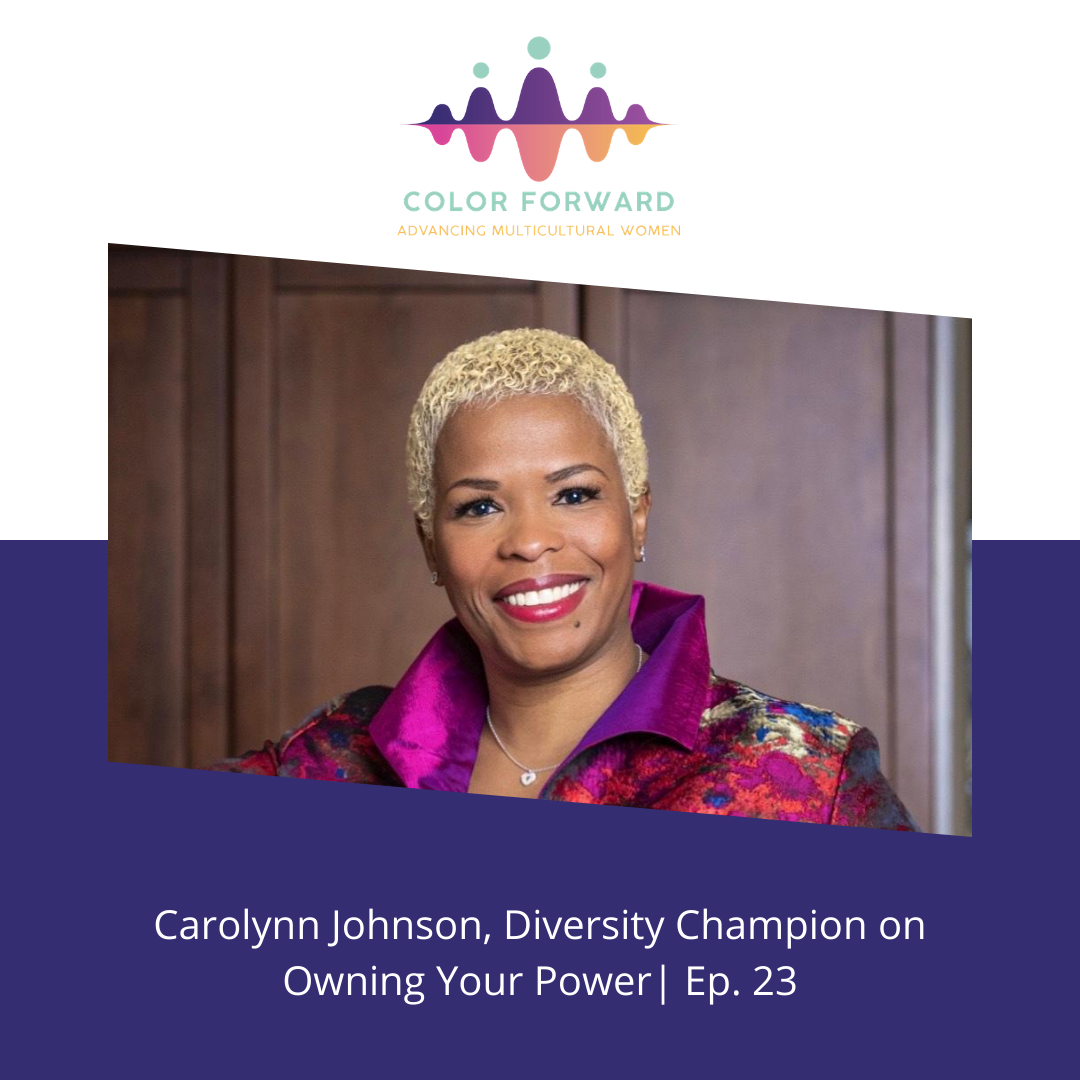
Carolynn Johnson still recalls the exact moment she was done being the model employee and started owning her power. As CEO of DiversityInc, she now owns it daily by choosing to be an ally to the communities she serves. Listen as Rosa and Alisa reflect on Carolynn’s lessons about the power of relationships and how to own that power for good.
Ep 23. Transcript
Alisa: Rosa, what do you think it means to own your power?
Rosa: I tell you what he meant to me once, when I was interviewing for a job, and I didn’t like the question that they asked me, and I literally stood up and walked away.
Alisa: Really?
Rosa: I did.
[cue music]
It was at a job interview of a job that I really, really wanted. The line of questioning wasn’t really relate it to the job itself, and by the time he got to “Are you planning to have kids anytime soon?” I said, what does that have to do with the job at hand? And the three men that were interviewing me, looked at each other. And then I said, okay, I guess it doesn’t, so therefore probably I’m not the candidate that you want. And I stood up. Thank you very much. It was a pleasure to meet you. And out I went.
[music fades out][heartbeat sound effect]
It was one of those moments that you realize that you’re doing it and you’re just like, Am I doing this? Am I doing this? Oh, yeah, I am doing this.
And I remember my high heels and clocking along, clop, clop, clop.
[high heels on floor sound effect]
My heart was beating so fast.
[music fades back in]
Oh my God. I thought like, what am I doing? I thought like, This feels awesome. And I walked away and I didn’t look back.
Alisa: Oh, I have goosebumps.
This is why I want to be you and I grow up.
Rosa: can I tell you something else?
Alisa: Yes, please.
[music fades]
Rosa: They called me back and they offered me the job.
[theme music starts]
Alisa: It sounds like it was easy for you, but not everybody does it. And our guests today, she is another model of owning her power.
Carolynn Johnson: I am Carolynn Johnson, CEO of DiversityInc.
Alisa: They hold major corporations accountable for having diverse and inclusive workplaces, but she wasn’t always the person in control.
She had her own journey of owning her power and it really started with breaking the rules.
[cue uptempo music]
Carolynn Johnson: My father would never tell me what to do. He would just tell me what my options were, tell me what the outcomes of those options would be, and then he would let me decide. And so that foundation that my father laid with not making me feel like I was always being told what to do, but I had a choice, I think that contributes to who I am today, and quite frankly, how I’m bringing my own children up.
Rosa: Yeah, what I found fascinating about Caroline is how, you know, she took charge, and really thought through what was important for her. And she was intentional.
[music cuts]
Carolynn Johnson: I can actually go back to the exact moment I was just done being the model employee. I was at work. I was still nursing. And I was trying to get everything done, but then I knew I needed to get home to her.
And I was just like, you know what? I really don’t even care about this right now. Somebody else can do it, if they don’t do it, it wasn’t that important anyway. Been there done that, got the t-shirt. And if anybody has a problem with the fact that being a mother with a three month old is more important to me right now.
Then, I guess that just sucks for them. I walked out the office, I left my computer that never happened. And I went home to my daughter and I did not look back and I did not regret that decision. And so I will tell you that that was the moment where I was just like, this is me. And this is how I get to the whole, I’m not there yet. I don’t know with, by the time I take my last breath on this earth, I will be, but I do know that I am intentionally on the path to being whole.
Alisa: I got goosebumps again. All these women owning their power. I love it. When you talk about being intentional, that is such a huge part of this, because she took a look at her life and what she wanted, and then based her decisions around that. She asked herself, What is filling me up and what is depleting me? Because I only want to be in a place that feeds me.
Carolynn Johnson: I think the greatest tragedy is just we don’t ask ourselves questions, right? Just sit down and have a quiet moment with yourself and say, where does my strength come from?
Like what depletes me, so that I can do less of that? I think sometimes we just fail to ask ourselves the most important questions and then we don’t give ourselves the grace and time in answering them. The best time that you could ever spend is developing yourself, loving yourself, trusting yourself.
And we don’t do enough of that, because we’re so busy out here in the world trying to be all things to other people.
Rosa: When we talked about owning your power or leading with your power, owning who you are, you also need to understand what does not give you power. You need to become aware of what or who takes your power away?
And I don’t think we do enough reflection to even contemplate, Am I in a situation? Am I in a job? Am I in a company? Am I in a relationship where the only environment in which I am is actually an environment that is just taking away that power, versus where, what and who gives me energy and gives me the power to really be who I want to be and be intentional about moving forward, right?
Alisa: When you say taking the time to reflect, it’s so important, because if you don’t do that internal work, outside voices, they start to own you. And for Carolyn, she had a father who had the best intentions for her and for her life. And he did not want her to work for a White man. And when she left her job, that’s exactly what she did.
Carolynn Johnson: My parents are older. Given the times in which they came up the civil rights movement and, you know, they were out there marching. To the degree that I have gotten in my trusting relationship with Luke Visconti.
Alisa: The former CEO of DiversityInc.
Carolynn Johnson: I trust him. I trust him to give me the best advice that he can. He trusts me to do the best job that I can.
Alisa: Her father, once he saw what was happening and his relationship with Carolynn and how he was really her ally, her advocate, he changed his mind.
Carolynn Johnson: It was my 30th birthday party. And I saw Luke and my father talking. And then Luke shook my father’s hand, and I heard my father say this, Thank you for taking such good care of my daughter. I want to kiss you on the cheek. And I said, you know what? That was one rule I would break over and over and over again. And I’m proud of it.
Alisa: But the only reason she felt comfortable and confident doing that was because she looked at the wholeness of the situation.
Carolynn Johnson: Against all things I trusted my relationships with people and I didn’t lean on others understanding. And I think sometimes we make those decisions based on what we believe is happening versus what we know is happening. And we don’t have trusting relationships that will allow us to better understand what’s possible. That was the main ingredient to all the other things that happened for good.
Rosa: And sometimes there are certain relationships with certain type of folks that may not you look like you or that you may have some bias against that might be the relationship that will actually bring that power back to you. And you might find it in places and in people that you hadn’t thought of. So being intentional about the way that you build trusting relationships is going to be so important because you never know what that is going to bring in the longer run and maybe you can play that game. And on the other you can be quite strategic without necessarily taking advantage of people, but knowing what can I get out of this and how can I give back as well? It’s not only one way, but both ways. And I think Carolynn really exemplified that when she affiliated herself with her boss.
Alisa: I mean, that’s exactly what she did. She took a chance. She was pretty young and she’s been with DiversityInc for 17 years now.
Carolynn Johnson: Actually no, going on 18 years. Oof.
Alisa: If anyone understands how important it is to build trust and assume good intent with others, it’s Carolynn. And because of that relationship, now she’s able to forge relationships with leaders all over the country, and she has such a unique understanding and a perspective of how we can bring people together because of those relationships.
Rosa: Yeah, and that is brave. Especially in the times in which we live today, that we really need to make an effort to speak to the other side. And having, and being able to harness that power in a way that you’re going to convene others to really have meaningful conversations for positive outcomes. It’s brave.
Carolynn Johnson: To really do something different with that convening power by bringing leaders who get it, and I’m talking about White male leaders who get it. And coupling them with leaders who I want to do better, but this is new to them and they just don’t know what to say.
I call it like this paralyzation, because you want to be part of the solution, but you don’t want to act as if you’re leading it. You want to be part of the solution, but you don’t want to say the wrong thing. That’s where folks like me, have to say, You know what, let me just take you under my shoulder and make sure that you understand these are the issues. I don’t expect Black people, Brown people to get us all to the promised land, the stories that we have to share and our experiences we’ve got to share with the right people with the right tone at the right time, in the right way, to get us there.
[cue music]
Alisa: Carolynn is the representative of DiversityInc. And through the top 50 survey, she’s allowing major corporations around the country to examine their own values through the lens that this survey provides. She looks at human capital diversity metrics, leadership accountability, talent programs, workplace practices, supplier diversity, philanthropy.
Carolynn Johnson: I mean, our survey is intrusive. And I am saying that. Okay. I mean, listen, we’re going deep into corporate crates. Okay? We’re not just talking about overall workforce, but we want to know how diverse is your board.
Alisa: It takes trust to be able to share all the internal information about your company. And Carolynn is really that bridge that gives people an opportunity and permission to share that kind of information about way they run their companies.
Carolynn Johnson: DiversityInc from the time the company started to now, we have really developed trusting relationships with major organizations and that trusting relationship kind of manifest itself by way of sharing data that they typically don’t share with anybody else.
Rosa: For me, there’s two things, one, talking about things that are intangible. That are a little etherial and hard to comprehend. It’s something that businesses have a hard time doing, because it’s all about numbers, profits, and show me the money.
So surveys provides the opportunity to really quantify. And being a bit more business driven, talk in the same language in terms that it can be understood and that you can draw critical insights from it that will then help you formulate certain actions that will allow that organization to move forward, to really take a stand and being committed and then being able to know like where and how I’m going to be making a change. For some, they would say that’s the one thing that they do.
But for me, I think what they do really well, this kinds of surveys and DiversityInc in particular, is create what I call “the excuse”. Really it’s the excuse to bring about conversations to hold, in his case, corporations accountable to their words, accountable to what they say they’re gonna do. And that is way more powerful than just showing numbers, because then there is a way to then really bring it up without necessarily pointing fingers.
Here it is. Now it’s on you to make a difference. And I think that’s what, in this case, DiversityInc, and Carolynn in particular do, and that’s why they embody this incredible influence in our country and beyond when it comes to making a change in the way that we really lead.
Carolynn Johnson: We all know nothing happens if leaders don’t talk about it and be about it. That’s from a perspective of talent development, supplier diversity, of procurement, and how companies show up in the communities in which they do business or get products and services from, workplaces practices. That’s all inside. How do you treat your people once you get them, right? Um, and then again, philanthropy, you know, are you making sure that, it’s not just the valet, but that you’re giving to organizations that really do support people from underrepresented groups? That’s our survey and that’s the mechanism for which we have developed this trust.
Rosa: Imagine how powerful it would be if we were doing that with each other. If we were able to imagine ourselves as a DiversityInc, asking you about all this data and how you process information. How you apply meaning to the world around you. And then I could go and challenge that for you Alisa, to break down some of the barriers that unfortunately we see today in really mutual understanding of where everybody else is coming from. And I think what Carolynn does so well is actually bring it from like a big entity to then very specific way of really engaging and really helping others explore what it could be like if they were to increase their diversity and having more inclusive working environment.
Alisa: And I think what she does through her work is she assumes good intent for other companies. And she is completely okay with informing and educating, assuming that people are looking to be more inclusive. For other people who might have a chip on their shoulders, like, I don’t want to educate anyone because they should know, it’s a really easy place for us to go, but she really takes the next step, and seeks to educate and inform people about anti-Black racism. And she probably feels like a broken record.
Carolynn Johnson: The other day I was putting together some comments for a talk I had to give on anti-Black racism for one of our top 50 companies. There’s a lot going on now. This inflection point that, that we have found ourselves in right now where, people have had an opportunity to quietly listen, and consume discrimination, systemic oppression, I think it is, and don’t think I’m crazy for the work that I do, I think these are great times that we live in, because people are actually ready to receive and be part of the solution. Not to be perfect. But to participate.
Think about how the people that are always hurt in this country were just served up on a silver platter with words. When words like Chinese virus are said from our president’s mouth. We saw a despicable increase in hate crimes against people who are visually identified as Asian. I mean, we talk about the wealth gap in this country between White families and Black families and in Latino families.
Well COVID-19 is not just taking lives. It’s also wiping wealth away at an alarming rate. And then we think about useless killings of Black bodies in the streets, by people who are there to protect them. Well, my goodness, we got so many stories in such a short amount of time while we were forced to sit still.
I think that the universe couldn’t have planned this better. And I think that as leaders, if we are not better for this, then what a shame for not taking advantage of that opportunity.
Rosa: Why do you think it’s so difficult to actually truly build trusting relationships with people that do not look like you or think like you?
Alisa: For me personally, I think it’s fear of the unknown. Maybe that applies to everyone. If I don’t really know what you’re about, I don’t know your intentions and it makes me afraid to even share because you might judge me. I don’t know what I’m getting into and I don’t feel comfortable.
Rosa: I think fear plays in so many aspects of our lives, and it’s such an impediment really to fulfill our potential when it comes to really harvest what a relationship can yield, right? And that’s why a lot of what we do is such superficial. We stay at the surface and we navigate surfaces, really, when we are in school, when we are in a corporation, even with some friends, because we are fearful of really digging deeper and finding things that we are very uncomfortable with. And I think the one thing that Carolynn demonstrated is that, if you’re willing to do that, then you can truly bring those who actually have power to change things, power to change environments, power to make decisions, together and really have a different outcome.
Carolynn Johnson: If we are going to get to a place where there is true lasting irreversible change, we as a country, especially in the corporate space, we must be born again. And that means taking a step back and saying, where was opportunity denied designed in here, and what do we need to do to undo that?
I have a platform and I have an audience of people who are paying very close attention to what I say. And I’ve got to tell the right stories at the right time, with the right tone and with my heart in the right place, if I’m going to be effective.
Rosa: It’s not easy to do. And that’s why I think she does such an incredible job with also owning her role and her position to bring about certain awareness that without her doing that, it would be almost impossible to bring all these leaders together, right? If we truly think about the power of bringing those who make decisions and those who might work with us, those who can make good difference. What is it that we could do in the same line to be able to, deescalate and make a difference in the way that we relate to one another as human beings?
Alisa: Yeah, and I think it all comes back down to trust, even when you’re afraid and making the choice to do that.
Carolynn Johnson: I was thinking about somebody that worked at DiversityInc the other day, and why they left. Part of owning your power is standing up for people when they don’t have the strength or the voice to stand up for themselves.
And so at the time, I don’t even know what my real voice sounded like. You know, I was just in awe to be in the room, like, Oh my God. I was just thinking about that the other day and saying to myself, my goodness, if the timing was different, I wonder what I would have said and what I would have done, but most importantly, how I would have made them feel.
That somebody was showing up for them like that because were owning their own power, standing, and not worrying about being knocked down by standing in their own power.
Alisa: I think it’s important to recognize the influence that Carolynn and DiversityInc has on this country. If you think of any major corporation and the thousands and thousands of employees that they have and the people that they’re affecting. And then you put all of those companies together and they are all funneling up to a voice of influence surrounding diversity and inclusion. And that is Carolynn, and that is where DiversityInc sits.
Carolynn Johnson: I just want to be very clear. I think we all need to do a better job of being specific about what diversity is, because right now in this country, you have 38 White women who are leading Fortune 500 companies, and not one Black woman.
We’ve allowed diversity to be whatever people want to call it. And I think we have to be more intentional about that going forward. And so when I say diversity, I am not talking about just gender diversity. I’m talking about gender and ethnic diversity, and we have to look at those things separately, okay? And we have to look at that gender and ethnic diversity at the board level, and we have to understand the power dynamics there. Are folks on the board just to be on the board so you can say you have them on the board, or are you grooming them to transfer power? Are they chairing committees like governance and audit and compensation?
Those are three very, very, very important boards for publicly traded companies. And then, your executive leadership team, what does the diversity look like there? That’s a view from the bottom to the top and how your pipeline is filled and how engaged people are with your company and willing to stay so they can eventually make it there too. So when I say human capital diversity metrics, that’s what I’m referring to.
Alisa: She is in a really unique place of influence where she’s influencing the influencers and the leaders of the country. Whether they’re on the top 50 list or not all corporations who have a value of diversity are looking to the standards that she and her company have set.
And we’re bringing it way down to the individual level, because they’re both important. Taking her example and helping these women through Color Forward figure out, okay, well, how can you do that yourself? And what does that look like for you today?
Carolynn Johnson: The most important part of my story, relative to what is happening in the world right now is, how effective sponsorship in that, you put your capital, and whatever your leverage was in place and on the line to make sure that somebody that you vetted, that was ready, had access to opportunities.
When there is a truly genuine sponsorship relationship, I believe that that quickly unleashes authenticity for people who don’t genuinely get to show up as themselves, right?
Somebody is pouring into you and helping you understand that. it’s not that we’re giving you a seat at the table. You’re welcomed because you earned it. That is how you get to that place where you’re not worried about, you know, the things that come out when we’re dealing with imposter syndrome.
That stuff doesn’t matter anymore because somebody in the already in crowd is telling you that you more than belong here. And so you’re not worried about the hair. I mean, I’m the cutest blonde I know, I’m just saying it, right? So, no, and I’m joking. But I’m not worried about the uniform and I’m not worried about the things that allowed me to gain entrance to a place that I had already gained entrance to just by showing up.
Rosa: It’s so exciting for us, I think, Alisa, the possibility that we’re creating for multicultural women, women of color, that you may have thought that you did not have the power. You may have thought that you can stand up and walk away from an interview, because I tell you before that interview, I think for me, I always thought that I had to be appreciative that I was called for an interview. I always thought that I had to be, you know, kind of even servant like, to say, Oh my God, they are giving me the opportunity to talk and it’s like…
Alisa: This is so special, I should take what I can get.
Rosa: Exactly. Whereas it’s like, no, they want you. You’re there because you have something that they have.
And I tell you today, in this environment, in this marketplace, we all have something that they do not have. We all bring certain skillsets that many folks out there do not have. It’s our resiliency, our determination, our grit, our way of thinking about things and solving problems, because we’ve been doing this all of our lives and this is what companies today actually need.
And there are not enough people that can actually face the ambiguity, the uncertainty, all that we have in front of us today, there’s no other people like us, like women that are listening to this podcast that can take it all. And that’s why it’s important that we own that power and that we know our worth. And then that we walk forward and don’t look back, as Carolynn said.
Alisa: So many diversity leaders talk about helping other people of color, but she also sees the power of teaching people about anti-Black racism specifically, and her allyship is to White people.
Carolynn Johnson: I think if we’re going to make the type of change in the amount of time we have. We have to view ourselves as the ally, I think often we look to White men and White women as allies, but there is a certain level of bringing along, and the transferring of trust and basically validating the person that you know, that White woman or that White man to be, and making sure that you are being the ally in your communities and in your circles.
[cue music]
Because you’re never going to have a situation where a person just walks into a room and everybody accepts them. That just doesn’t happen.
And so we have to consider ourselves to be the people that usher the folks that are really doing the work, and that really have a passion and a purpose. We have to be their allies as they step two feet into the room.
Rosa: I think you have to balance and make a choice and think about, how can we break barriers at the end of the day? If it really is genuine then let’s do it. Let’s walk together and let’s be allies. And I’m very optimistic. I do believe in the power of possibility and we have that choice.
Carolynn Johnson: Everybody has power. I don’t care if you’re a coordinator or if you’re the chair of the board, every single person has power.
Because every single person has a relationship or series of relationships and there is so much power in relationships. And so view yourselves, no matter who you are, as an ally and exercise that power every day.
Alisa: Rosa, let’s bring it home for people. Based on the example that we’ve learned from Carolynn. She gives us five ways to own your power.
The first is be intentional. Many times you have to break the rules in order to make a real change.
The second, build trusting relationships. If you can assume good intent with the people that you’re around, whether you are fearful or uncomfortable, people will then trust you. If we all want to work together, we can’t move forward without that trust.
Third, stand up for those who don’t have a voice. And if we want to stand up for others, we have to bring people together to stand up for the ones that don’t have a voice.
Fourth, bring allies along, and we know that allies can mean a lot of different things.
And the fifth is my favorite. Don’t look back.
[cue outro]
No matter what we do, whether we’re the person that takes out the trash or the CEO of a corporation, we can all own our power. We can own our positions. So if you’re listening right now and you’ve decided to be intentional about your life. I want to invite you to think about Rosa, and her clicking of the heels, put your hands on your hips and own your power.
Rosa: Hell yeah, I did. Don’t look back.
Alisa Manjarrez: For more inspiring stories, please subscribe on Apple, Spotify or wherever you listen to podcasts. If you have a guest you’d love to hear on the show, send us a DM on Instagram at @colorforwardpod.
I’m Alisa Manjarrez, producer of Color Forward. Thanks for joining us and, please, leave us a review.
[outro theme ends]