
33. Chloe Arnold, Emmy-Nominated Choreographer on How Small Acts Can Shape the Future
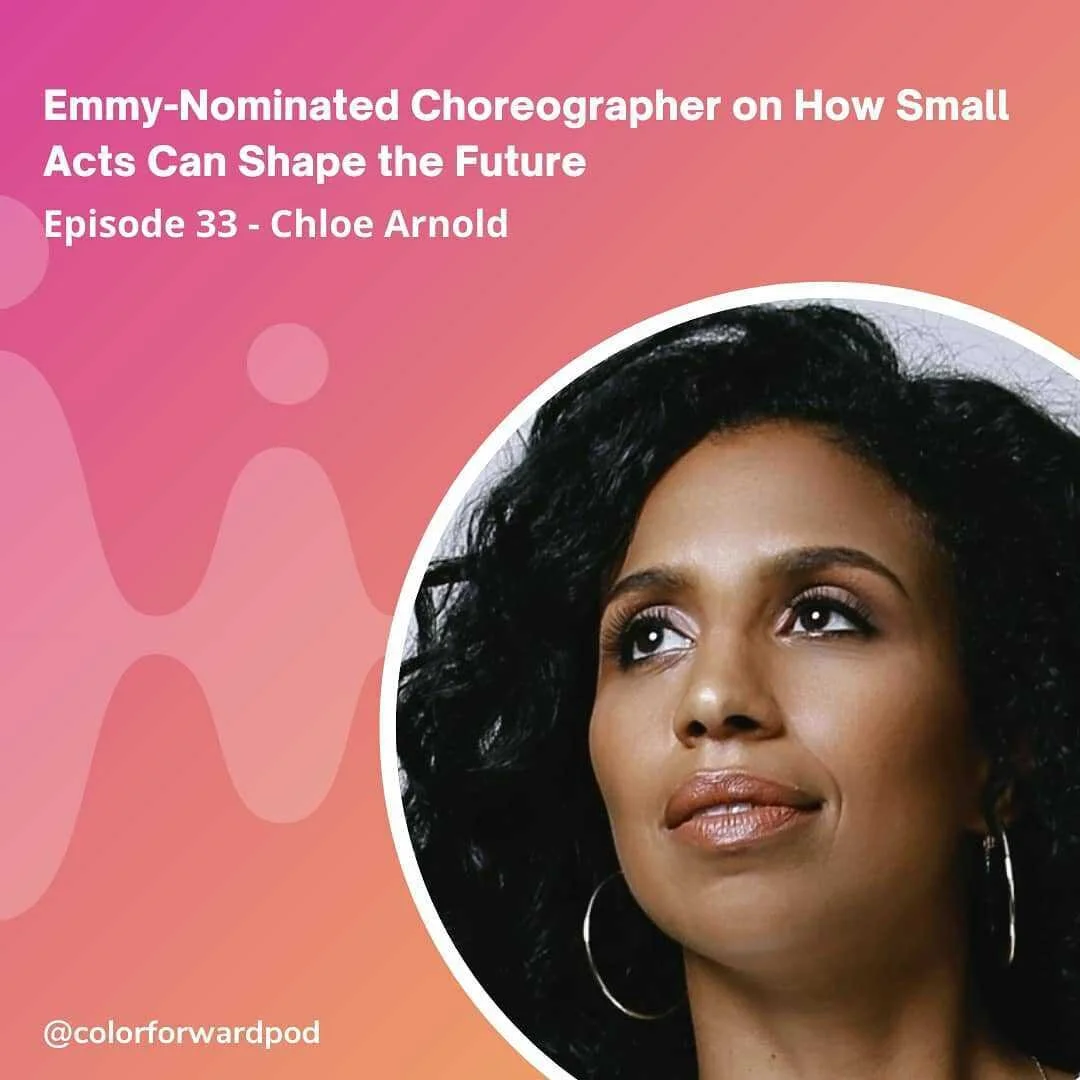
For Black History Month, we’re highlighting an artist and two educators, beginning with Chloe Arnold, Emmy-nominated choreographer, tap dancer, founder of the hit female tap sensation Syncopated Ladies. Listen as Chloe shares why she went against the world’s expectations to embrace her own possibilities, create her own spaces, and how she is passing that knowledge onto others.
Episode Transcript
Rosa Santos: I think it’s about the common experience. It’s all about what unites us versus differentiates us, and I think everyone who has some kind of tag around their neck because of who they are, where they come from, how they think, how they show up, I think we all have a shared common experience of what it is to be a woman of color and multicultural woman in this country and in the world at the end of the day. What we need to do, really, to unify, to support each other, to learn from each other, to lift each other up and to push forward. So we can show up and exercise our voice and our worth, which is why we did this in the first place.
[cue music]
Alisa Manjarrez: Okay. That’s our intro. That’s our intro right there.
Merary Simeon: There ya go.
Alisa Manjarrez: Alright, you guys, it’s 2021. It’s our first episode. Happy New Year.
Rosa Santos: Hello, happy new year.
Merary Simeon: Happy New Year.
[music stops]
Alisa Manjarrez: We’re in our new season for Color Forward, and appropriately so it is Black history month. And since we’re all about highlighting women of color, it’s really our privilege and honor to be able to highlight some of our Black guests. I want to ask the two of you, Why it’s important as Hispanic women to highlight the stories of Black women? We all have our own lens of viewing the world, so for Black history month, Why is it essential for us to be sharing these stories?
Merary Simeon: As a woman overall, I think it’s important that we share our success stories. For me personally, I asked myself, Where would I be without my Black sisters? Since my young age, ’til today, Black women have played an instrumental role in my personal life, professional life and spiritual life. And any time that I get the opportunity to talk about or to highlight the things that they’ve done in my life and that they continue to do for others, you can count me in.
And that’s what this platform is all about, elevating others. And I’m so honored to be able to do that today.
Rosa Santos: I agree with Merary. I think it’s our duty, actually, to showcase these women. We have incredible talented Black women as guests this month. And as it pertains to me, I wish we didn’t have to do that, and we didn’t have to choose a month or episodes dedicated to this, to highlight these women, that we could do it every day. And hopefully we are doing this through our podcast, anyway, beyond the month of February.
[cue music]
Alisa Manjarrez: I love that we’re kicking it off with an Emmy nominated choreographer, tap dancer, founder of the hit female tap sensation, Syncopated Ladies. Her story is inspiring. She has embraced possibilities, gone against the odds and taught the world the language of dance.
Chloe Arnold: My name is Chloe Arnold. I am an African-American woman. I am a sister. I am a teacher. I’m an entrepreneur. I am a businesswoman. I’m a philanthropist. I’m an artist. I’m an activist. I’m a lover. And I’m a happy person.
Alisa Manjarrez: She’ll tell you that she’s more than a dancer, but her choreography has been featured on hit TV shows such as, So You Think You Can Dance, Good morning, America, The Ellen Show, The Talk, John Legend and Chrissy Teagan’s a Legendary Christmas and over 40 episodes of The Late, Late Show with James Corden.
[music stops]
Chloe grew up in Washington, DC, dancing in a studio in a strip mall, in a small shopping plaza.
Chloe Arnold: It was not the most advanced training, but it was fun.
And my mom, though, realized at a certain point in the training that I had an affinity for tap. We were supposed to get this duo choreographed by one of the teachers at the studio so that we could perform it myself and my Korean sister. Her name is Katie, and the woman who choreographed our piece wasn’t very interested in us.
We were the women of color at the studio. My mom recognized that the duo was just not very good. She was like, this sucks. My mom was very honest. She was like, this is terrible. So she was like, you know what, you guys, go to Katie’s house, ya’ll make it up, go figure it out. So we went to Katie’s basement and we rechoreographed it. And then my mom came and looked at it, she’s like, this is much better. And so that was kind of a key turning point of a couple of things, one recognizing that we were serious in our own right. That we were going to take leadership and ownership over what we were presenting and that also, if someone under invests in you, how to reinvest in yourself.
Rosa Santos: The one thing that is interesting for us to reflect upon is sometimes how very small acts, even though they may be a small, very, very intentional can actually change the course of somebody’s life for the better, and to really start pacing a path that maybe you didn’t even think of yourself.
And that’s, I think, what definitely Chloe’s mom did for her.
Alisa Manjarrez: We’ll see today that that’s had a huge impact on Chloe’s future and how she’s also then invested in other children and young women around the world.
What does it look like for you when you come to that fork in the road where you have a choice to make a small act to change someone’s life? How do you know that this is your opportunity?
Because I feel like Chloe’s mom did this intuitively and like, in 20 seconds.
Rosa Santos: Our mothers always want the best for us. And I think, for those of us who are mothers now, right, we’re trying to do that every day. But in this case is how intentional she was to allow her daughter, Chloe, to explore possibilities beyond what there was available for them.
And I think us, we need to think about sometimes even, it might be about just saying the right encouragement, or encouraging words to somebody, so they can actually break through and really grab something that they thought they couldn’t do, or they couldn’t say, or they couldn’t really fulfill into. And how many times, sometimes we don’t realize, and how many times we could have been even more intentional than what we were by actually looking at maybe that little girl or that coworker or sister who might need the right words at the right time to lift her up.
Alisa Manjarrez: Yeah, it’s kind of like owning the responsibility of showing people that they’re capable.
Merary Simeon: I may have a responsibility to show people what they’re capable. What I admire about Chloe, that she had the mentality, I could do anything. I have no limits. All you had to do was shed a little bit of light and she took it and ran with it and she used it as a torch for the rest of her journey.
Chloe Arnold: We were ultimately raised in a single parent home with my mom, but foundationally, both of them really instilled in us that we are capable of everything we imagine. Intellectually, creatively, athletically, emotionally, like we had zero limits put on us by our family, which is so important.
And I, and I’m very tuned in when I’m training young people that not everybody has that, so I aim to instill that. Because you have to have people that like are rooting for you like there is no way that you can’t achieve what you imagined.
Merary Simeon: She allowed her imagination to be limitless. And I think that was an amazing strength that allowed her to have no limits in what she was able to do.
Alisa Manjarrez: And this is when she was nine years old. So, wow. It started so early and because of the doors that her mom opened up for her, she had the opportunity to work with remarkable dancers. And she leveled up herself. She started working with these amazing dancers and then she’s like, okay, also, I’m going to Harvard.
Chloe Arnold: So I worked diligently and I ended up staying and through that company that was in DC, I was able to take masterclasses with people like Gregory Hines, Eddie Brown, Buster Brown, the Nicholas brothers, and that was really life changing. So at nine, ten years old I was taking from the most renowned names in the art of tap, and they just happened to be coming to DC to give back. And I was one of the young people that was able to receive their knowledge and their inspiration and their lessons.
And so by ten, I was telling everybody, I’m going to become a professional tap dancer, and I’m going to go to Harvard Law School. And that was the plan. And one of those came true. I actually did get into Harvard, undergrad, just because I had spoken it so much that I had to apply as part of my like, This is a choice, but I ended up going to Columbia because I wanted to tap and New York City and tap dance were the way to go.
Rosa Santos: I think the trick for us sometimes is, you’re working or you’re seeing somebody who may not have that determination or that will, or something else might be happening, and then you just, just need to be there to push them, right, to give them a little push to really, make them discover what that capability is all about. What their full potential could be. And then help them see it so they can be it.
Merary Simeon: And this is so important because society still today, the environment, things around us, tries to hold women back. And it is so important to recognize that your environment doesn’t dictate your future. Your failures does not dictate your future. Anything can be possible, but having someone to just give you a little nudge can just open so many possibilities and move you from the mindset of, oops, this failure was painful to, I can do all things.
Chloe Arnold: First of all, I grew up in the inner city, right? So, innately, inner cities are designed to under-invest in the members of the community. So from the beginning, I was set up in a situation where under investment was the norm and if you didn’t see another standard or have someone feed you the inspiration that there is another standard, you just wouldn’t even know there was another level to where you can be living and what you could be learning and what you could be eating and consuming.
Rosa Santos: How do you find the right vehicle for yourself and for others so they can get to do that, right? And I think for Chloe, with her dance, that was a vehicle. And I just wonder what everyone’s vehicle might be and how you’re going to use that to your advantage, to really just, again, become the potential that you ought to be in this life.
Alisa Manjarrez: Yeah, and I love that she said she was locked into possibility when she was exposed to all of these dancers.
Chloe Arnold: So what happened was when I was in this dance company at ten, eleven, I audition for a show and that show got us the opportunity to perform at the Kennedy Center to go to New York and watch Gregory Hines on Broadway in Jelly’s Last Jam. And also Gregory Hines had just done the movie Tap. So I’m seeing this superstar on TV and now he’s in front of my face teaching a class, and this was so vital for my awakening of possibility. And that’s why so young, I locked into possibility, because I was witnessing it firsthand. And so now instead of just what was around me, I was seeing like, Whoa, it ignited my desire.
Rosa Santos: We sometimes talk a lot about like, Oh, we need to be role models, but we don’t realize truly the importance of not just supporting and being there, but seeing, seeing yourself in somebody else so you can actually, again, become it. And, and I think that’s why this conversation and, listening to her story is so important.
Because hadn’t she had those role models that she could see and see what she could be and the fact that she could turn down Harvard to do it and to be it without those role models for what we know she could be, you know, a Harvard Law grad right now, rather than this amazing creative dancer, who’s doing so much for the world.
Alisa Manjarrez: Yeah, those role models showed her that she really could carve her own path. So even though she had set her mind on Harvard, she chose herself over her own goals, which is powerful.
Merary Simeon: And the reason why she’s happy.
Alisa Manjarrez: Yeah. I mean, that’s when we asked her, who are you? She said, and I’m happy.
Merary Simeon: Yes.
Alisa Manjarrez: You know, Rosa, you talk about these small moments and small choices. Her mom really set the stage for her. We talk about rule breaking, her mom was like, okay, my kid’s future is more important than the rules.
Rosa Santos: Yes. Because this is the moment of the pamphlet.
[cue music]
Chloe Arnold: We did not have money, but we had imagination and we had faith in our ability to soar and to fly. Even if we didn’t even know like where that might take us, we knew, like we can do it. So my mom, this is really cool, my mom was resourceful.
And I mean, like she is a resourceful woman, okay? When you have, you know, three kids in a one bedroom apartment, you figure it out. So she saw a poster up in the subway that was advertising Kaplan SATs studies. She took the poster from the subway, and the sign said, what if Harvard were your safety school? And because I had spoken it so much about, this is what I’m going to do, she got the sign, she put it on our front door. So every day that we went to school, that was the messaging that we had ingrained in our head.
Rosa Santos: But I think it’s not just the small act that is gonna incite a choice that you or somebody that you’re helping or supporting or help grow is going to take.
But it’s being intentional, right? It’s what is the intention behind? So then all of a sudden you, go, I see it. And I’m sure you all have had that small act that someone did for you that made you then look at whatever it was in a very different light so you could do it. I think for Chloe is was that, you know, her mother ripped off that pamphlet, put it on the wall to remind themselves that they could do that.
Chloe Arnold: Like, I will never forget what it looks like. I will never forget what it made me feel. It was such incredible messaging. And so when Harvard became my safety school, it, to me, was this full circle of the power of thought. Everything that we say is an investment in either constructing what we imagine or destroying ourselves.
Rosa Santos: We all have a safety-something that we know we’ve been able to break through in order to get to what we are. And if we don’t, I think we have our own responsibility to find what that safety thing might be and just go for it, because it’s worth it.
Chloe Arnold: I’m trying to construct all of the things I’m imagining.
[music stops]
Alisa Manjarrez: Yeah, I think about my journey as an entrepreneur and the idea of building a business, bringing in revenue, all of that. One of my mentors said, think about how much money you want to make and then triple it, and then start going after that number, and that’s scary. That’s asking someone to think bigger for themselves then they would think on their own. When you have those people pushing you and saying, What if you made Harvard your safety school?, like, Whoa, that just opens up so many possibilities.
Merary Simeon: The beauty of that is, there are so many negative seeds planted each day that having people plant these positive seeds are so critical. And sometimes we don’t realize one seed can grow to become who Chloe is today. Just because of that one act.
Alisa Manjarrez: Merary, earlier you talked about how society isn’t always built for our success, and then you have other people who are not rooting for our success. Something that I loved about Chloe is, she created her all female tap dancing band in 2003, and there were no open doors for her in that moment. So she had a choice. She said, either I wait until society brings opportunities to me or I create my own. And she wanted to put tap on the map and she went for it. She was 22 years old, and she said, I’m going to create my own thing.
Chloe Arnold: When I was in New York, I, you know, had that initial dream of like, I’m going to go to Broadway and it’s going to be amazing. And then I got to the reality of that, which is, all the roles for female tap dancers were mostly white women, all the same body type, in a chorus. There were no leading women and definitely no leading women of color on Broadway.
Now I could have stayed in New York and pressed against Broadway and tried to find a show that would let me in or where I could break the barrier. But there was a very special woman named Debbie Allen, who was my mentor. And I met her when I was 15 and she always taught me, if it doesn’t exist, create it. And so instead of waiting for the guard to change, which is only happening now, by the way, in 2020. So this is 2003, I would have been waiting 17 years for something to not change, okay? Instead Debbie Allen gave me her dance studio in LA to rehearse for free. And at 22, I started this company consisting of girls that were 11, 14, 15, 16. And I was like, Hey, girls want to be a part of something? We’re going to rock out and we’re going to do our own thing. And, you know, it just seemed like, Oh, a little cute dance company. That’s what it looked like from the outside in, but in my imagination, we were going to put tap dance on the map.
Merary Simeon: The actions that she took determined her future. And it’s in responding and creating these moments that do not exist and having that faith in herself, that she could do this. That Chloe was able to create this powerful and strong group of women that empower other women now. Back then they were supporting themselves. They were the community that each other needed to be the power for women that they are today. And to be able to today look back and say, we can empower others. We can pay it forward.
Rosa Santos: And I tell you what resonated with me through the conversation with her is, despite everything, it is her joy, her absolute lack of resentment for it, on the contrary, how taking something like that made her stronger and even more determined to be successful.
On her own, I would say on her own, inverted commas, right? On her own alongside the rest as one, right? And, and, and being, again, I go back to what Merary said, happy. Being happy, right? And irradiating that happiness of, you know, what, I can do this and we can do this. And that’s, you know, that’s not an easy, an easy thing to do. Because it’s difficult to separate what makes you angry or when somebody is putting you down, right? It’s difficult to take it out and then just take this, you know, was she referred to as… what Michelle Obama said, right? When they go low, we go high. It’s easier said done, and she makes it look so easy,
Alisa Manjarrez: I know, it’s like she just does a tap dance and she changes the world.
Merary Simeon: I love it.
Alisa Manjarrez: But that’s also the cool thing about Chloe is that she chose a love that she had and her mom saw it in her. So like, if we’re looking, going full circle, her mom said, you know what? I think you have an affinity for tap. Let’s create opportunities for you. Chloe saw more possibilities. Then she started making them happen herself.
And she has used dance this entire time as a reflection of her own identity. And now, I mean, talk about going deeper and deeper and deeper. So what started out as like a fun hobby turned into a career, turned into her language of self-expression.
Chloe Arnold: As a dancer, my dance is a reflection of just like who I am. Dance is just like speaking. When we’re creating all of these things, it’s really amplifying our voices and who we are more than like, Oh, I’m doing cool dance moves and they go viral. It’s not like that. I think the reason they go viral is because we are literally just being ourselves fully. And I think that that inspires other people to do the same. And that’s why people watch and why people support.
Rosa Santos: There were rooms where I was not wanted, but I made my own. And I just wonder how many rooms are we creating? And in this case, now she’s just not creating a room for herself, but she’s creating rooms for other folks and she’s bringing in people into that room.
Chloe Arnold: I watch someone find the language and then it’s the most beautiful thing in the world.
Like we have this young woman who’s special needs in some regards, and when I tell you, we met her during this, right, and she started taking our classes online and how I’ve seen her evolve in eight months is so incredible. She is full. She is expressive. She is speaking. She is expressing herself and it’s all because she learned a language where she felt she was being heard and being loved and appreciated and respected. And so she’s with us for life now. Like I already know that, because of this language and that’s, what’s so exciting.
Rosa Santos: And if you think about what she’s able to do with all kinds of dancers, and how she’s managing to utilize that vehicle so folks achieve that full potential for themselves, it’s very remarkable. So how are we creating those rooms where we can be who we are and fulfill that potential?
And how are we making rooms to allow others to fulfill into that potential. What does that look like? Imagine if we were to create a world where everybody could tap into their full potential and we were all together in one room that you didn’t have to create your own.
Alisa Manjarrez: Yeah, and if it doesn’t exist, create it.
Rosa Santos: Yeah.
Merary Simeon: As we’re all talking about here, I let my imagination row, and I’m like, how big is that room? Like when you’re opening a room, be like Chloe open one that’s worldwide. Do not put limitations on how big that room can be. You know, one of the things that I love about Chloe is that she’s done all of these amazing things despite the odds.
In fact, adversity has pushed her to work harder. And this just resinates with me, she just got me excited and motivated all over again. Throughout her life she had people telling her she couldn’t get into a tap company. She wouldn’t get into Harvard. She got flack from the industry when she started Syncopated Ladies.
And I just love to say, but look at her now. She is a world known powerful woman. And those are the things that I admire her for, but also that give me that energy to go back and keep going and keep taking that next step forward.
Alisa Manjarrez: Remember when we saw the pictures of her Rosa?
Rosa Santos: Oh, my God, yes. I wanted to be her.
Alisa Manjarrez: Yeah, she was so powerful just in her poses and in her dancing, it is, so inspiring. Beyonce noticed her as a result of her putting in that hard work and creating her own room. And when Beyonce shared her work, it really shifted things for her. And it doesn’t come without bad reviews or the haters as we like to say, but there is reward. I guess it’s two sided. You get both when you’re doing things big.
Rosa Santos: It’s funny, because I think, and we’ve had this conversation before about conforming… So we have this tension of conforming to what we think we should do versus being who we are. And sometimes you are being told, yes, be who you are, be yourself, bring your whole self to the stage, to work. And then you do it thinking, okay, I got it. This is it. I am going to do it. I’m going to show up as who I am. And then all of a sudden people don’t like it. And that’s exactly what happened to her. And that’s when she, again, decided, you know what, I am just going to take it to a different place and, I am not gonna let this push me down or determine who I will be in this space. Because I’ve worked too hard to get to where I am.
And that resonates so well with, me, and I think with us in general, right? Because we are again being told all the time and we’re, we’re always playing this vague space of wanting to conform, but really wanting to be who we are.
Alisa Manjarrez: I feel like I fight that battle daily. I want to be more me, but I know that being more me is sometimes scary, sometimes risky. I don’t know how people are going to receive me and I hold myself back. And I’ve noticed when I’m free, I’m free, but I sometimes put myself in the cage.
Rosa Santos: Yeah. Yeah, exactly. And that can be incredibly limiting, incredibly limiting for, again, for really developing to not only what you want to do, but really that full potential that you have that you’re repressing yourself from and from exhibiting. And I think that’s why, and, Merary, you remind us of this all the time, of having clarity about who you are. What your values are. What’s your purpose? And going back to that center, What centers you? What is it that centers you that no matter what you do and the decisions that you make, you’re going to go back and say, is that aligned to who I am and what I want to be, and my purpose?
Merary Simeon: And I think that’s important because today in a social media society, society likes to say, be yourself and have your own voice, but society’s also the first one to bullying you into being somebody else or into being how the majority or the minority think, whichever way you want to put it.
And I feel that it’s gotten harder to be yourself, because more eyes are on you and more eyes and more people are determining how people should act and what people should do and what is correct and not correct. That is being dictated more and more versus allowing you to be yourself, express yourself and be who you are.
Chloe Arnold: It’s the greatest lesson that we teach our young people. And I always tell them, I’m like, look, do not dance like Chloe. No. What I want you to gain from me is, do you, because that’s why things are working for me. Because I’m doing me. You do, you. You lock into who you are and then shine that light brighter and brighter and who you are…
[cue music]
… and I promise you, you will most importantly being happy, but then also you’ll start to attract all the goodness, because you’ll actually be aligned with your purpose.
Merary Simeon: I love that. Because when you align with your purpose, it allows you to worry about you, put yourself first and be happy, be joyful. I don’t know how many people out there are not fulfilling their purpose and can say that they’re happy. But I know a lot of people that say they’re fulfilling their purpose and you cannot take that smile off their face, regardless how hard the situations may have been to get there.
Alisa Manjarrez: Yeah, try knocking me down. Just try it.
Merary Simeon: I dare you.
Alisa Manjarrez: Chloe’s story is so inspiring. I mean, starting with her mom investing in her, and then from there she started creating her own possibilities, imagining more. She had role models to show her she’s capable. Then she created her own path, finding her passion. And now she’s passing it on to others. She’s smart. She’s innovated. She’s mentoring and teaching dancers around the world. Now she has students ages four to 80 on zoom. And she’s creating her own rooms over and over again.
She’s saying if I can’t do this in person, I’m doing it this way. Like, I think what I love about her is the game never stops. She keeps on playing. She keeps on pivoting. She keeps on changing and she always stays aligned to her purpose. And what it looks like may change, but she always stays constant.
Chloe Arnold: I’m so proud that other little girls can look to us for inspiration to be entrepreneurs, to be business owners, to create your own vision, to not compromise who you are at any point, for success. But rather, know your purpose and go for it.
[music transition to outro theme]
Merary Simeon: Chloe’s story is one of great inspiration and a reminder to all of us that we have what it takes inside of us, however, it is up to us to nourish it with possibility or regret. I challenge everyone to not let others determine your worth and stop you from achieving your purpose, from laughing, from feeling that joy that we all deserve, and most important to not let people bully you with their lack of imagination. You got what it takes inside of you.
Chloe Arnold: There’s so much noise and you have to find the quiet and the love and the joy, and so that no matter what happens in this world, you have something you lock into that makes you feel like life is worth living.
Alisa Manjarrez: For more inspiring stories, please subscribe on Apple, Spotify or wherever you listen to podcasts. If you have a guest you’d love to hear on the show, send us a DM on Instagram at @colorforwardpod.
I’m Alisa Manjarrez, producer of Color Forward. Thanks for joining us and, please, leave us a review.
[outro theme ends]