
What Rules!? Podcast - Past Episodes
54. The Messy Middle: A Woman’s Journey in the Midst of Hardship
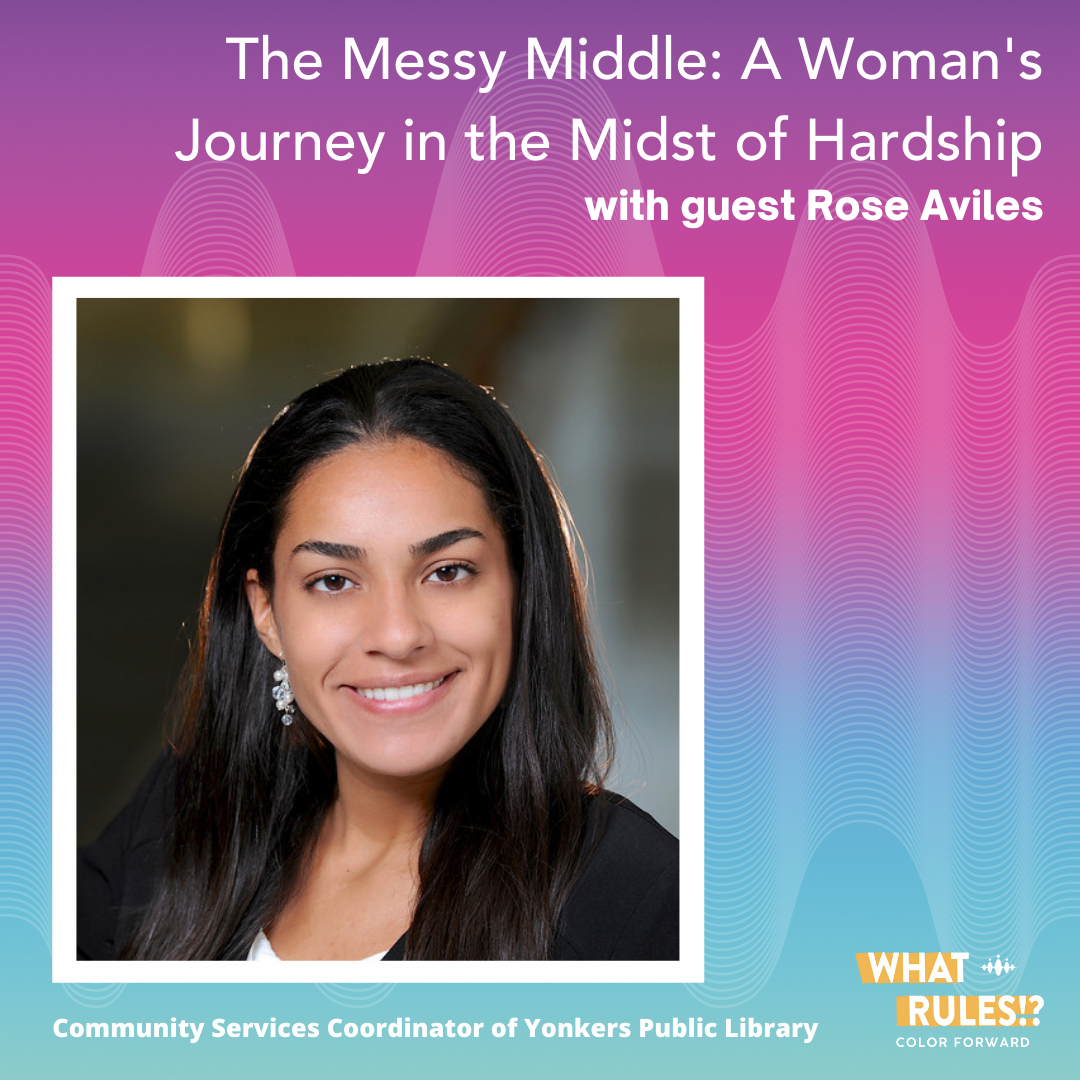
What do you do when the price of staying quiet is too high? Do you assume the risk and say what needs to be said? Or do you soldier on and live to fight another day?
For Rose Aviles, the answer is all too clear.
In this episode, Alisa and Dr. Merary are joined by Rose, a Community Services Coordinator for Yonkers Public Library, who shares the incredible story of her journey to the top of a LITERAL mountain… amidst a global pandemic… while pregnant. Talk about owning your power.
Alisa Manjarrez: (00:00)
I think we’re going to talk about Merary and her house. I just wanted to hear what’s happening because your house was flooded and you’re still not in it five months later.
Dr. Merary Simeon: (00:10)
This is what I called, been practicing patience maybe. February 17th to be exact, there was a Texas freeze and my house was severely damaged and since, we’ve been living in temporary housing. Finally two weeks ago, the house is finally approved for the contractors to start working on it. It’s been a journey but the positive thing is it’s coming along. The floor is done and I was able it to pick out some of the cabinets and some of the lighting and cool stuff. That’s exciting and I’m just trying to stay positive but it’s been a rough ride.
Alisa Manjarrez: (00:52)
It’s been crazy because she’s been recording in different hotel rooms or locations. I never know, it’s where in the world is doctor?
Dr. Merary Simeon: (01:02)
In different boxes. It’s like I’m hiding here just so that I can record but it’s looking better. We’re very positive. Hopefully from last week it will take 60 to 90 days I hope. My goal is to be there before the year end.
Rose Aviles: (01:22)
You said something, even though that this was disastrous and you’re out of your house, you’re still optimistic and it’s looking better. Maybe in some way worked in your favor.
Dr. Merary Simeon: (01:34)
Yes. No, absolutely. The gratitude piece has just been something that I had to really work on because our family’s still healthy. We still have a place to live. Even though I’ve been recording out of different places, the kids are good, my parents are healthy, we’re all healthy. Despite the fact that we’ve been out of our house, I could not be any more happier than just still have everybody together. And we’re healthy. Right now, that’s a high price and something that I’m very, very fortunate to have right now. The house and the rest of this stuff is just be patient.
Alisa Manjarrez: (02:17)
It really makes you rethink your priorities, huh?
Dr. Merary Simeon: (02:22)
Yeah. Oh, absolutely.
Alisa Manjarrez: (02:22)
You’ve been homeless essentially for eight months. It’ll be almost a whole year by the time you get back into your house. It’s crazy.
Dr. Merary Simeon: (02:31)
Yes. It’ll be almost a whole year. It’s been interesting what you learn to live without. Because we came to the temporary housing. It’s like an Airbnb. They already have their own furniture and you don’t really bring all your clothes so you end up really, like you said, at least at prioritizing things. Do I really need this? No, I don’t. I just need, these are the essentials that I need. This is what the kids need and we’ve been making it. On the positive side, when I go home, a lot of my clothes it’s going to be like, yay, this is new, but it’s not it’s just because I haven’t used it and a lot of the personal stuff. But there’s this positive side to everything. I’m going to have a whole new downstairs. That’s what I keep looking forward to.
Alisa Manjarrez: (03:22)
Yeah. We’ll have to post pictures somewhere so we can see.
Dr. Merary Simeon: (03:27)
I know.
Alisa Manjarrez: (03:28)
The before, after. The Dr. Merary on bad days and then on gratitude days.
Dr. Merary Simeon: (03:34)
Yes. Yes. Some days I got to practice more gratitude. You know what it is? It’s you don’t even realize how much it affects you because sometimes, and I don’t know, I think I’m blaming it us as women is we’re trying to do so much. I want to make sure the kids are taken care of, my husband, the family. Everybody’s good and then I wake up and I’m cranky. I’m in a bad mood. And I’m like, well, it could be that I haven’t been living with what I’ve been working so hard to attain all this year is number one. I’m still wearing the same clothes. No, but like that. But gratitude is, it’s something that I’ve definitely learned to appreciate more since we’ve been out of the house.
Alisa Manjarrez: (04:15)
You’re a great example because I don’t know if I would be as gracious as you personally.
Dr. Merary Simeon: (04:21)
I try. I try.
Alisa Manjarrez: (04:23)
Well today we’re talking about a lot of things today. We’re talking about resilience. We’re talking about courage. We’re talking about rejection. We’re talking about speaking up and I’ve been thinking a lot about courage lately. And when you think of the word courage, what comes to mind? What is your definition of courage?
Rose Aviles: (04:48)
Well, since Dr. Merary opened this can of worms about homelessness, I’ve been there too in a very real way though, where I was living out of a car and unfortunately my mother also was living out of the car. When I think of courage, I think of my mother and I just continuing to push forward and be resilient. Even though in the midst of it, we didn’t know we were being resilient. We were just like, we got to get up. We got to brush our teeth. Let’s get a bottle of water, let’s get a toothbrush, find a way to do these things. Kind of couch surf. Thankfully it was only three months. We were quick to get back up on our feet. However, courage definitely is that ability, that drive, that inner something. Maybe it’s inspiration, spirit, motivation to just say, “Okay, it’s time to get the ball rolling and just keep rolling that ball.” Make sure it rolls, light a fire under it. Do whatever you got to do to keep it going. That’s courage.
Alisa Manjarrez: (05:52)
Wow.
Dr. Merary Simeon: (05:52)
Wow.
Alisa Manjarrez: (05:52)
Okay. Now I’m like, man, I got to step up what my definition was going to be.
Rose Aviles: (05:59)
Dr. Merary did that.
Alisa Manjarrez: (06:00)
I know.
Dr. Merary Simeon: (06:03)
No, it’s a total different definition of homeless definitely what you’re talking about. It’s real to so many people. And since we’re talking about so many things and this is about what rules, I’ll take the opportunity to talk about the work that I do for working with Back on My Feet, which is really that impacts the homeless and fighting homelessness. And I think that’s why I have so much gratitude too when I think about my house, because I really, I could never compare what the members that I work with and their homelessness and what they’re going through. That has definitely also put things into perspective for me.
Dr. Merary Simeon: (06:42)
But for me, courage is about going past obviously the comfort zone but really going past my fears. When I think about courage, if I had to define it, is moving past my fears, whatever that may be. I don’t know. Some days my fears may be I’m not going to be a good mother or some days it may be, ooh, I don’t know how well I’m going to do on this presentation. Some days the fear may be small but it’s going to take a lot of courage. I would define courage to me is whatever’s walking past that fear. It doesn’t matter how big or small it is. It’s still going to take courage and for you to do something different.
Alisa Manjarrez: (07:24)
I love that. Wow, you guys are so good. I was thinking about courage. I looked it up in a dictionary and so there’s two definitions.
Dr. Merary Simeon: (07:33)
I love it.
Alisa Manjarrez: (07:34)
One is the ability to do something that frightens one and the example is she called on her courage to face the ordeal. And then the other one is I really like this, one strength in the face of pain or grief. He fought this illness with great courage. And I started thinking about how it’s not courageous if it’s not hard and it’s not courageous if there’s no fear because if you do something that might be courageous to someone else, we’ve talked in the past about jumping out of an airplane. For some people that is way out their comfort zone and it takes courage to do that. To other people, those in adventurous people, they’re like, oh no, I got this. It’s not even courage. It might be fearlessness. But it can’t be courage without the fear and maybe in this Webster dictionary definition, there can’t be courage without the pain too or the prospect of pain.
Alisa Manjarrez: (08:37)
And I was thinking about work, just work environments where I’ve had to be courageous and speak up for myself. Just recently, a couple months ago I was working on a project and we’ve heard this story over and over on our podcast but I was doing some brainstorming and this man kept claiming all my ideas as his own. And I don’t even think he noticed it honestly but I had to say like, “Hey, just so you know, that was my idea.” I wasn’t super scared but it there were consequences that I could potentially face. It could have backfired on me. It ended up being a really great discussion. We worked things out. We figured out how to communicate with each other, all that kind of stuff.
Alisa Manjarrez: (09:26)
I bring all of this up because of our guest today, who is Rose, not Rosa. We swapped them out. We swapped them out today. This is the What Rules!? Podcast.
Alisa Manjarrez: (09:48)
My name is Alisa Manjarrez, I’m an executive coach and a vision producer at The Happy Cactus. We have Dr. Merary Simeon with us. She is an HR executive and motivational speaker. And then our special guest today, Rose. Why don’t you introduce yourself? Tell us who you are and just the different hats that you wear professionally, not professionally. Who are you?
Rose Aviles: (10:16)
Okay, great. That is a hard question. I got to have courage for that one. Let’s see. I’m Rose Aviles and I am a community services coordinator for Yonkers Public Library System currently. That’s something we’ll talk more about later in the episode. I also am a public speaker. I enjoy public speaking engagements, paying it forward and education. I’m an adjunct professor as well at LIU Posts and multimedia law and ethics. And I’m a soon to be mother as well. I am currently five months pregnant.
Alisa Manjarrez: (10:55)
Yay.
Dr. Merary Simeon: (10:56)
Congratulation.
Rose Aviles: (10:58)
Going really well. Yes, thank you. I’m also a [foreign language 00:11:02] to two, well, three beautiful children of which two of them recently lost their mother. It’s kind of like [foreign language 00:11:13] mommy. You know that word, right?
Alisa Manjarrez: (11:15)
Wow.
Rose Aviles: (11:16)
We’ve heard of that role.
Dr. Merary Simeon: (11:17)
Wow.
Rose Aviles: (11:20)
And then among all the other things, I’m a great friend. I’m a community server. There’s so much more that I can say about who I am but I think the most important thing that I want to say about who I am is that even though that defines me, I’m still in the process and I think it’s a forever journey and figuring out at the core who I truly am, if that makes any sense at all. Essentially just evolving. An evolving person on this planet and trying to really get through challenges and the best to not just be the better me but to be the better me to serve on the outside as best as I can while I’m here.
Dr. Merary Simeon: (12:07)
Wow. And I have no doubt that you will be able to bring it all forward and put it all together. And I think sometimes we underestimate how sometimes going through these times, it’s when our purpose comes out and our real us comes out. I have no doubt in my mind that if you are carrying a hard load, it’s because you can carry it and you will well and knock it out of the park.
Rose Aviles: (12:36)
Thank you, Dr. Merary.
Dr. Merary Simeon: (12:37)
And now you have us behind you to support in any way we can, whether it’s to listen, cheerleader, whatever you need, we’re in.
Rose Aviles: (12:46)
And it’s not a coincidence. I’m not a firm believer in coincidences. Sometimes I am but very rare that I’m on this show because I’m actually thankful to the both of you right now, Alisa and Dr. Merary for having me because I feel like this is a huge part of the decision I’m in the current process of making right now. And I spoke with Alisa probably, I don’t know what was it? Two, three months ago and by accident, she started to coach me and I was just like, oh, this is a great conversation. Wish I had these more often because I remember hanging up the phone and thinking, fear ain’t got on shit on me. Boom. I hung up the phone and I was like, okay, I got this.
Dr. Merary Simeon: (13:30)
That’s right.
Rose Aviles: (13:30)
And then a month later, I was like, maybe I should call her for another coaching conversation.
Dr. Merary Simeon: (13:38)
I love it.
Rose Aviles: (13:38)
Oh man. Thank you for having me today.
Alisa Manjarrez: (13:44)
Well, I’m just really excited that you previous to this podcast in conversations and emails, you’ve shared with us that this is not the typical time of your life that you would say, “You know what? I’m going to go talk on a podcast.” It is so much easier and better when you talk after you’ve overcome. And what I really love about you coming on today is sharing where you’re at today. And I want to kind of hear where you’ve come from since we’ve talked, where you’re going, what is happening now? This is life, first of all and these are the things that we don’t hear and these life just happens. And when we’re going through it and we hear of these people saying “Yeah, you got this.” That can only go so far. And so today I know that part of this theme that we’re talking about, courage, speaking up, rejection, transition, out of those things what is kind of on your mind today?
Rose Aviles: (14:53)
Well, all of them but I would say at the forefront, the most, is overcoming fear with courage. And the last time I spoke with you, I was questionable about whether or not to resign from my job. Really quick about my job. I absolutely love my job. I have a career that I enjoy. I work in the community. I serve people. I help people. I assist people. And honestly the reward is they do the same for me. I’m always learning new things. I’m always interacting with new people, learning new people, meeting new people. There’s always opportunities. However, what recently happened, we had a transition in my organization with our directors. Directors, deputy directors and I went through this period, I would say about two and a half years ago where I really honed in on what it is that I wanted from my career.
Rose Aviles: (15:54)
I wasn’t just going to settle for anything. I was persistent. I got job offers and marketing communications in Colorado, different places but I was really key. And it was because of a previous experience that I’ll explain that has to do with speaking up for yourself really. I learned to speak up for myself through an experience I had prior to. Fast forward, I apply for this position and I absolutely fall in love with the organization. I fell in love with my bosses. I fell in love with everyone that I worked with and it was the perfect place for me. Things changed though. The pandemic changed a lot of things. Everyone stayed home. I got a new boss and there’s something called organizational culture that I really believed in.
Rose Aviles: (16:48)
During my master’s degree I studied organizational culture. I did this huge paper on Howard Schultz versus Steve Jobs. And I was like, oh, I picked and tweezed out of like both of them. I was like, I like this. I like this. I don’t like that. I don’t like that. I’ll just give you the inside disclosure. I love Howard Schultz organizational culture. He’s phenomenal at what he does. However, what I found through that experience was how I valued organizational culture and I refused to settle for anything less than what I felt was the right place for me. I would feel it inside of me. I just knew. And that was that place. When we had this change in our organization, I was really open to it. I’m really resilient. I like to believe I am anyways. And I was so like, oh wow, we’re getting this new person. And I won’t mention any names but I will mention locations. He came from Brooklyn, New York and I was like, okay, this is different.
Rose Aviles: (17:49)
We’re in Westchester County, not a lot of people know this but Yonkers, New York is the biggest city in Westchester County. We serve over 200,000 residents and we’re kind of what a lot of people would consider that sixth borough that is like a ghost, you could take the subway in and out. We thought it was exciting to have a borough director coming in. Boy, it’s been a challenge. And I’ve just every day within myself asking, okay, is it you? Or is it this? Or is it that? Questioning. And so we’re going on nine months now that I’ve been dealing with this questioning. When I got pregnant, there was no question. It was okay. I’m just going to exit this whole thing the way that I’ve been feeling because that sensitivity became ultimately stronger. And I had to listen to it. I couldn’t ignore it.
Rose Aviles: (18:47)
It was almost like the baby is tapping me my shoulder every day. That’s where I find myself right now. I tried to resign. I spoke up for myself. Most importantly, I did speak up. Ladies, I had the most tremendous breakthrough in myself. I walked into that office and I was like, I sat down. I was like, I’m pregnant and I’m resigning. I got to go. I got to jump ship. And I already knew to jump ship though. It was just that extra push. And would you believe he wouldn’t let me resign?
Alisa Manjarrez: (19:23)
What happened?
Rose Aviles: (19:24)
He said, “If you can get me a doctor’s note that states X, Y and Z, you can work remotely.” Okay, wait. This gets better. This gets so juicy.
Alisa Manjarrez: (19:36)
Oh my. Jaw drops all around.
Rose Aviles: (19:42)
Because the thing that happened before this pregnancy, unfortunately I lost my first baby, my first pregnancy. But I decided to try and keep that a secret and work through everything that I had going on in my life. Two months later, 6.5 weeks later, I miscarried. And it was, oh my God. It was so tough. It was one of the most confusing, traumatic experiences. And it wasn’t necessarily, of course, losing a child is at the heart and core of why this is so tragic. But what was more tragic was that I never told anyone in my place of work, “Hey, I’m pregnant. I got to take it easy.” I didn’t know that that was a thing. And so second time around, soon as that, I was like, okay, this is my cue. And so when he told me that I could work remotely, I said, “Okay, this might be a little different.” Because his change management in the organization because I work literally right next to his office and have to consider his ways of managing very different. There were things that really started to trigger, push little buttons inside of me.
Rose Aviles: (21:04)
And they were red flags really. And some of which, maybe came from past experiences and dealing with the whole speaking up for yourself and having the courage to jump ship. But I did feel like it was time to release something and it was that. I agreed to the remote. Who wouldn’t? I don’t have to be there and I know I can get my duties done. And so here we are, we are officially two months into my remote and I get an email that states, “I don’t know if it’s working out for him that you’re remote. I think that he misses having you in office and we just want to know if there’s a different approach to you coming back to work, be it hybrid.”
Rose Aviles: (21:55)
My first thing was maybe now he kind of got me comfortable with working through my pregnancy. Whereas before I said, “No, I’m not going to work through my pregnancy.” Isn’t that interesting? I’m like, oh, maybe I can go back in. I went back to the office last week for one day. There was something about that day that I was like, I can’t be here and I need to get back to that safe space. People are still getting COVID unfortunately it’s a public library. It’s inevitable. And then foremost, that change management, the courage to say, “This is no longer serving what it is that I came into it as. Things are so different.” And I tried. Ladies, nine months is a hard try.
Alisa Manjarrez: (22:51)
I’m going to pause you and then Dr. Merary, we’re going to pretend like Rose isn’t here and I just want to talk about, I want to react to everything that she’s shared to this point because my jaw is still dropped.
Dr. Merary Simeon: (23:07)
There’s so much. Number one, the pregnancy and losing the first child because we’ve talked about it before. I believe that’s something that women don’t talk about enough. It’s devastating. I talked about it on mine, I had lost two and it’s devastating. To be able to talk about that, that was one. I was like, yep. I feel you. I’ve been there and we just need to continue to talk about it because it’s critical.
Dr. Merary Simeon: (23:33)
Number two, I applaud that Rose had the courage to speak up because the price of staying quiet was too high. Then what took me by surprise is, okay, he wants to retain her. Great. But at the end of the day, I was struggling with that while I was listening to it because it was almost like he was taking the power away from her. She had the courage to speak up and he took that power away from her. That’s how I felt listening to that. It’s a lot. It’s a lot to process and as I think through it, I’m like, wow, how is it that some people feel that it’s okay to take the power away from somebody else? And how sometimes how easily it can be done because I’ve been there.
Alisa Manjarrez: (24:35)
Yeah. We’ve known Rose. We know Rose from an event we did earlier this year, she was a moderator for us. And when I first met her, I was like, this is a strong woman. She knows what she wants. She’s an excellent communicator. She’s very intelligent. This is someone that I want to be around because let it rub off on me. And then I hear this super strong woman who reaches this point of crisis and instead of backing down, she speaks up, which is super cool. But then this guy has her compromise and she says yes to it.
Alisa Manjarrez: (25:15)
And as another, I feel like I’m a strong woman too. I totally get it because I’ve done that too. I’ve allowed other people to compromise my deepest desires, my thoughts, all of that. And I don’t know what it is that gets us to that place. I don’t know if it’s that being nice or oh, you’re willing to compromise? Since you’re willing to compromise, I’ll compromise too. And then I end up backing up more than I really wanted to but I feel so good because we have a nice conversation. It’s so dumb but I get it.
Dr. Merary Simeon: (25:56)
Well, I think it’s because we start doubting ourselves. We’re like, well, did I really make the best decision? Or did I not consider this? Or did I not consider that?
Alisa Manjarrez: (26:03)
Yeah, it’s like being open minded to a fault.
Dr. Merary Simeon: (26:06)
I’m with you. It’s definitely a difficult situation. I’ve been there and I consider myself to be a strong woman as well. And I go back to okay, what am I willing to risk? If I had done that assessment and knew that I was willing to risk leaving work, then why is it changing now? Why am I letting this individual do that to me again? I’ve been there, different situations so it’s easier said than done but I love that we’re talking about it because it happens more times than we think. And I think it’s a flag that next time it happens to us we’re like, wait a minute. I’ve been here before. I know what to do.
Alisa Manjarrez: (26:42)
Oh yeah. I’ve been there before and still made the same mistake. I’m waiting for things to click. I’m going to unpause us and go back to Rose.
Dr. Merary Simeon: (26:55)
Hey Rose.
Alisa Manjarrez: (26:56)
How was it listening to us talk about you?
Rose Aviles: (26:58)
Oh honestly, tears. Maybe it’s also baby hormones. I’m easily emotional. However, I appreciate everything that you said because it pinpoints my next moves. Where I’m at currently with this situation, I realize several things. One, yes I’ve been here before and that’s not okay. Two, I started thinking that I was manipulated in this situation probably about a week after I made the decision to say yes to remote. And third, I’m in a position now where I’m much stronger to say, “I appreciate you wanting me to come back and you wanting to retain me but I now know more about the way that you manage this organization and it’s a strong, no.” I had to meditate. This meditation was so fierce today that I actually washed my phone in the washing machine by accident. I don’t even have a phone.
Rose Aviles: (28:07)
I was like, I’m going to get ready for this podcast and one thing that I thought about as I geared up for this podcast was okay, standing up and speaking for yourself, having the courage to move forward to do what it is that’s right for you, awareness and authenticity of who you are yourself. What does that mean going into this podcast, Rose? And I said, “There’s no way that I can sit here and be a hypocrite.” Because it’s very easy to slip back into those things just as you ladies said it perfectly, we get there way too often. And without that awareness or that authenticity, we get so confused. I found myself in panic mode a lot and I was just like, this is equally just as unhealthy as me being there. Okay, it’s time to shut the switch off.
Rose Aviles: (29:08)
And they want me to come in next week to have this conversation. I live three hours away now. And I’m just like, why? I don’t need to do that. This sense of panic and fear is what really has me clinging. That word clinging is very important. We cling onto things because it’s a sense of false security. And when I meditated, that hit me very hard today. And I was like, why are you clinging Rose? What is this false sense of security? Oh no. There’s no reason to go into the office and have this conversation. He already knows that you are high risk pregnancy. He already knows that COVID is highly prevalent in the public library and this is me risking myself again and putting myself in a situation and letting that person steal my power. That’s absolutely correct.
Alisa Manjarrez: (30:02)
And it’s not just you, it’s you and your health, your baby, there’s so much at stake here.
Rose Aviles: (30:09)
And Dr. Merary said it in the beginning of this podcast when we started, her family, even though she’s going through all these devastations in her life and things aren’t exactly put together the way that you want them at best, your family is healthy, you’re healthy. Everyone is doing good and there’s gratitude. I refuse to be stuck in this situation. And with that said, I’m just even more grateful to be on this podcast to release it because I think it’s important to talk about it. If we don’t talk about it then and how are we ever going to be able to affirm to ourselves that hey, this decision is rock on.
Dr. Merary Simeon: (30:55)
We got to make sure that we own our careers and we own our decisions. The day that the organization owns our careers more than we do, that’s the day we gave them control. And it happens all the time. That made me think, who owns my career? Who owns it? Because at the end of the day, it’s who’s determining my next move and it should be you. I applaud the way that you’re thinking about it at the end of the day, as no, I can have this conversation from here. I’m safe. I am not going to put my life at risk or my family or my child’s life at risk to go and have a conversation in person and good for you.
Rose Aviles: (31:36)
Yeah. Thank you Dr. Merary. Especially because, and I’ll go back to the miscarriage. That was tough. It was tough for a while to talk about it. It was even very tough to say, “I am pregnant and I’m at risk because I had a miscarriage right before this and I was here and you all saw my face every single day through that whole experience.” And there was one woman in the office that I remember, she looked at me and she said, “Are you okay?” And I said, “Yes.” And I must have been purple because I had lost so much blood. I was just very fatigued. And she said, “Are you pregnant?” And I thought to myself, not anymore. And I remember it just built up inside of me so strongly and I said to myself, “Something is off and something is just really not in balance and I need to find that balance.”
Rose Aviles: (32:43)
Being able, I think to speak for every woman about miscarriage, we need to normalize that conversation because I didn’t have anybody to talk to about it. Doctors, yeah, there for you, but it’s so normal to them that it’s not a real conversation that actually satisfies that need to release and heal. I think that healing experience really came from this ability to have courage, to do something that you are absolutely terrified to do. And ironically, I was cast into a pilot show called A Climb to the Top. I was at this point, three months pregnant. I still looked like I wasn’t pregnant and A Climb to the Top is all about climbing a mountain.
Alisa Manjarrez: (33:40)
Literally climbing a mountain.
Rose Aviles: (33:42)
Literally climbing a mountain. And it’s one of the Adirondack Mountains. I think it’s actually the second hardest Adirondack Mountain. And at first I was like, man, can I do this? Should I do this? I’m not going to work and I’m high risk but something was telling me to climb this mountain. Chuck Garcia, he wrote the book, A Climb to the Top and he does a lot of inner soulful kind of conversations. And he’s also a professor. He’s the professor that actually helped me get my position at LIU Post. When this opportunity arise, I kind of couldn’t say no. This is my buddy. He needs people. And he wants to cast me for this show. I go with one, two, three, there were four, five, six of us climbing this mountain with a huge television production crew. It was insane. I was like, how are they climbing this mountain?
Alisa Manjarrez: (34:45)
Oh my gosh. I cannot even believe this story is true right now. What?
Rose Aviles: (34:52)
Some people didn’t even make it up the mountain and it was heartbreaking because they were just maybe 500 feet from the top. And to make a long story short, I was terrified to do it but something in me said, “You have to do this for yourself and for the baby inside of you.” Once you know and you do this mountain climb, just counting every single foot and putting one in front of the other but what made it easier was that television production crew. They needed to take breaks as much as I needed to take breaks as a pregnant woman. And to actually have these conversations with my baby and say, “Hey, how you doing? Are you okay in there? Do you think I should stop? Do you think I should keep going?” When I made it up to the top of that mountain, I was terrified more so about getting down it. I was dreading it. I was like, oh, I made it to the top. Can somebody bring me down this mountain please?
Alisa Manjarrez: (36:04)
Is there a helicopter that can just like swoop me up?
Rose Aviles: (36:11)
It was honestly much more difficult to go down it than it was to go up it. However, no one knew I was pregnant.
Alisa Manjarrez: (36:19)
No one knew you were pregnant.
Rose Aviles: (36:21)
No one knew because I felt like if I would’ve told anyone, I would’ve been the center of attention kind of, oh, let’s make sure she’s okay. And I didn’t want that.
Alisa Manjarrez: (36:31)
You felt like you could take care of yourself in that regard.
Rose Aviles: (36:34)
Exactly. And people sometimes put these limited beliefs inside of you and that was one. I was considered high risk for the first two months, when pre-developmental phase of the pregnancy. And then I went to see my doctor, I believe right before. I was four months pregnant the day that I did that hike. And a week before I went on that hike, I saw my doctor and she was like, “You gained way too much weight way too quickly. You can start walking, you can start lightly jogging, do something with yourself because you’re not supposed to be this heavy.” High risk, I just thought I could sit here and do nothing and just meditate. She was like, “No,” she was like, “you’re okay, you’re good to go.” And I asked her, “Can I hike? How do you feel about elevation?” And she said, “If you feel good, you go for it.”
Rose Aviles: (37:38)
And so I was a already training myself, self-training. For three weeks, my fiance and I, we would go on these miniature hikes when we got to Algonquin. I couldn’t believe what I got myself into. I was like, oh, this is different. This is a different kind of mountain. I don’t know. But I did it. And when I got down, I still anticipated not telling anyone but at the last minute I told Chuck, I told him, “I climbed that mountain with a four month old child in my belly of which this past year I lost my first baby with a miscarriage and I feel great. I feel very healthy and I feel very alive and I feel like if I can do this right now and I can conquer this self limited belief, then what can we not do?”
Dr. Merary Simeon: (38:38)
You’re bringing it up and I’m tearing up over here because I remember when I lost my first one, they told me, “Oh, you’re high risk,” because I was almost 40. And then they’re like, “You need to sit down,” whatever. And I did the same thing. I gained weight. I didn’t do anything. I lost the baby. And the next one, I was a runner so I was running half marathons and I was like, I’m going, I’m going. And I remember my husband, “You’re not thinking of the baby,” blah, blah, blah. And I’m like, “I talked to my doctor and she’s like, if you feel good, you do it.” And I did. And both kids, I was three months, I ran half a marathon because I actually was doing what I loved and I felt good.
Dr. Merary Simeon: (39:20)
Now there were times I walked, times that I ran but I did that. And it was such a game changer not to listen to, okay, you’re 40 years old. You’re high risk. And I love that you’re talking about it because it’s really about do what you love, do what makes you happy. And honestly, your body is divine the way that it works. Your baby will let you know, your body will let you know. To me, the way that I look at it now is there was something wrong and at the end of the day, that’s why I wasn’t able to have the other kids but these ones were fine and they were basically in my belly saying, “Go mom, you got this.”
Alisa Manjarrez: (40:01)
And they came out like that too. Your kids are go getters to the max.
Dr. Merary Simeon: (40:09)
It’s never underestimate listening to your body, listening to yourself. Now, I do believe we definitely have those limiting beliefs but when you listen to your body and you’re like, no, I got this. I knew I could do it. And I just listened to all this other stuff. I’m not saying that’s why I lost them but I’m saying that I was glad that I was able to on the second time around, go for what I loved and that fire kept me going.
Alisa Manjarrez: (40:39)
Which is another part of owning your power. This is what we talk about, owning your power, owning your sense of self, your agency and doing what you know is right for you in those moments. I feel like we can go another hour to be honest.
Dr. Merary Simeon: (40:57)
Oh I know.
Rose Aviles: (40:57)
Yes we can.
Alisa Manjarrez: (41:01)
Okay. Well, first of all, Rose, I want to tell you that we are behind you, in all of this as you’re climbing these next mountains because you have a lot more mountains to go and you have so many lessons learned too, that you are taking with you. And as we said, this evidence that you can do it and that you can listen to your body, you can listen to your mind, you can persevere in the face of adversity. And I’ll also speak on behalf of our What Rules!? listeners because I know as they’re listening, they get you too and we’re all this army of women walking behind you. When you have those next hard conversations, when you have those moments of doubt, picture all of us, multicultural powerhouses behind you.
Rose Aviles: (41:56)
Love it.
Dr. Merary Simeon: (41:58)
Yeah. There was a few things that I got from today and there were great reminders. I would say, you must speak up when the price of staying quiet is too high. The other thing that I would say and remind our listeners is operate for of a place that feels authentic. And I think that is what Rose did today. I also feel that going up that mountain was because she was being her authentic self and that pushed her to become first of all, to go over the mountain and just see this realization of the power that she still has within her. Ask yourself, what is the worst thing that can happen? But own your power. I think today it’s all about owning your power. Do not delegate it. It’s yours to hold and protect it because your purpose depends on you.
Rose Aviles: (42:50)
Wow. I resonate with that and I appreciate this podcast and our listeners because sometimes we get caught up in the day to day, in the confusion and the panic and the fear. And that’s why we have podcasts like this. We need to sometimes hear those reminders and those affirmations to just get that extra little lift, that extra boost of [foreign language 00:43:15] in the morning. Hey, is listening to Alisa and Dr. Merary tell it how it is. I appreciate you ladies for giving me that affirmation of ownership of my power and for affirming that what I’m doing is being supported, not just by the both of you but by that army of multicultural women who are sitting out there saying “Yes.” And you know what? Today I’m going to do the same thing, I’m quitting.
Alisa Manjarrez: (43:42)
Want to know how breaking the rules can help you level up your career game? Search What Rules!? podcast on any social media platform and join our members only group on LinkedIn, where we discuss rule breaking strategies for multicultural women. What Rules!? is a production of Color Forward. The show is produced by me, Alisa Manjarrez with editing and fabulous sound is on by Mathr de Leon. Visit colorforward.com for more stories, events and of course all the episodes of What Rules!?
Dr. Merary Simeon: (44:27)
The podcast is about what rules? Climbing a mountain while pregnant. If that’s not a rule breaking.
Rose Aviles: (44:33)
I know.
Dr. Merary Simeon: (44:35)
Kudos to you, for doing that and owning your power. Ladies own your power and break the rules that you need to so that you could walk in your power.
Meet the Hosts
Archives
- February 2023
- April 2022
- March 2022
- February 2022
- January 2022
- December 2021
- November 2021
- October 2021
- September 2021
- August 2021
- July 2021
- June 2021
- May 2021
- April 2021
- March 2021
- February 2021
- December 2020
- November 2020
- October 2020
- September 2020
- August 2020
- July 2020
- May 2020
- April 2020
- March 2020
- February 2020
Copyright © 2026 What Rules!? Podcast. All Rights Reserved. Powered by Podcast Theme