
What Rules!? Podcast - Past Episodes
60. How Understanding Your Identity Opens the Doors to Success
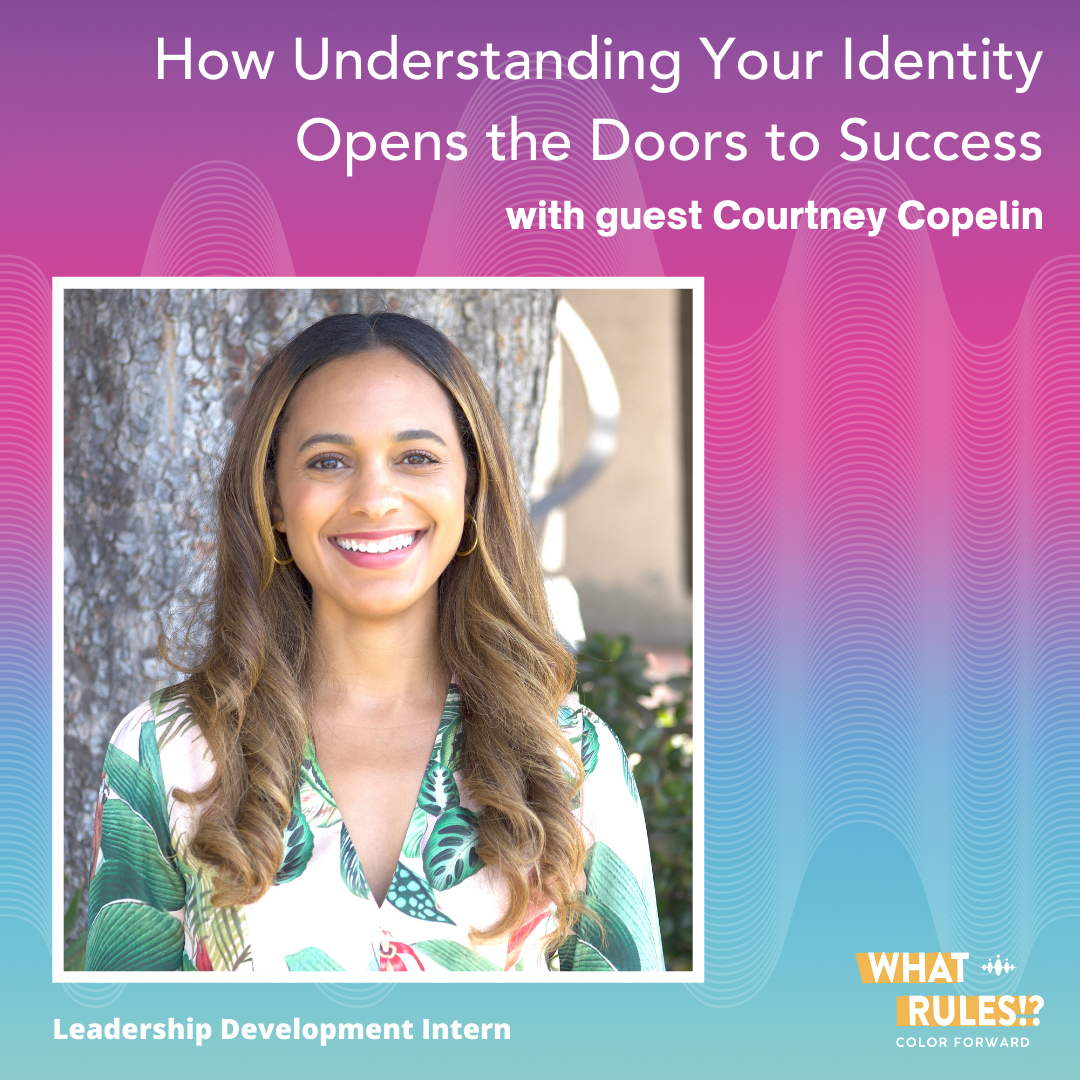
“Intersectionality”, coined by professor Kimberlé Crenshaw in 1989, refers to the ways all aspects of our identity intersect and interact.
Join the whole What Rules team as they dive into what intersectionality means to them and how understanding your unique identities can help create opportunities for yourself and your community.
Alisa Manjarrez:
Let’s talk about how Dr. Merary is back in her house. Should we celebrate?
Dr. Merary Simeon:
We should celebrate. Absolutely, we should celebrate. After a year of being out of the house, we just went through a storm, a big ice storm here in Texas and everybody’s like, “Oh my God, are you scared?” I’m like, “I just came back into my house so I’m a little worried of what would happen.” But thankfully, everything went great, no issues and we’re back home. Still waiting for furniture because as you all know, it takes about three months for you to get your furniture. But other than that, I’m good to go. So when I have furniture, I’m going to invite you all over.
Alisa Manjarrez:
Yes.
Dr. Merary Simeon:
It feels good to be home.
Alisa Manjarrez:
You’ve been out of home for so long, I just still don’t know how you’ve done it. That would be my excuse for my life falling apart and your life, from my perspective, maybe it has fallen apart and you haven’t told us but it seems like you’ve been just fine.
Rosa Santos:
Exactly. I think you’re the perfect picture of, what is that saying where you’re given the lemons and you make… I guess you know that. Make lemons-
Alisa Manjarrez:
When life gives you lemons, make lemonade.
Rosa Santos:
Exactly.
Dr. Merary Simeon:
Lemonade.
Rosa Santos:
Well, you make really good lemonade, let’s put it that way.
Dr. Merary Simeon:
Thank you. That’s why every time it’s like, “Hey, you want to do this?” “Sure. Why not?” I don’t have a place, might as well go someplace else and do something fun.
Alisa Manjarrez:
Yeah. The perfect picture of resilience right there.
Dr. Merary Simeon:
[foreign language 00:01:31].
Alisa Manjarrez:
Speaking of resilience, we have a very light topic today, we’re talking about intersectionality.
Rosa Santos:
Very light.
Alisa Manjarrez:
For our listeners, if you are listening to this before you go to sleep, this might wake you up, maybe save it for the morning. But before we truly get into it, I want to introduce all of us today. My name is Alisa Manjarrez, I am a Vision Producer at the Happy Cactus, I’m an Executive Coach. And if we’re doing this mission introduction, my mission is that I’m passionate about seeing all women reach their fullest potentials in everything that they do and I want to make sure that their visions are seen and known and understood. I’m going to introduce our chief of possibilities here, her name is Rosa Santos. Rosa is an HR Executive, a Leadership Expert and all about helping you see that whatever’s in front of you is not the end result, it’s not the end game. She helps shift towards possibilities and everything she does from an academic approach and a social approach and from a place of genuine kindness and curiosity.
Rosa Santos:
That’s so nice. Thank you. All of a sudden I feel this responsibility on my shoulders though.
Dr. Merary Simeon:
You’re doing it already. So if they feel heavy, that’s why. You’re already doing it.
Rosa Santos:
Right. Well, that’s why I look like that today, now you understand.
Alisa Manjarrez:
Okay. Dr. Merary, tell us who you are?
Dr. Merary Simeon:
Dr. Merary Simeon, I am an activator of talent, creating a world where multicultural women in position of power are the norm. And my mission is to activate the power that you already possess.
Alisa Manjarrez:
So let me just preface this with Courtney. It’s our special episode, we have brought Courtney on as an intern for are Color Forward, which is the organization that puts on the What Rules!? Podcast. And she came to me because she also has a passion to see multicultural women succeed. And Courtney, tell us what you’re studying, tell us what you’re doing, tell us who you aspire to be and what you’re passionate about?
Courtney Copelin:
Well, thanks for having me on today. This is super exciting. And honestly, I’m just so excited to have a conversation with all of you about it. I know everyone’s so busy and so now we get the time to chat. I am currently a graduate student getting my Master’s in Science of Applied Psychology. So that is business psychology, for those of you who don’t know what that means, I am studying organizational leadership and development. So my background a little bit, I’ve always been obsessed with psychology, my undergraduate degree was also in applied psych but I studied child development instead. So I have basically been obsessed with studying people forever and it’s super interesting to me.
Courtney Copelin:
But my passion for leadership started when I was 16, actually. And it’s something that was very new to me, I didn’t really know people studied leadership, it sounded kind of cheesy but I fell in love with it. And so I’ve been on this 10 year journey, studying many leaders, different mentors, reading their research, self-help books, you name it, I’ve probably looked into it. So today is actually a really big milestone in my life where all of this passion really shifted and came into place. Literally, I’m not kidding, 10 years to the day. So this is really exciting, I’m so pumped to talk about intersectionality. Even though it’s a little bit of a heavy topic but we’re going to make it digestible for you guys
Dr. Merary Simeon:
10 years today, is that what I heard?
Courtney Copelin:
Yeah, 10 years to the day. I checked my journal this morning.
Dr. Merary Simeon:
Congratulations for going with it and not giving up because it’s not easy, especially study psychology and it’s definitely not easy as a multicultural woman. So we celebrate you today for not giving up and being resilient.
Courtney Copelin:
Thank you.
Rosa Santos:
Hey and congratulations for having a journal.
Courtney Copelin:
I have stacks of them.
Dr. Merary Simeon:
That’s awesome. I have to say something about the journal. I started one, two years ago and I love it because just yesterday I was looking at some things and I went back and I started flipping through it and I was like, “Wow, a lot has happened in the last two years.” And just to see where I am now from two years ago. So if you don’t have a journal, it’s never too late to start, I just started mine two years ago and I love it.
Alisa Manjarrez:
I feel like we could do a whole episode on journaling because I too am very passionate about this.
Rosa Santos:
Journaling, yeah.
Alisa Manjarrez:
Yes. Okay, getting us back on the topic at hand. I asked Courtney to do a little bit of research for us for this topic and she gave me an amazing definition of intersectionality. It is unique form of identity created out of intersections.
Alisa Manjarrez:
We’ll post of video from Kimberly Crenshaw and she actually shows an illustration of a black woman in the middle of an intersection and there’s a car coming at her that’s racism and another car coming at her as sexism. And what it does is it shows you that there are different, multiple angles and layers of social injustices that can take place because of the multiple identities that a lot of us carry. And that’s really one of the things that all of us are passionate about with this podcast and all of the Color Forward movement I would say is because it’s not just about advancing women in the workplace, it’s about advancing multicultural women and understanding the nuances that we all bring to the table and helping us create strategies around that, acknowledging it. This is not a complaining fest, this is just, “Here it is, this is what we have to consider as we move forward.”
Rosa Santos:
I think we have a responsibility to, in fact, bring awareness to what this is and how it’s felt because I think everyone of us here have felt and continue to feel this intersectionality. And I think for me what we do by doing this, and thank you Courtney for saying, we’re going to make it really bite size so everybody gets what we’re talking about. It really is about providing the language so then when you’re experiencing it, you can see it and then you can articulate it. Without the language, it’s very challenging and difficult to really even acknowledge that something like this is happening.
Courtney Copelin:
I would really agree with that because I just told Alisa recently. So I’m writing my thesis and I really should have been firm in my topic by now and I’m not kidding, last week I kind of shifted and I was like, “My population needs to be women who feel they have intersectional identities.” And I just changed my thesis to focus specifically on barriers to leadership advancement for multicultural women, women of color, diverse women. And when you’re breaking that down, what does that mean to someone? How can we make this digestible? So if you’re analyzing leadership advancement, then you also have to look at leadership development and then we ask ourselves, “Okay, how are we developing diverse women?” And that’s really what I think we need to talk about when we’re talking about intersectionality and applying this really complicated concept to our world and how can we understand it? What can we do with this concept? Where do we go from here now that we’re aware of it?
Dr. Merary Simeon:
What intersectionality represents to me is everything that I represent that impacts in different ways, it closes the doors or it opens the doors. So as a woman, as a Latina, as a mother, as a woman who has a relationship with Christ, as a caretaker, all those things are part of me, it’s who I represent and because of all those things, there are doors that open and close. So that’s what it represents to me when you want to talk about breaking it down in bite size, take a look at yourself, take a look at who you are and what policies are actually not supporting who you are. What laws are not supporting who you are? What is society’s unconscious bias about who you are? So to me, it’s very complex. You can have all kinds of things, you can have frameworks, you can have developments but at the end of the day, it starts with us, for me at least, understanding who I am and what are those doors that open and close so that I can strategically either develop, build networks, development, learnings and things like that.
Dr. Merary Simeon:
So that’s what it means to me when you talk about intersectionality. But at the end of the day, for me, I concentrate on what I can do to make sure that those doors continue to open, the same thing you’re doing Courtney through your thesis. So definitely do what matters to you so that other people could learn. Because it’s easy to sit here and say, which is true, policies and all these things are broken but what am I doing if I’m keeping my mouth closed? Number one. Or number two, if I’ve already made it through the door but I’m not letting anybody in, then I can only look in the mirror.
Rosa Santos:
The fact that you are showing up with all the attributes and all who you are produces this impact and ripples in the places where you show up. And lately, especially, so many people are owning who they are, are owning the fact that they have these intersectional identities or they’re just simply diverse or different or they’re black or Hispanic or they’re a woman and they’re showing up and they’re saying, “Hey, this is who I am and because of this, first, I need to be respected. Second, I need to be taken as seriously as anybody else. And thirdly, I’m just asking for an opportunity to demonstrate what I’m capable of.”
Rosa Santos:
And it is fascinating to me how the more that this is happening, and I think lately there’s a bit of a wave that is raising all boats and I’m seeing more of it. And at the same time, there’s also another wave that is just trying to [quartile 00:12:35] all these bursting through the seams possibilities that we are all trying to create, not just for ourselves but also collectively for our society so we become a much holistic rounded and really growth kind of society and human kind as a whole. What do you guys think about that?
Courtney Copelin:
The word that keeps coming to mind is identity. And I’m actually bridging both of your comments, one about identity, but also how does this look in terms of redefining what’s already existed? And so when I think of intersectionality, it’s also really changing our understanding of leadership and then leadership is now shifting the expectations of leadership or the standard of leadership is shifting. Because there are so many studies, I’m sure we’ve all seen them, about diverse thought increasing innovation. I just think there’s now such an important and necessary shift that needs to be discussed more.
Dr. Merary Simeon:
Like what?
Courtney Copelin:
One, that the current definition of leadership really isn’t inclusive of intersectional identities. And I was thinking a lot about this and that’s actually a great segue into an HBR article that I was reading, it’s literally called, Does your definition of leadership exclude women of color? And it’s an amazing article and it basically invites the concept of cultural capital into the conversation. Cultural capital is so valuable and so what does that mean? It’s basically simply put saying that diverse women, diverse people bring so much to the table and diversity is such an asset. And now that business is way more global, you have to recognize that there is so much talent found in diverse people, there is so much innovation found in diverse teams. And I feel like in order for our world to honestly run more effectively, you have to not only welcome in these conversations, but actually give people a seat at the table to allow that change to happen.
Dr. Merary Simeon:
So why do we think it’s not happening? I’ll open that to everybody because we know the research, we know you can Google it today or you could, go into any research publication and find that diversity is absolutely what Courtney says. It breeds innovation, the leadership just goes beyond and above greatness. It’s proven, it’s research. So why is it not happening?
Rosa Santos:
I have a very simplistic theory.
Dr. Merary Simeon:
Bring it.
Rosa Santos:
It’s fear. It’s the theory of fear. I think it’s kind of embracing the unknown. Sometimes it’s the lack of willingness and commitment to understand and also to value people who may not think the same way as you do. I think it’s also the theory of feeling and uncomfortable. We don’t like that.
Alisa Manjarrez:
But I was just going to say with the fear of being uncomfortable, a lot of times when you get stuck, and I say stuck intentionally, in that corporate jungle, you come up against, and this is for anybody, including white males, everybody can get stuck in this trap of, “Well, this is the way we’ve always done it, this is the way it is, this is the way it goes.” And so introducing any kind of new thing, I never thought about it as fear but it is because you’re asking people to step out of their comfort zone.
Dr. Merary Simeon:
Yeah. I think that’s brilliant because you’re absolutely right, I mean, the both of you are. When you’re in the comfort zone, you’re comfortable, anything that’s different will bring you fear and rightfully so, we’re wired that way to protect. But it’s getting out of that comfort zone to really invite others that are different than you and have the different intersectionalities that will help not just you grow personally but society, your business, the world as a whole. Imagine how many more things we could be discovering right now and finding a cure for if we had really diverse minds, diverse people of all different intersectionalities come together?
Courtney Copelin:
If people also feel very threatened by what they don’t understand, you can say, “I want this person in the room,” but when you break it down to communication and decision making, building trust, that all takes understanding. And I feel like people in general, we are human, we all want to understand because your ability to understand helps you to connect better. So when we’re not able to connect and not able to understand, it’s frustrating and I feel like people almost would rather not deal than tackle on the biggest concept that is intersectionality, that is diversity. So why are the doors not open? Why is there not a seat created at the table? Because opening door means that you have to open your mind in ways that you maybe haven’t before and that can feel really scary if you feel underqualified, if you feel ignorant. No one wants to admit that they’re ignorant in the topic, are you kidding me? How many times have we all been like, “Oh, I know what I’m talking about.” And I’m like, “I have no idea what they just said.” We’ve all been there.
Dr. Merary Simeon:
You said something that made me think Courtney, because absolutely I think being able to learn and shifting from learning is what helps you grow and really understand that, “Hey, I may not understand and have this fear that this person may be better than me or whatever it is.” But it’s through the learning that you then got to take action to get to the growth part, which is what would enable you to really be more comfortable around the different intersection. I think people are really hiding behind the learning piece. How much more research do you need? How many more papers? And how many doctors and researchers proving this do you need? Even scientists are proving it neurologically and all these things. I mean, look at the Neurological Institute, for God’s sake, those people are brilliant. How many more do you need for you to say, “I’m still learning.” It’s an excuse, you’ve got to be able to move forward. Again, that’s my opinion.
Courtney Copelin:
That’s why my master’s degree is so cool because it’s not a master’s in arts, it’s a master’s in science. There is data, there is evidence to support what we’re talking about and these psychological concepts are very quantifiable. And I feel like people think that psychology is all about theory, which it’s largely about theory, but now we’re applying those theories, we have evidence. Don’t tell us, you cannot tell us this isn’t important because we have data to support it. Don’t try us.
Alisa Manjarrez:
I’m really curious about all of the three of you, what you think, for our listeners, what do we do now? Because one of the things that I’m tired of is people feeling like the victim and only talking about the problems and not the solutions. So for all of us, we could have our own fear in staying in our own comfort zone. What do you feel like is our responsibility then as individuals?
Rosa Santos:
I know we say we need to stop being victims and complain but you need those outlets as well. It’s pretty hard sometimes to be targeted left and right because of who you represent or who you are and it can be hurtful and offensive. There are a lot of, still today, disrespectful folks that sometimes they don’t even know they’re being disrespectful to you. Now, I think you need to say, “Okay.” And you need to vent and you need a friend to vent with, you need to open up your network and find a safe space to be able to do that and then really work through, how do I go back and when that happens again, because it will happen again unfortunately, how are you going to manage? And what are you going to say? And how that kind of respond reaction to it is shorter, you shorten it because I think that’s what we are trying to do. So you can overcome and move forward and then ask for what you want.
Dr. Merary Simeon:
What works for me and what’s been working for me, it’s really understanding my identity and I go back to the doors that close and the doors that open. So what I do, the doors that I know I open as an executive, as a woman of color in a position of power, I take every minute that I can to ensure that I empower another woman. So I use my voice to make sure that I’m helping others. So that’s how I help. Now for those doors that are closed, it’s hard work. I’ve got to strategically work to find people that have those doors open so that they can take me along because the key is for me to get to that door and open it. There’re thousands, millions of women of color, multicultural women waiting for somebody to open that door. So what I do is I strategically work.
Dr. Merary Simeon:
And when I say door, it could be in school, it could be at work, it could be in a position that you want to get to department that you want to get to, it can be a political position, something in the community, whatever it is. But I have to strategically work to find somebody that my intersectionality doesn’t threaten them. And when you find that person, that person can then pull you along. So does it take work? Absolutely. But I couldn’t do that if I didn’t understand that, if I didn’t understand myself. So for me, understand who you are, what you can do for other people.
Dr. Merary Simeon:
You may say, “I’m not an executive.” You know what? You can mentor somebody in high school or you can mentor somebody in your neighborhood. You’re an executive, I really hope that you are opening the doors and sponsoring multicultural women. But if you are a woman like me, that there’re doors that closed, then I [inaudible 00:24:00], I’m telling you, find somebody that can strategically open that door for you and once you’re in-
Courtney Copelin:
Bring others along.
Dr. Merary Simeon:
Yes, bring others along. And not just people that look like you but other people that can then open those doors. It’s like, “Hey, now I’m here and I’m here with people that do not look like me, let me show you how beneficial it is to have other women that look like me here?” So when I say, bring others along, I’m talking about bring those allies along but then also pull other multicultural women with you.
Courtney Copelin:
Something I think really deeply about is how we can plant seeds and then water the seeds. So by that, I mean, none of us can really expect to see women of color, diverse women in a room if you don’t start to engage early. I am very passionate about children in adolescent development and so I really connect well with high school students and college students. And I really think about, what were the things people told me I couldn’t do when I was their age? What was I told? “Well, you won’t have access to that,” or, “You can’t do this.” A lot of that is connected to education, which is also why I’m simultaneously passionate about education and educating women of color in leadership. Because I feel like we all have that in us but you have to be exposed to the conversations and the resources and the opportunity that’s watering the seed that’s already in us.
Courtney Copelin:
And so a part of growth is also exposure. So I try to engage in those conversations with a lot of youth because you don’t even know what your possibilities are if no one’s talking to you about it. A lot of the statistics that we see in the workplace and even within education about so few women in STEM, so few women as the CEOs and executives of Fortune 500 companies. Well, you don’t just end up in those positions, it starts education, it starts with taking that class, it starts with going to that conference, it starts with going to that seminar. And those are all ways that we’re developing but if you aren’t starting on a smaller level, we can’t hold any person to the expectation to build. So my action in really shattering that glass ceiling and changing those statistics is starting small.
Alisa Manjarrez:
Snap, Snaps.
Dr. Merary Simeon:
100%. I wouldn’t be an executive if somebody changed that view for me, I would not. Because there’s nobody else in my family who’s an executive and in our school, whenever there was conference, who went? All my respect to the military because my husband’s a veteran but who went to those high schools? The military to recruit you. And that was it, maybe one company or here but never did they talk about corporate America. It was a miracle that this one teacher knew another somebody else that worked in corporate America that got me there. But I agree with you 100% Courtney, we need to start young and show them the possibilities because they don’t know them.
Alisa Manjarrez:
And that’s one of the reasons why we have this What Rules!? Podcast. There’s that saying, “You can’t break the rules until you know the rules.” And so helping people to understand what intersectionality is all about is so that you can understand that all of these things come into play as you advance in your career and there are some rules you’re going to have to work around. And so I think that listening to the stories of these women that we’re highlighting is really important, not just for your own understanding for your own life, but to put yourself in other people’s shoes and to see how they have gone around the rules and broken them themselves.
Alisa Manjarrez:
So I would encourage all of our listeners to listen to these episodes. This is for you, for your own learning so that you can see that there are a ton of workarounds to these issues, there are a lot of solutions for you. And we have almost a hundred women now who are coming with their experiences so that you don’t have to do this alone and you don’t have to do this uninformed of what’s some of the harsh realities of being a multicultural woman in the workplace.
Rosa Santos:
My first proper job was to create a coaching playbook for plan managers on how to manage women and how to promote women. And the reason why I say this is because we’ve been at this for so long and I feel that there’s so much research. I feel that sometimes we may progress and then we’re knocked down and we have to get up and go at it again. And I think we know what’s happening, we know it and everybody acknowledges, what I still have a lot of trouble figuring out is the how and how we change minds and hearts here. Because even though you have all these men and women who say, “I have daughters.” And sometimes it’s like, “Well, what happened because they’re still going through what I went through 30 years ago?”
Rosa Santos:
I am tired, I want to see how can we count on those who are allies, who can augment this in a much faster, much more visible way than what we are seeing today. And the point that you guys were making earlier about pushing the redefinition of leadership is absolutely key and important that we do and we strive to do and bringing those women and empowering those women along the way in whatever way possible, it’s absolutely essential. So sometimes we might think that we do very little but the little that we do, it can be huge for somebody, for one person, you can open up possibility for that person in a way that they hadn’t seen for themselves ever. So please go do it every day, small acts of kindness can change somebody else’s outlook for life.
Dr. Merary Simeon:
I love the piece about small acts of kindness because I do believe we all need to be kind but I want to say small acts of bravery. Because I go back to what Rosa said, they may have fear of not understanding what we bring and we may have fear of not being enough or whatever it may be. So what I would say to the allies is, “Every day, take one step towards an act of bravery.” And I would say the same thing to every multicultural woman listening, “Every day, take one step forward towards an act of bravery.” And if we all do that together, we can change the world.
Alisa Manjarrez: (33:35)
Want to know how breaking the rules can help you level up your career game? So What Rules podcast on any social media platform and join our members-only group on LinkedIn, where we discuss rule-breaking strategies for multicultural women. What Rules is a production of Color Forward? The show is produced by me, Alisa Manjarrez, with editing and fabulous sound design by [Mather de Leon 00:33:58]. Visit colorforward.com for more stories, events, and of course, all the episodes of What Rules.
Meet the Hosts
Archives
- February 2023
- April 2022
- March 2022
- February 2022
- January 2022
- December 2021
- November 2021
- October 2021
- September 2021
- August 2021
- July 2021
- June 2021
- May 2021
- April 2021
- March 2021
- February 2021
- December 2020
- November 2020
- October 2020
- September 2020
- August 2020
- July 2020
- May 2020
- April 2020
- March 2020
- February 2020
Copyright © 2026 What Rules!? Podcast. All Rights Reserved. Powered by Podcast Theme