
What Rules!? Podcast - Past Episodes
63. Owning Your Achievements, Pt. 2
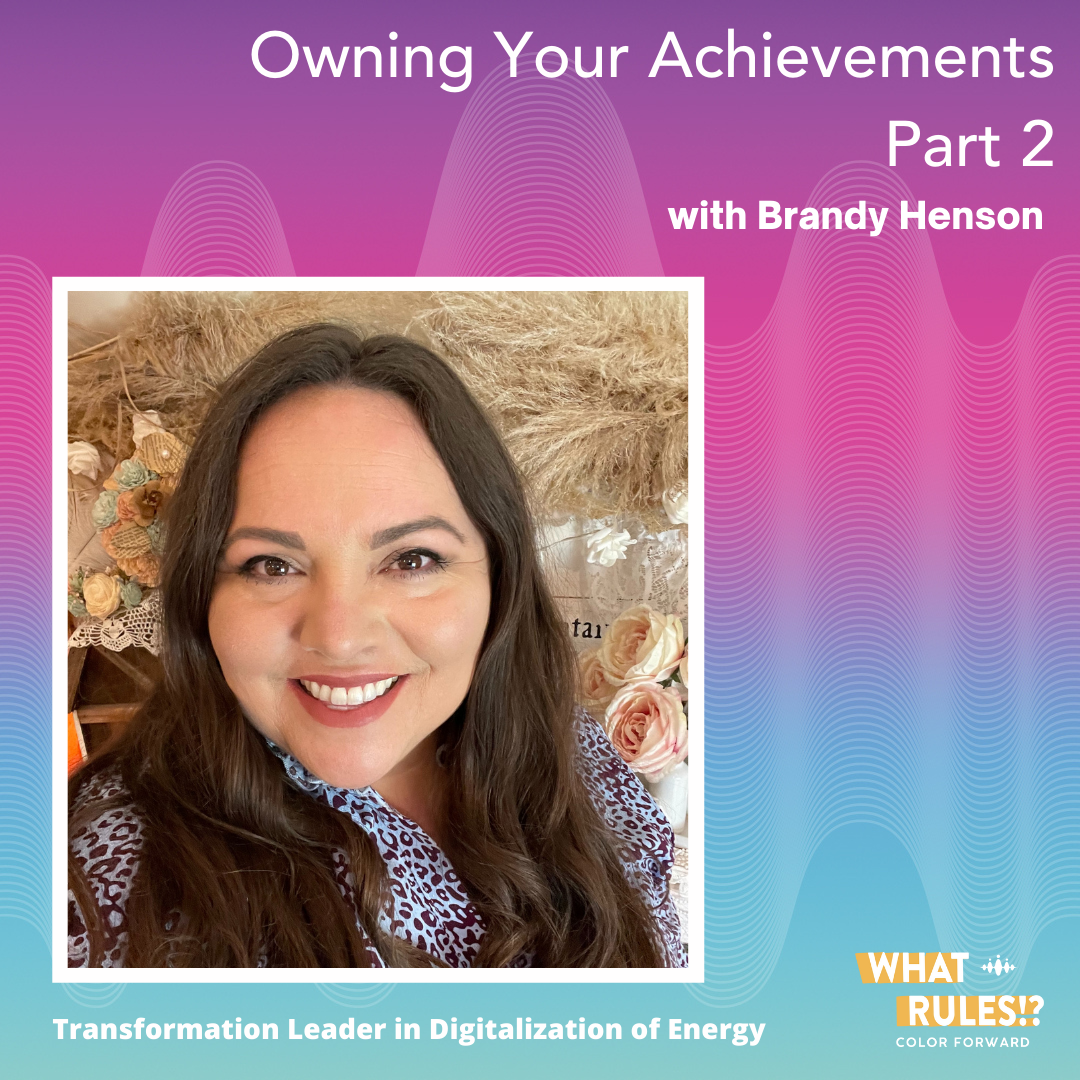
We’re back with another round of insights on owning your achievements. It’s SO important that we couldn’t fit it all into a single episode.
Listen as Rosa and Dr. Merary chat with Head of Federal Government Business for Siemens, Brandy Gonzales Henson, about owning the narrative on your achievements. If you don’t do it, no one else will.
Dr. Merary Simeon:
I guess we’re going to talk about any plans that anyone has for the weekend. I know you just had a wonderful birthday yesterday, Rosa.
Rosa Santos:
I know.
Dr. Merary Simeon:
So, happy birthday.
Brandy Henson:
Happy birthday.
Rosa Santos:
Thank you. Yes. I feel like it’s a whole birthday week, actually.
Dr. Merary Simeon:
Yes. That’s the way it should be. You should be able to celebrate every day.
Rosa Santos:
I know. We need to find a way of celebrating something every day. But, yes, it was my birthday yesterday. It was awesome. It was very relaxing.
Dr. Merary Simeon:
Good, good. You have any plans for the weekend?
Rosa Santos:
Plans for the weekend? I do. I do have plans for the weekend. The most important thing I’m doing this weekend is training my dog.
Brandy Henson:
I can relate to that. I can relate to that one.
Rosa Santos:
We’re getting a new trainer and hopefully my almost one year old puppy will start behaving, because she’s a bit of a riot. So, that’s like-
Dr. Merary Simeon:
I love it.
Rosa Santos:
… anything else can be moved, but not that appointment.
Dr. Merary Simeon:
I love it.
Rosa Santos:
Yeah. It’s my second. They say your first child is perfect and the second one does all… Yeah, this is it. With my first dog, perfect, relaxed, nice. He does all the things that you ask him. Second, she is a riot. She is out of control.
Dr. Merary Simeon:
Well, what a time, right, to celebrate accomplishments?
Brandy Henson:
Yes.
Dr. Merary Simeon:
You mentioned it was your birthday yesterday, but celebrating it every day, right? And just even thinking, “Wow, today it’s a great day to be alive.” So I want to welcome everybody to the What Rules!? podcast, where multicultural women share how they outsmart the game to advance their careers. My name is Dr. Merary Simeon. I’m an activator of talent, creating a world where multicultural women in positions of power are the norm. Joining me today is our co-host Rosa Santos. And we have a special guest that will be introducing herself in a minute. But right now, Rosa, why don’t you introduce yourself?
Rosa Santos:
Yes. Hi. Chief possibility officer. So what that means is I really enjoy and I’m purposeful in engaging folks in creating and delivering and activating in their own possibilities for themselves and others. While I work as a talent management executive in human resources as well and leadership experts.
Dr. Merary Simeon:
Awesome. Today, we’ll be talking about owning your achievements. So why don’t we go ahead and get started? Brandy, I know this is one of your favorite topics. So would you please introduce yourself and tell us about the many hats that you wear?
Brandy Henson:
Yes, yes. I’m Brandy Henson. I have spent about 18 years in the energy industry, so focused on renewables, on generation, on microgrids, and all in leadership roles, and just had a lot of fun growing up in that space. And I work now solely with the federal government, which sounds maybe boring, but it is fantastic and lots of fun and it’s all about energy. And they are the largest energy consumer in the world. So it is a lot, a lot of fun. And one reason I would say this is something that I’m really passionate and excited about is because it’s something that I just see so many women struggle with. And I don’t know if it’s just built within or some other little tips and tricks, but I’m extremely passionate about it because you have to own it. If you don’t fight for yourself, who’s going to? You have to be your number one champion. So, excited to be here talking with you all about this today.
Dr. Merary Simeon:
I love it. And it’s funny that you say that because organizations use praise or rewards all the time. They even have a rewards department, right?
Brandy Henson:
Yes.
Dr. Merary Simeon:
Because they know recognition increases performance. So recognizing your achievements, whether big or small, actually, research shows it decreases stress and encourages better habits. And who doesn’t want to reduce stress?
Brandy Henson:
Yep.
Dr. Merary Simeon:
So tell me a little bit more about, were you always like this? Were you always owning your achievements?
Brandy Henson:
Yeah. It started, I think, really at a younger age, growing up and being confident. And I just remember so many situations like that where they need somebody to read and nobody would raise their hand to read. They need somebody, they’re like, “Oh, Brandy will do it.” And sure enough, I was always there ready to raise my hand. And so I had that confidence at a young age just to be bold and own it. And I really think that’s what sets the stage as you’re developing and growing and then having positive leadership and positive role models that are speaking truth into you, right, at a young age. And I’m extremely passionate about STEM and girls going into engineering and stuff because that’s where it started with me. Especially this week being Engineering Week, it’s so critical and important to empower especially young women to go into math, science and engineering and start them young.
Dr. Merary Simeon:
I love that now. Rosa and I had this conversation before about how difficult it is for some, right? I’ve gotten better, but it took me a while to get comfortable with my success because I felt like I was bragging or it wasn’t the right time. But it hasn’t always been easy, and I know this is something that you’re passionate about too, Rosa, because, at the end of the day, we’re stating facts of what we’ve achieved.
Rosa Santos:
I think I’ve shared this before here in this platform and forum that it is actually that even though I’ve, to your point, Merary, got better at it and owning my successes, I think we or I shouldn’t generalize, but I come from a culture where you really needed to be a bit more collective in the way that you thought about your successes. And even though maybe you were the instigator, you were the one who raised the hand, you were the one who actually ideated, but this sense of it was a team effort, it was a team effort, right, kind of dilutes your own imprint on what’s been delivered.
Rosa Santos:
So, that’s something that even to this date is still challenging. It’s still challenging for me, even though, as I said, it’s I have to practice it. And then I have to have my own set of cheerleaders who will tell me, well, who will push me to be able to speak about my successes in a way that I can feel it’s okay to embrace them. What do you think about strategies maybe, Brandy, or what worked for you? Because it sounds to me that you are very much… Maybe I’m making the assumption, right, but the way I look at you is like you got it. How did you get it?
Dr. Merary Simeon:
We want some of that.
Brandy Henson:
Yeah. I’m trying to think of really what started and what initiated in me as I’ve grown in my career and grown in leadership. And I think it’s also just a lot of constant learning and constant development, right? So early on, you don’t really know. I mean, like just establishing thick skin. And I would say it comes back to, when I first started in my career in the utility, you don’t hear many people going into the utility space, right? It’s a male dominant field. It’s usually 50 plus, a lot of the folks that are in that field. It’s an aging workforce, right? That’s one of the challenges. And I came into that environment as an engineer but always felt like I had to prove myself.
Brandy Henson:
And then after a certain point, after a few specific incidents, kind of like, “I don’t need to prove myself to these people, right? I know what I’m doing. I know my worth. I know my value.” And I just really started building up from there. And I think that if I hadn’t also checked in intentionally on how I was feeling and sometimes, and maybe just one quick example, going into a meeting with maybe 10 men that are 50 plus and they’re quizzing me before they treat me like a normal human being. And this happens all the time in the workforce, right? Or at least it happened to me.
Rosa Santos:
Right.
Brandy Henson:
And then starting to know that that’s the pattern, without being stereotypical or generalizing, but that’s a pattern. And so I would come in very confident and just set the stage. And I’ve always been in these commercial facing roles, so it was required of that as well. And I think each time you do that and you conquer it, you’re like, “Check,” right? And then you conquer again and, “Check.” And so you build up more and more confidence and you get thick skin and then you realize, “It’s not me, it’s them.” Right?
Rosa Santos:
Right.
Brandy Henson:
And then you use that to go help other women, especially diverse women, right, that it is, culturally, it’s different. Right? And helping them own their voice and giving them that excitement and joy to own their voice, right? I feel like that’s what we owe. That’s why I love doing stuff like this. I feel like I owe that to other women, because you have to have somebody speak that truth into you or you don’t even realize it.
Rosa Santos:
And I think we all know this, but I want to ask you the question. Why do you think that’s important? Why do you think it’s important that we own our accomplishment and our successes?
Brandy Henson:
I hate to say it so cheesy, but it’s almost like the fake it till you make it. Because if we don’t believe in ourselves, if you do not love yourself and believe in yourself, nobody else will. Right? And even just being a kid at a young age, thinking like, “If I don’t love myself, who else is going to love me?” And I had parents that every day looked at me and just were like, “I love you. You’re a beautiful child of God,” and raised me with that confidence. And so many other people and just friends, colleagues were not raised like that, and it really changes how you think of yourself, the negative voices in your mind. I feel like all of those experiences really start building up to how you can really shift how you view your yourself.
Brandy Henson:
And then knowing your worth. So when you’re going out there and asking for your next promotion, it’s not, “Should I ask? What kind of money?” It’s like, “No, I’m worth this. This is what I’ve done.” Convince yourself. Fake it till you make it. Convince yourself and then build up your case on why you should get promoted and why you are the person over this, and really empower yourself there. At least that’s what I try to do and that’s what I do to help other women as well.
Dr. Merary Simeon:
I love that. You said check in, right?
Brandy Henson:
Mm-hmm (affirmative).
Dr. Merary Simeon:
So check in, “Why am I feeling this way?”
Brandy Henson:
Yeah.
Dr. Merary Simeon:
And the other piece that I heard you say, they were facts. You were stating the facts. You know this information. You know you’re worth. This is what you’re worth, based on what you bring to the table. So it’s almost like how do we change that mindset of feeling insecure about sharing our achievements? Because if we continue to feel insecure, we’re going to allow somebody else to dictate those achievements for us or to say, “Oh, this is all they are and all they’re worth.” But by us just stating the facts, “Yes, I am worth this because of everything else that I bring to the table,” or, “I’m smart,” and we’re the ones that are saying, “Hey, I know my worth. I love myself enough. This is what I want.” Communicate. At the end of the day it’s not so much about owning it, it’s communicating, or maybe it’s both. It’s owning and communicating it, because you can own it, but if you don’t communicate it then no one knows.
Rosa Santos:
Yeah. That’s very important. I think this is stages, right?
Dr. Merary Simeon:
Yes.
Rosa Santos:
I mean, if you think about it, it’s stages, and sometimes it’s becoming aware of your accomplishment. I think there are a lot of us out there who do a lot of things and they think it’s the thing to do. And then you don’t necessarily put a tag or a value to it. And if whomever is listening hasn’t done that exercise, it might be good to start thinking about like, “Let’s look at what I’ve done and how this compares.” Right?
Rosa Santos:
Because I think that also brings you, when you go into the market, whatever marketplace is, then you can very much really gauge against your value, what your value is against others and that set of accomplishments to then being able to come to the realization, “Yes, I did that,” or, “Yes, I impacted this group of folks this way,” or, “Yes, I helped to advance the organization by doing X, Y, and Z. And then I want this.” Right? And then to your point, Merary, you have to communicate it. And communication might be, and I don’t know what you guys think about this, but I think communication might be a form of gaining allies, right, who know of your accomplishments and supporters and sponsors that can actually vouch for you as you ask what it is that you want.
Brandy Henson:
Yeah.
Dr. Merary Simeon:
Yeah. I love that idea, Rosa, and I think it’s twofold. The only other thing that I would add, communicating your achievements and your accomplishments, you become a role model to other women who may be struggling. We know, right, research shows it, this is not easy. It’s rare, Brandy. You’re rare. That’s amazing. And I’m so glad to have you. But it’s not very comfortable for people to talk about it. So being able to be a role model to others and say, “Oh wow, she’s saying it.” Right? Because a lot of the times we don’t see women. We don’t see women talking about their achievements. It’s very rare, at least for me that I’ve seen it is. So being able to communicate it, yes, so that you can have a great career and people know what you bring to the table, but communicating it because there are people out there that need to hear what you’ve accomplished.
Brandy Henson:
Yeah. And on that as well, I was just thinking, when you start also being really intentional about managing up, right, that is a learned behavior, right?
Dr. Merary Simeon:
Yes.
Brandy Henson:
That is definitely a learned behavior. It’s something you have to really work at and practice at because you want to do it in a tactful way. You want to be classy about it. You want to get feedback. And I think soliciting feedback and not being afraid of feedback helps you so much own your accomplishments, because then you’re opening up a forum where you can get feedback to try to improve yourself even more, and then you want to share that. So the feedback piece of that and communicating up I think help really drive that even more, because you want to be proud of what you’re filtering up, right? I sure want to be, right, or I don’t want to filter it up. I don’t want to manage up if it’s not good stuff going on.
Rosa Santos:
Yeah. But I think there is a strategy, right, Brandy, to do that?
Brandy Henson:
Yeah.
Rosa Santos:
Managing up has negative connotations. And I think when folks, and by folks I mean women, right, think about that, it’s like, “No, I don’t want to manage up. That’s not good.” But what we mean by it is how strategically are you building relationships in the next layer up that could become, again, a sponsor for you whenever your name comes up and they can actually talk about you in certain way that you want?
Rosa Santos:
Now, I think part of that strategy is how you go about building that relationship. And I think what you’re saying, Brandy, is a really nice way of building that relationship is by maybe scheduling a meeting where what you ask is for feedback. Right? And you go in in a somewhat of a vulnerable way to say, “Hey, I want to speak to you because I want to gain your feedback about how that project that I am leading is going, right? And in your view, what are some of the things that I can do to make things better?” So just by the mere factor of asking for that, you’re already building a lot of equity within that relationship with that manager or manager’s manager for you, right? Because everybody, and I think even those of you who might say, “Well, but my managers are terrible,” even the worst manager loves to be in a position to help. I think it’s just pure human nature, right?
Dr. Merary Simeon:
Absolutely. So I want to ask a question to both of you because I agree with both of your statements, but how will you encourage some of our listeners who are feeling insecure about sharing their achievements? Because asking for feedback is tough.
Brandy Henson:
Yeah, right.
Dr. Merary Simeon:
And sharing your achievements may be tough. So what are some of the strategies or things that you’ve done that work for you when you’re feeling insecure?
Brandy Henson:
Yeah. So I would say that it’s, for me, whenever I’ve felt insecure in a job or in a role, or especially even going through starting a new role, right, and going through a 30, 60, 90, and not feeling as confident, it’s like if I’m not tracking to something, and as maybe cheesy or I’m not trying to create another task, but if I’m not sometimes tracking to see what I’ve actually done, then it’s you get so caught up in the reactiveness, the day-to-day. And so having a strategic plan, right, on like, “This is what I want to accomplish and this is what I’m proud of.” So it could be starting each day just saying, “These are the three things I want to accomplish. I don’t care about anything else.” And I got this from a podcast or read it from somebody, but it was writing down a few things that mean something to you that day. And I take that same approach to more of a longer term plan.
Brandy Henson:
I mean, when you see those results, I feel like when you see it, you see what you’re doing. And if you’re not having those results, then you don’t feel good about what you’re doing. And I think you have to start somewhere and you have to document a little bit. I would say hands down that’s probably the first thing that you really could start is like, “Hey, over the next 30 days or my rolling 90 days, what am I going to get done that I would, ‘Cheers,’ my champagne to on day 90?” Right? And seriously think of it like that, like, “This would be a win and I will be proud of this.” And if you don’t like what you did, then you have another, right, to keep on to give you some excitement, something to be joyful about. Right? And I think that’s how you start.
Dr. Merary Simeon:
I love that.
Rosa Santos:
I think some of the things that I’ve done are very tactical when I’m feeling in that position.
Dr. Merary Simeon:
No, Rosa.
Rosa Santos:
Yes.
Dr. Merary Simeon:
No.
Rosa Santos:
Believe it or not, I can be very tactical, Merary. But sometimes, honestly, sometimes it is really being purposeful about minimizing that voice in your head that is telling you like, “Ah, maybe they don’t like you. Oh, they didn’t. Oh, yeah, they’re looking at somebody…” I mean, all that chatter that is in your head, first of all, recognize that is that chatter, that it’s this voice in your head, that it’s not you. And sometimes I do very silly things like counting backwards, 10, nine, just to get it out of the way. And then writing on a piece of paper, “You are good,” or, “You are great.” Or just doing affirmations for yourself, that’s the other thing that I do.
Rosa Santos:
And I think the third, again, very tactical things that work for me when I’m in those moments is calling somebody who knows me for who I am, that in those moments can actually say, “Look, stop it. This is who you are.” And I’m fortunate enough to have friends like Dr. Merary, who tells me things straight. When I need that, I can call her and she will tell me. She will tell me. And it’s like, “Okay, I got it,” and I can move on. You need to enroll somebody who can actually take you out of that funk, if you like, of that place to then go back to who you are. Because you’re going to get those moments where people or situations are going to force you to off center a little bit who you are. And then you need somebody to tell you, “No, no, go back. Let me remind you, this is who you are.” And then I go back to my plans and my strategy. But sometimes you just need that kind of like somebody shaking you up a little bit.
Brandy Henson:
And who you want to become, right?
Rosa Santos:
Yeah.
Brandy Henson:
Because I’m on a journey on, how can I be a better leader? Right? I just thought, when you make a decision, you’re like, “Man, I could have handled that better. I could have said this. Oh man, I’m not so proud of that.” Right?
Rosa Santos:
Right.
Brandy Henson:
And it’s like, “Who do I want to become?” and thinking about it like that too.
Rosa Santos:
Exactly.
Brandy Henson:
I 100% agree with the-
Dr. Merary Simeon:
Powerful.
Brandy Henson:
… the sponsorship, having a sponsor, having a coach, but then also having a friend where you could just check in completely, right? Like the friend version. And I have a great old work friend, we used to work together, we were peers, and he will call me out. And he knows me. He’s like, “Brandy, stop saying that to me.” He will just call me out. And it’s great because I can’t call myself out like he does.
Rosa Santos:
For those of you who do not have that, go find it.
Brandy Henson:
Find it.
Dr. Merary Simeon:
Yes.
Rosa Santos:
Go find that friend, coworker. I know some people call it, “My board of directors and I am the business,” right? Find your board. Find someone who can challenge you and can really either recenter you or help you put in the right path to get to where you want to be or who you want to become.
Dr. Merary Simeon:
Absolutely. I think I heard so many powerful things, right, that the board of directors, having that, those people that you trust that are going to give it back to you, “This is who you are. Do not forget who you are,” so remind you of all your accomplishments. But since we’re talking about accomplishments, any of you want to share what is your greatest accomplishments that you’re most proud of?
Brandy Henson:
Well, I got to think for a second on that. I feel like I’m usually so up front with my accomplishments.
Rosa Santos:
Merary, why don’t you take us first? Go, because you’re so good at it. Come on. Give us a few minutes.
Dr. Merary Simeon:
I had to think about it in two because I couldn’t deal with just one accomplishment. Right? But when I think back about in my career, my biggest accomplishments that I’m most proud of is when one of your mentees calls you or when that person that you’ve been sponsoring calls you to tell you about their next role, that they achieved what they wanted to achieve. So to me, that just brings extreme joy to know that those seeds that were planted are now blooming and they’re going to be able to do great things. So, that’s one of the greatest accomplishments. And it just happened recently so it’s fresh in my mind. The other, I would say, the personal greatest accomplishment is just being able to have friends that love me enough to tell me the truth. And that is an accomplishment to be able to have people around you that you can trust, because there are some that don’t have that. So to me, I cherish that.
Brandy Henson:
I can agree with that completely. I’ve had 12 different roles in 18 years, which sounds like a lot of roles, right? So now I’m a head of a business and I love it, but it’s each time that I’ve had to take a new role, I’ve had to switch, right? So I’d say I didn’t grow up doing the same thing, a perfect pattern, right, throughout my leadership journey. I’ve taken new roles which have put me completely outside the box. When I started working with the federal government, I didn’t know anything about the federal government. When I started working with oil and gas, nothing about oil and gas. Data centers, nothing about data centers. So what’s been really neat or what I’m probably most proud of is being able to switch throughout these different… All in energy, but switch customer segments, customer verticals, and then still be able to pick it up and learn it and keep moving with it. Right? So it’s that, I guess, switchability, if that’s a word and staying true to myself too.
Dr. Merary Simeon:
Love it.
Brandy Henson:
That resonates with me. And I know authentic self gets overused these days, but it really is like who you are inside. So you’re not faking that till you make that, at least.
Rosa Santos:
That’s great. I so relate to what you guys are talking about because I could call those my accomplishments as well. But I may do it slightly different, which I think you guys also will relate to. I think for me it is sizing opportunities, but not just sizing the opportunities, it’s creating them. And that’s why I talk about this idea of creating possibility. Brandy, I’ve had a lot of roles as well, and I’ve had the great opportunity to work in quite a number of organizations that, like you, were very different. But all of them were by choice because I wanted to work there since the beginning of the beginning.
Rosa Santos:
Since I was in college, I would just go for something that I really wanted. I knew nobody in those companies. I had no connections, but I always, to this day, managed to find the role that I wanted from a professional perspective in those companies. And I managed as well to then being able to work and live in various countries around the world, again, when I say by choice, it’s by creation. Right? I want to work in Germany because I know Germany has this works councils that are very difficult to deal with and I want to negotiate with the works council in Germany, even though I don’t speak German. I did that. Right?
Brandy Henson:
Creating your destiny. Yeah.
Rosa Santos:
So I mean-
Brandy Henson:
I love it.
Dr. Merary Simeon:
That’s right.
Rosa Santos:
Yes, yes, exactly.
Brandy Henson:
I love it.
Rosa Santos:
And then by way of doing that, I think it’s building resiliency and building an agility and a flexibility of, to your point, Brandy, take anything on. “Bring it on. I’ll make it work.” I feel really proud out of that attitude and I feel proud of really thriving in change. And if there’s no change, I’ll create change. And I think like you, Merary, one of the things that I feel the most proud of is how I, again, very intentionally help folks to achieve or to get to achieve their goals. I think that’s something that it’s been so present throughout my career, both personal and professionally and especially around women and creating open opportunities for women. So it’s that sense of always going about and creating what I wanted to see that I think I feel the most proud of. And I think I have that ability even now to just continue to do it and continue to do it and create it for myself but also for others.
Brandy Henson:
And that’s what’s rewarding, right?
Dr. Merary Simeon:
See the possibilities.
Rosa Santos:
Yeah.
Brandy Henson:
It’s so rewarding, right?
Rosa Santos:
Exactly.
Brandy Henson:
It’s not about making a profit for a company. It’s fulfilling and rewarding, right?
Rosa Santos:
Yeah.
Dr. Merary Simeon:
Absolutely. So I heard so many nuggets today, right? So number one, it is important, critical, extremely urgent that you begin to own your achievements because it makes you a better person. It decreases stress. It encourage even better habits. I also heard keep track of your successes, right? Brandy, you mentioned, “Hey, what are some of the things that I’ve accomplished?” Creating them. Save those accolades, or those notes, or those emails from people or friends that are telling you how amazing you are, or just calling them up. There’s so many things that people can to own their achievements, but I would love to hear from you for the people that are listening to this episode, what is the one thing that could be a game changer if they start today? And maybe what are some other small steps that they can do each day if they’re not comfortable doing that one big game changer?
Brandy Henson:
What comes to my mind is earlier on in my career I didn’t have as much of a leadership approach. And I see it with people that I coach right now, different people on my team, and it’s how you react to situations will really change the course of who you want to be. And I really honestly feel like just reacting to different circumstances, right, really changes how you’re perceived, how you can change a situation and then own what you do, right? So we can’t control everything, but control the things that you can control and apply more of that leadership mindset to it. So how would we want to respond to something versus how you should if you’re really trying to empower and lead.
Brandy Henson:
And when you do stuff like that, those are the things you’re really proud of. Because you didn’t succumb to the world and just, hey, fire back at somebody or send the nasty email, right? And you start really getting proud of these achievements. I honestly think it’s a lot of little stuff like that that changes to where you’re proud of what you’re doing. And even making really, really tough decisions, if you do it in a very thoughtful, tactful way instead of how your natural reaction might be, then you feel really good about what you’re doing. Right? I mean, that resonates to me really strongly, even though it’s not completely related to achievements, but it’s how you respond.
Dr. Merary Simeon:
No, I think that’s great because how you respond will help you even feel more comfortable.
Brandy Henson:
Yeah, yeah.
Dr. Merary Simeon:
How about you, Rosa? Any suggestions of what is the one thing that somebody could start doing today, or small things that they could do throughout to help own their achievements that they so rightfully deserve to own?
Rosa Santos:
Yeah. I think it goes back to what Brandy was saying. I think you need to just take a bite-size approach. So when you’re done listening to this episode, just get a piece of paper and think about what you accomplished today.
Dr. Merary Simeon:
Yes, love it.
Rosa Santos:
Right?
Brandy Henson:
And that check-in.
Rosa Santos:
Yes.
Brandy Henson:
When you write down and you check in with yourself, you force yourself to be intentional about what you did. And then when we talk about how if you don’t react, right? We’re all human, we all fall short of the glory of God. I sure know I do. Right? But checking in with yourself on just, “Wow,” will slowly get you there. We can all do that thing.
Dr. Merary Simeon:
I love that.
Rosa Santos:
Well said.
Dr. Merary Simeon:
Yeah, absolutely. For me, some of the suggestions that I have is start recognizing the achievements of others. I think when we do that, it helps us recognize and maybe even feel more are comfortable about talking about achievements.
Brandy Henson:
That’s great.
Dr. Merary Simeon:
I think the other one is accepting compliments with just a, “Thank you.” I know that I wasn’t good at it and I’m still continuing to practice, but when somebody’s like, “Oh my God, you became a doctor?” I’m like, “Yeah, but you don’t understand. I had all this help and I had all this and that.” I downplay everything.
Brandy Henson:
“Yeah, I did.”
Dr. Merary Simeon:
Yeah. One of the hardest things for me and I didn’t make it up, somebody told me, I forgot who, but it’s like, just say, “Thank you,” and stop minimizing. Just say, “Thank you,” when somebody gives you a compliment. So I think it goes both ways. One, yes, start recognizing your achievements and owning them. But when somebody gives you one, just say, “Thank you,” and be so intentional about fighting back wanting to minimize your achievement.
Brandy Henson:
I love that.
Dr. Merary Simeon:
And [crosstalk 00:31:58]-
Brandy Henson:
I do the same thing. I do the same thing.
Dr. Merary Simeon:
Sometimes I’m like, “Just shut up. Don’t say nothing else. You know you’re only supposed to say, ‘Thank you.'” And I’m like, so I have a conversation.
Rosa Santos:
Isn’t that bad, right? What’s wrong with us, you guys?
Brandy Henson:
Or like even somebody saying, “Brandy, your hair looks so beautiful,” I’m like, “Oh, I mean, I finally blow dried it today.” I’m like, “No, just thank you.”
Dr. Merary Simeon:
Well, exactly. Right? We just don’t take it.
Rosa Santos:
Justifying it, it’s so bad.
Dr. Merary Simeon:
We want to justify it. So I think if we start with something small as just saying, “Thank you,” that’s a big one. I love the idea of the list because one of the things, and you both know this, but, Rosa, we know this from studies, right, that many of our achievements as multicultural women go unnoticed. People just don’t even notice them. So it’s important for you to do that check-in so that you can see, “Wow, I did this. I did this.” Because starting with yourself recognizing it, it has to shift in your mind. And it does make you feel better. So the advice would be, don’t wait for others to recognize you because that day may never come.
Rosa Santos:
Never come.
Dr. Merary Simeon:
But that is really it, I think, at the end of the day. Recognize yourself and just say, “Thank you,” and smile.
Brandy Henson:
Agreed. You fake it till you make it. And that comes with confidence, I think, so much in the workplace. Right? You say, “Thank you,” like when somebody gives you a compliment, and then after a while it gets a little like that’s your natural response.
Dr. Merary Simeon:
I don’t like to fake it till you make it.
Brandy Henson:
No?
Dr. Merary Simeon:
I know a lot of people use it and it works. So this is What Rules!? Right? It works for you, it may not work for me. Only because it is not fake that you achieved that. You may feel uncomfortable. You may feel uncomfortable accepting it, but it takes practice until you get better. Because I think sometimes, at least for me when I say that, I’m like, “Well, wait, I didn’t fake it. I did achieve that.”
Rosa Santos:
Yeah. You achieved it. Yeah.
Dr. Merary Simeon:
Right?
Rosa Santos:
But I think it takes certain level of courage, right? And I think that’s the fake part.
Brandy Henson:
When I think of fake it till you make it, next week I’m going to be speaking with our top 200 leaders. Right? I’m going to be leading a session. I’m very excited about it. I’ve done quite a bit of public speaking. I’m great. But there’ll be a sense of me faking it up there a little bit when I get a little nervous. You just fake it, right? And I’m very confident, but there is a little bit of that. So, that’s kind of how I take it. I have the power to do that, to portray that level of confidence. So I hear what you’re saying, and I like that you mentioned that because it is, right? There is. It’s the confidence in you that gives you that persona to be confident.
Dr. Merary Simeon:
Yeah. I have no doubt that you’re going to be over there and you’re going to kill it and that you’re going to do amazing.
Brandy Henson:
Thank you.
Dr. Merary Simeon:
And you’re going to come back and you’re going to be like, “I didn’t have to fake anything.” Because that was you up there with all the confidence in the world to show up in front of the 200 leaders and say, “Yes, I did this.” So we’ll have to hear about that, right? Rosa or Brandy, anything that I didn’t ask or that we didn’t ask? Trying to make Alisa proud here.
Brandy Henson:
No.
Dr. Merary Simeon:
Any closing comments?
Brandy Henson:
I have one closing comment. I put some notes down and one of the things was on that confidence in the voice in your head. And it reminded me there’s Brené Brown, and I’m not sure if this was on her TED… I don’t think it was on her TED Talk, but it was something that she’s posted. And she talks about those negative voices. And she’s in some bathing suit and going swimming with her husband of however many years. And she uses the words that said when she told her husband when she was uncomfortable or she thought he was judging her in her bathing suit from something. Who knows? Right? It didn’t even matter what the story was, but she invented the story she was telling herself. The story she made up in her head was 100% off and wrong.
Brandy Henson:
And I love that story because she told her husband and he said, “What are you talking about?” I wasn’t judging your bathing suit or anything. I didn’t even notice.” But that’s what I think about when I think about people not having confidence in the workplace, because when we don’t own our achievements and we’re not proud of what we do, we start making up these stories in our head that, “They didn’t tap me for this job because I did X, Y, Z, or didn’t do X, Y, Z.” And we invent these stories which then limit our voice to raise our hand for the next opportunity where we can be proud. And so that really resonated with me on this topic because, don’t let that happen. Right? Don’t invent a story in your head that’s not true. So I probably messed up her whole story, but if anybody knows what I’m talking about, she communicates about it much stronger. It was a great example of how to reference that.
Dr. Merary Simeon:
Yeah. I would say I’m notorious for making up stories in my head. I don’t know if this happens to you, but I’ll be driving and I’ll have a conversation that I’m having with a leader or sometimes it’s even at home. And I have this whole movie scene in my head of what’s going to happen and how horrible it’s going to be. And then usually it’s never that bad, but so I can relate to that.
Dr. Merary Simeon:
But I would also say there is a lot of conversations that people have about us and sometimes we find out and they’re not good conversations. And I think at the end of the day, I love the one thing you said, Brandy, we have to have the confidence. That it doesn’t matter if the story somebody has about us is the wrong story, that those are my achievements and that I still have the courage and the confidence to keep moving forward, because the reality is they’re not going to be as probably dramatic in my head. Hollywood will have a ball if they just see the movies that I create before these conversations. But they are going to be there.
Brandy Henson:
There are going to be haters.
Dr. Merary Simeon:
It’s the reality. There’s going to be haters.
Brandy Henson:
Haters going to hate.
Dr. Merary Simeon:
Multicultural women unfortunately do not get recognized as much, as research is out there. It’s that confidence piece to know, state the facts, “I achieved this. This is what I’ve done.” Rosa, just what you said, you worked all around the world. That’s a fact, and you succeeded in all of them, right? So those are the things that it doesn’t matter what people think. We need to feel confident enough to know, “I’m moving forward because I did achieve that. Yep. That was me.” Rosa, how about you?
Rosa Santos:
I cannot top any of what you guys are sharing, so I don’t know what else I’m going to say. But I remember I was an intern in a company in England and I was meeting some customers and I was freaking out, right, because I had never done any of that. And I remember my manager at the time, he sat me down and said, “Rosa, look, they don’t know this is the first time that you are ever meeting a customer. They don’t know that. You know that, but they don’t. So play it to your advantage because if what you are worried about is it’s your first time and, ‘What will they think?’ they don’t know it’s your first time. You don’t have to say it.” So it’s really how you frame and reframe yourself in those situations so that you can be successful and continue to collect those achievements. And a lot has to do with, again, that confidence and how you choose to show up in those moments.
Brandy Henson:
I love that.
Dr. Merary Simeon:
Own your narrative, own your achievements. You cannot control what others will say about you, but you can control what you communicate and the achievements that you let others know that you have reached.
Alisa Manjarrez:
Want to know how breaking the rules can help you level up your career game? Search “What Rules Podcast” on any social media platform and join our members-only group on LinkedIn, where we discuss rule-breaking strategies for multicultural women. What Rules is a production of Color Forward. The show is produced by me, Alisa Manjarrez, with editing and fabulous sound design by Mathr de Leon. Visit colorforward.com for more stories, events, and of course, all the episodes of What Rules.
Meet the Hosts
Archives
- February 2023
- April 2022
- March 2022
- February 2022
- January 2022
- December 2021
- November 2021
- October 2021
- September 2021
- August 2021
- July 2021
- June 2021
- May 2021
- April 2021
- March 2021
- February 2021
- December 2020
- November 2020
- October 2020
- September 2020
- August 2020
- July 2020
- May 2020
- April 2020
- March 2020
- February 2020
Copyright © 2026 What Rules!? Podcast. All Rights Reserved. Powered by Podcast Theme