
What Rules!? Podcast - Past Episodes
64. Dr. Carey Yazeed: Truth Teller, Fire Starter
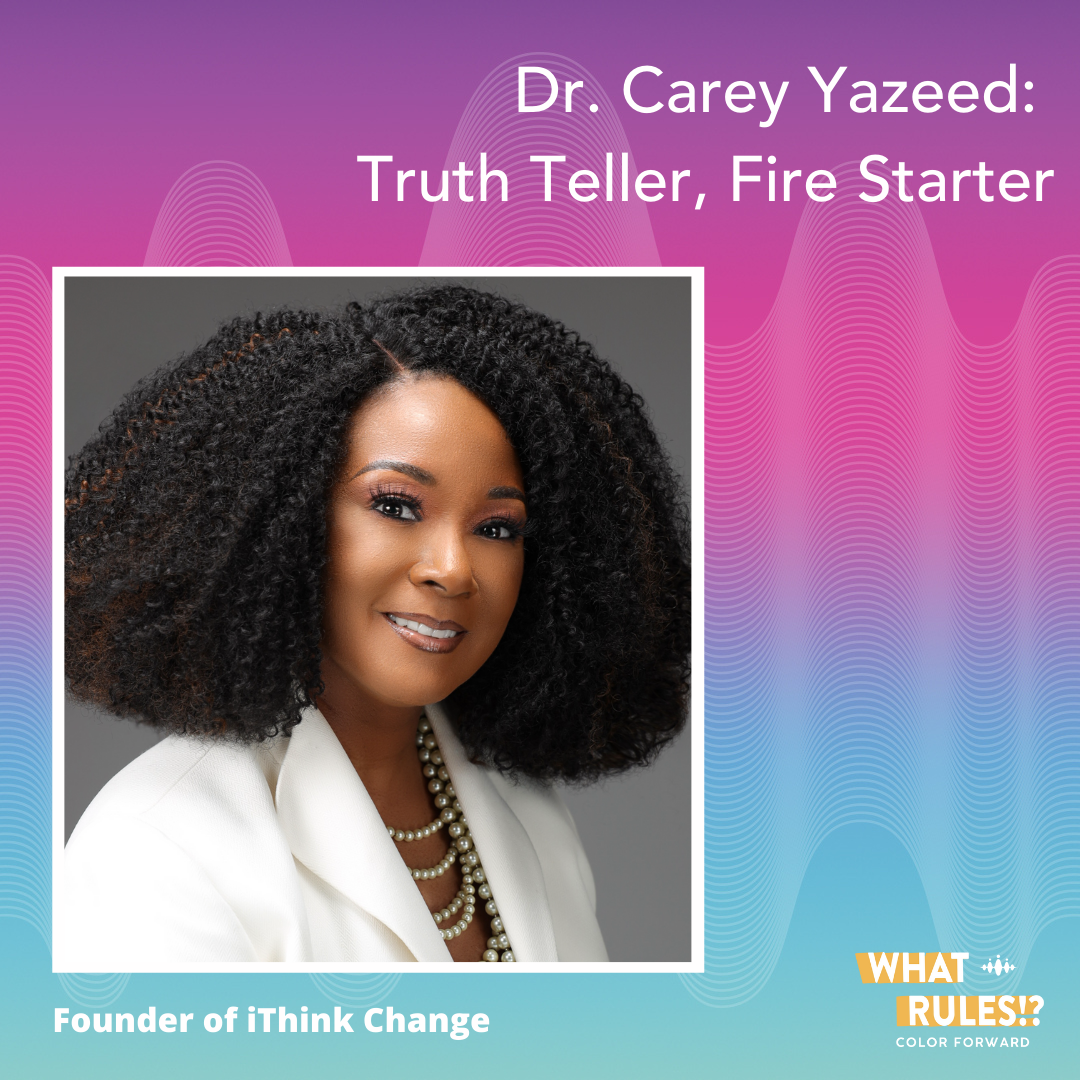
What happens when the story being told is not your own? When the advice being given is not only unhelpful but dangerous? Join Rosa, Alisa, and Dr. Merary this week as they discuss the issue of advice that misses the mark on intersectionality with Dr. Carey Yazeed.
Dr. Carey Yazeed’s viral blog post, “The Dangers of Courage Culture and Why Brene Brown Isn’t For Black Folk”, discussed the issue of why Brene Brown’s push toward vulnerability is not safe advice for everyone.
Alisa Manjarrez:
One thing that we should talk about today is glasses because Rosa isn’t wearing her glasses today, but Dr. Carey has some fabulous blue and white textured or patterned glasses and it puts the rest of us to shame. And every time I’ve seen you you have a different pair.
Dr. Carey Yazeed:
This is true. I have six pairs.
Alisa Manjarrez:
Oh, where do you get them?
Dr. Carey Yazeed:
I order them online. They were pandemic purchases.
Rosa Santos:
I love it.
Dr. Carey Yazeed:
You’re sitting in the house, it was just like, well, let me update my eyewear.
Rosa Santos:
Do you need them? Or is just pure aesthetics?
Dr. Carey Yazeed:
They’re all prescription. Yes. I’m blind as a bat. So yeah, I’m just going to look good while I can’t see, so.
Rosa Santos:
That’s right. Don’t do what I did today. There was somebody who came to my house to actually show something to me and they were bringing papers. And we were all masked up and everything and we were in the living room and this two super well put together women and they’re showing me these papers and these papers and these papers. And I say, “Grace, I say, thank you so very much. I’ll come back to you next week when I have my glasses and I can see what you just presented.”
Dr. Carey Yazeed:
I totally understand.
Rosa Santos:
And they were looking at me oh, they were still into it and I said, “Do I tell them I can’t see what they’re saying?” So I let them go.
Dr. Carey Yazeed:
Been there, done that. They are prescription, so if I take them off, we’re in trouble.
Alisa Manjarrez:
First, I want to welcome everyone to the What Rules!? Podcast where we outsmart the game to advance our career. We’re here highlighting multicultural women, women of color, helping them to advance in the workplace. My name is Alisa Manjarrez, I’m an executive coach and a vision producer at the Happy Cactus. And why don’t I hand it over to Merary? Who are you?
Dr. Merary Simeon:
Hello everybody. Dr. Merary Simeon. And I am an activator of talent, creating a world where multicultural women in position of power is the norm.
Alisa Manjarrez:
Awesome. Rosa.
Rosa Santos:
I subscribe to that, but my new title, my newer title that I just loved, that somebody gave me to me the other day is chief possibility officer. So that’s how I am. There you go.
Alisa Manjarrez:
Now, we have a special guest today, Dr. Carey Yazeed. For you, Dr. Carey, I would love to hear not just your title, but tell us a little bit about the many hats that you wear as a person.
Dr. Carey Yazeed:
Today, my new title became, I am the fire starter, I’m a troublemaker in a good way. And I was like, oh, okay, thank you, that’s a new one. Many hats that I wear. Wow. Diversity professional, adjunct professor, mom of two young adult sons, and then mom of three furry friends that we had to lock out the room for this. So they’re not happy with me. Activist, soap maker and an avid crock pot cooker.
Dr. Merary Simeon:
Wow, we could have a whole podcast on that.
Rosa Santos:
Yes. Soap maker, yes. We can have a whole other episode on that. I want to it.
Dr. Carey Yazeed:
Yes.
Alisa Manjarrez:
I don’t know. Okay. I think that, you say crock pot and I feel hungry first of all, but what’s your crock pot specialty?
Rosa Santos:
It’s a good thing, Alisa you didn’t say, what is that? Because I’ve heard people saying something like, what, excuse me. You can tell they’re from another generation.
Dr. Carey Yazeed:
I’ve done beefs stew but I’ve actually did an entire pot roast at once.
Alisa Manjarrez:
And Dr. Carey, where are you from?
Dr. Carey Yazeed:
South Louisiana. So I’m 60 miles outside of New Orleans and 30 miles from the State Capitol of Louisiana, which is Baton Rouge.
Alisa Manjarrez:
How cool? I just get excited hearing your voice because you’re this, I mean, people don’t know, and I didn’t find this out until you told me when we first met that you’re very small in stature, but you have this ginormous trouble making fire starting personality.
Dr. Carey Yazeed:
Yes. I don’t know. I think people think I’m this tall, model built woman and I’m actually short, 5’2 and a half, so you have to give me my half. And I’m not a big person. So when people meet me, that’s just, what I get it’s like, you’re short.
Rosa Santos:
That’s lovely. When people tell you, thank you.
Dr. Carey Yazeed:
Yeah. It’s just, what am I supposed to say? You were expecting what? It’s me, just not tall.
Rosa Santos:
It’s super interesting how the expectations that others have over of us, the ideas that they form of ourselves. And then it’s a bit like a big of a jot if you don’t conform to the idea that they’ve made up of yourself in their mind. That happens so often.
Alisa Manjarrez:
We’re all nodding our heads.
Dr. Carey Yazeed:
Yes. I have to agree with that. Yes.
Alisa Manjarrez:
All right. Speaking of fire starters, how this started was, a Twitter conversation, a long Twitter thread that Dr. Carey wrote about Brené Brown and that spurred on a blog post called the dangers of courage culture and why Brené Brown isn’t for Black folk. She writes this article, it blows up. Rosa sends it to me and Merary and we’re like, yes, why aren’t more people talking about this? Fast forward to today, Dr. Carey, you are here, living and breathing so we can hear it straight from you. Welcome again.
Dr. Carey Yazeed:
Thank you. And to give credit where it’s due, the Twitter thread was not mine. I was just an avid participant. And then the starter moved out and I was left in this thread that I didn’t start. And I was like, this seems like a conversation we need to continue. And so I just took my thoughts and put them in a blog post that I thought no one would read.
Dr. Merary Simeon:
Well, we were so intrigued because one of the things, I think it was the episode before we were talking about it, we were having a conversation. We were like, that’s the whole point that we’ve been talking about on our podcast is that the rules that society or other women have put out there do not apply to women of color. So when we read your article we were like, yes that’s it, that’s what we’ve been trying to say.
Dr. Carey Yazeed:
I definitely agree. It’s just that everyone has their own perspective. And so when I wrote the article, I was pleasantly surprised that it was well received. And a lot of people had the same reaction, like that’s why it didn’t resonate with me. And a lot of women were blaming themselves, that it was just like, I felt that I’m trying to apply these things that she’s writing about and it’s just not working for me, so I must be a bad person, I must be doing something wrong. And these were women of color not taking into consideration, well, boo she wasn’t writing about you, that’s the bottom line. It’s not going to apply to your life, your situation, who you are as a woman, because she wasn’t writing for you. She was writing for someone totally different.
Dr. Carey Yazeed:
And I just revealed that mystic, I guess, that had been hanging over their heads and took away that shame I think for some people. That I don’t think Brené Brown realizes that some of her work has created that for some women of color because they couldn’t find themselves in her work or they couldn’t make her work work for them.
Rosa Santos:
But it is so powerful what you’re saying. And I think that’s exactly the essence of why we started this forum and this podcast, because a lot of those writings, however you call those writings, really have not applied for women of color. And unpacking what that means and really taking it to a completely different experience, which then when you start having this conversations, you realize there’s more of you who actually are facing the same kind of challenges and are trying to break through molds that for some it’s like, I don’t know what you’re talking about. It’s just, this are the three things that you have to do. And then you try to do them, it’s like, well, they’re not working for me because I am not being listened to. And even opening that up, even for colleagues and friends of ours, whose experiences have been so different.
Rosa Santos:
And it was nice to see in your article and then in your comments, how some women, this was a true awakening for them as well, in terms of looking from a different glass or lens that they hadn’t even considered before. Because of course, you are my friend, I see you as my friend and we’re going through all this at the same time and you go, mm-mm, let me open up here a little bit and let me just show you what happens and what that hat wearer is. And you did such a good job in really distilling it in such good terms. And also, and I love because you said the Kool-Aid right, we need Kool-Aid, so people gravitate to something that’s like, okay, I got it. And then that disappointment that you describe is real, it really is real
Dr. Carey Yazeed:
It’s very real. And I didn’t think it was going to go viral. So like I said, I wrote it then was just like, only three people are probably going to read this because you’re talking about Brené Brown girlfriends, so this is not going to go anywhere, but I’m going to put it out in the universe. So I hit publish, I published it on LinkedIn, but I think for a lot of women, it was seeing other women in the comments agreeing and sharing their frustrations, that it wasn’t just me saying it, but they were being validated by each other. And I was just like, whoa, didn’t realize I was going to create that type of effect too. But I’m glad that I went ahead and did this. On one hand, I’m very happy with the results that it is getting as far as women really starting to think outside the box, having these conversations of what works for them culturally, what doesn’t work for them and to be okay with that. But I did receive a lot to backlash too.
Alisa Manjarrez:
Let me read what you wrote on LinkedIn to introduce the article. You said, “White middle class women are protected and allowed to be courageous while Black and Brown women are not afforded that same space, cover and protection.”
Dr. Merary Simeon:
That’s pretty powerful sentence right there. I read your article and right now, as Alisa read the title, I still got the chills and that because of the words covered and protected. I think there’s so many of us that can relate to walking in a room and feeling almost naked, like you’re not covered and you’re not protected. That resonated with me. Number one, that made me read their article, but then as Alisa said it right now, I got the chills again. And I’m just like, wow. And that’s because so many of us experience this on a daily basis.
Dr. Carey Yazeed:
You’ve been feeling like this your entire life. So for us, it’s different because this is who we are, when we were born, parents started to prepare us for what the world was going to be like, the challenges that we would face. We were groomed, but we were groomed to keep your armor up, when it gets real touchy, you don’t lean in you lean out, you don’t get confrontational because when you get confrontational, you’re viewed a lot different.
Rosa Santos:
You get taken out, let’s just keep it real.
Dr. Carey Yazeed:
If I take off my armor and I go in and I say, I’m going to be vulnerable and I’m going to be courageous and I’m at work, I am going to immediately become a threat. I’m going to be seen as assertive, I’m going to be the angry Black woman. I am going to be escorted to HR, given a pink slip and a severance package and then escorted out the door. And so that’s not me doing research on veterans because as I tell people, if you go down a Brené Brown rabbit hole, her background is veterans. So that’s where she says all of her research is on vulnerability and courageousness and courage that she talks to veterans. And I’m just like, well, okay, first of all, Cassandra, because then I start calling you by your real name when you’re getting it wrong, you’re telling us to be vulnerable and courageous like somebody who’s went out there to war, which is totally different than our lived experiences. So I think you need to also let people know who were your research participants and frame it correctly. It doesn’t apply to everyone.
Dr. Carey Yazeed:
It’s not a one size fits all because if a minority woman does what you’re saying, we should do, we’re going to be unemployed within two hours, max, we are not going to have a job, but we’re going to be written up. But the dynamics are going to change. We could possibly go to jail if we’re doing this in public, it doesn’t work for us, but you’re encouraging us without a warning label, so does speak. And that bothered me to so many degrees, it bothered me because I’m like, you’re taking what our parents have covered us with to help us get through life and you’re telling women, no, no, no, you take that off, you’re going to be okay. And it’s just like, no, we can’t afford to do what you have been afforded to do because of the color of our skin.
Rosa Santos:
And it’s so dangerous to advise based on your experience because you cannot relate, you can never truly relate a hundred percent to anyone who’s in front of you because you have not walked in their shoes. And especially when we are now, that we feel that we can have these conversations, because it wasn’t until very recently that we could even have these conversations. And when we even decided to put on the podcast, the discussions that we had to say, is this the right time? Can we have these conversations? It took us a while to even formulate what this was because what might work for me may not work for you. And sometimes this blanket sometimes a statement or like life is such a La La Land, but it’s like, why is it La La? Well guess what? It’s not a La La land for me. And even if I apply those principles, I’m not sure La La land will be in front of me. Maybe I can get my own nuggets and make mine, but that doesn’t mean that it’s going to work for me.
Rosa Santos:
So what you say, it so resonates with everyone of us here, but also those who we know listen to us and have engaged in this larger conversation with ourselves. And it is dangerous. It is dangerous to tell somebody else what to do when you’re not taking the risk. It’s very freeing because go do it, yeah, you’re not taking that risk and you won’t be held accountable for that risk.
Dr. Carey Yazeed:
Now that’s a good point. You might offer this advice, but you’re not the one taking the risk. And something that I want to revisit too, is about us not being protected and covered and that’s something that we don’t talk about is that we will go into situations and we know we’re open, we know that we’re vulnerable. And our automatic instinct is to, okay, I need to armor up, suit up, let me put my guard up, I know what I’m about to go into. Some of us are preparing in the car before we enter our job because you know when you go in there that there may be some attacks on you that particular day and so mentally you want to be ready. But when we look at what Brené Brown is telling people and she’s telling you to take off your armor, well then you’re just getting out the car, you’re not mentally prepared, then you’re attacked.
Dr. Carey Yazeed:
Well, then you really do start crying and now the person who got you to take your armor down is saying, oh, well, hold up now, I’m not comfortable with all these emotions girlfriend. You’re making me feel a little uncomfortable, ooh. Yeah. Well, you’re using some cuss words now, so that’s really assertive. And your cuss words might be, I’m just frustrated and you’re not cussing at her, you’re just cussing, but you’re all over the place. And so let’s say, if it was one of us and we’re there, we just like, girl, calm down, it’s not that serious. Well, your counterpart might not see it that way and all of a sudden you’ve offended her. And we have States like Florida that is trying to pass laws about White comfort and if people feel uncomfortable, we are talking legal issues.
Dr. Carey Yazeed:
So her ideology is going to get a lot of people messed up if they don’t shift their perspective and say, well, maybe I can use this inside of the comfort of my house. But when I go outside, I might need to look at Bell Hooks. I need to go pull some other people and use what they’re telling me to deal with the world. I just think we have to start putting stuff in perspective and understanding that just because something is put in front of us by the media doesn’t mean that it’s always good.
Dr. Merary Simeon:
And I love that because I think that’s one of the things that we can say, “Hey, we got to figure out what works best for ourselves.” Because I know when I walk in the room, I’m automatically thinking, okay, who can I trust? What can I say? What can I not say? And to your point, is always looking around to say, who’s actually has my back to say, “Hey, tone it down because that’s not going to be perceived right in this environment.” It’s not like having a conversation with us here where okay, you might be upset about something, but all right, let it out and let’s just talk about it versus not having that coverage where automatically it’s assuming that you’re being negative or assuming that you’re too passionate about the point or even assuming that you are just angry.
Dr. Merary Simeon:
So those are the things that, I mean, at least I tell people is you got to do what works for you. But I would also like to understand a little bit of what are some of the things that we can do besides leaving our armor on? Because at the end of the day, when we show up, we still got to do something. It can’t be the same way that Brene’s saying, but we got to do something otherwise we run the risk of staying muted in a place where our voice needs to be heard.
Dr. Carey Yazeed:
And I think for us showing up, it does look different for us. Again, I’m 52, I’ve been in the workforce for over 30 years. I will say this, my armor is always on and sometimes I’m just like, that it is coming and it’s bouncing off of the armor because I’m really just like, whatever girl, you’re tripping on a whole new level. I’m not letting them bother me because that’s my personality. But when you can pierce through my armor and now I’m starting to have some reactions, we have a problem. And so then that problem for me, looks like I begin to document what is taking place because if I’m feeling uncomfortable, something that’s causing that. And I’m not crazy.
Dr. Carey Yazeed:
I think a lot of minority women, when we start to feel uncomfortable in a workspace, we think it’s just us. And so we tend to ignore it. And then all of a sudden you’re sitting in HR and you’re like, well, when was there a problem? What happened? I didn’t realize this. And the red flags were there. You just ignored them. I’m like, don’t ignore them, document. If you don’t do anything else, you have your little journal, you have a Google doc, you document. And it’s okay to speak up, but it’s knowing how to speak up, it’s knowing when to speak up, it’s knowing who to speak up to. So then that means you need to be strategic in how you approach the situation. I myself will sit down with my tribe and a glass wine and get all of the what’s going to be assertive. I get that out at home with the girlfriends.
Rosa Santos:
I love that. We relate quite a bit.
Dr. Carey Yazeed:
So when I go in, well, I’ve gotten all the explicit sound, so now you’re going to get the calm, cool version, but you’re also getting the documented version. So I’m going in with my documentation. I’m not making this up, this is what’s going on. How are we going to resolve this issue? I’m a former social worker and so with that comes documenting. I do it when I find myself in those uncomfortable work situations, and that documentation allowed me to approach that situation from a different angle. It allowed me to be strategic, it allowed me to get my thoughts together, reading through it also allowed me to see that I wasn’t making it up, like wow, all of this happened? Oh girl, you’re good.
Dr. Carey Yazeed:
And I think talking it through with someone before you go in, because our courage and vulnerability is going to look different and you have to be prepared to walk away and know what heel you’re going to die on and what heel you’re just going to walk away and be like, it wasn’t worth it. And that’s what has kept me sane. Because I have been a person to dig in their heels and say, I’m going to fight and then I’m exhausted, I’m stressed out, I have anxiety, my blood pressure’s up. But then sometimes I just walk away and I’m just like, okay, let them figure it out. I didn’t have to learn a lesson from that, they did.
Rosa Santos:
You just said something really important though that I want to hone in, which is it wasn’t you, it’s their learning, it really in that engagement, it is their learning. In that process what you’re trying to do is offer them, I always talk in terms of distinctions, that they didn’t have before and that they couldn’t necessarily compartmentalize to even address or put a language on it. But I remember someone telling me, Rosa, you have to take the emotion and put it on the table, put it aside. It’s helped me throughout the years, not to take things personally in the heat of the moment, you go up and you have to come down really quickly and you don’t want to stay there because it’s going to ruin your day, your weekend. And why? What’s the point? It wasn’t you.
Alisa Manjarrez:
And there are layers of what’s happening too because when someone is on the other side and they’re learning it’s not comfortable and it’s new. And so they’re experiencing all these things that it’s not your responsibility to manage, but I think it’s important to be aware of, so that you don’t take all of that personally. Because even if they want to agree with you at the end, if they don’t understand what’s happening, it’s a whole another world going on inside that person’s head.
Dr. Carey Yazeed:
And I agree. From the article, those who disagreed with me, I did have some that were just like, well I’m not understanding or I’m feeling a certain kind of way and I need you to help me to unpack that. And I was just like, sir, it was the article, I’m not getting paid to help you process your feelings and whatever emotions you’re going through or however you’re even feeling towards me. That’s not my responsibility, I’m not going to allow you to make it my responsibility. I had someone say, “Well, you came on a public forum, so you need to be held accountable.” And I said, “Well, sir, do you hold Brené Brown accountable for half the stuff that she says, are you getting her on social media and saying, oh, well you need to explain X, Y, and Z to me? And I said, I’m not doing this with you. And I said, and you can get mad and I don’t care. Go pay your therapist, that’s not my problem.”
Dr. Carey Yazeed:
But people try and put you in this box and make it your responsibility. And my think is I can get you to a certain point, I’m having the discussion, but when you’re projecting your feelings onto me and I don’t know you, I never met you, it was the article that made you feel a certain way. So you need to deal with that not me. There’s two different things. And I had to take a step back because emotionally it started to become a lot, a whole lot. And I was like, okay, I need to take a break, I need to cut the phone off, breathe and then I came back and I said, oh God, they’re still here. I didn’t realize that when you go viral viral, it doesn’t go away for a long, long time.
Rosa Santos:
Well, we feel very privileged that you’re still talking about it with us. So thank you.
Dr. Carey Yazeed:
Yes. And I don’t mind talking about it in unfortunately safe spaces, but I had to realize all spaces were not safe spaces. I was asked to be on one podcast and five minutes before we went on, they muted everything and they were like, you can’t say anything negative about Brené Brown. Well, I was just, well, why am I here? If we’re not going to have an honest discussion about this article and her work, why am I here? I was there as a show piece. And it made me so angry because it was a space that I thought we were going to have a safe conversation. Over a hundred people had signed up to be there and they were just like, yeah, we’re not taking that direction. But that was what they had marketed.
Rosa Santos:
Yeah. But it goes back to what you said before, it really takes courage though.
Dr. Carey Yazeed:
This is that good trouble that I like to get into with good people. I commend you all. When you sent me the message to be on and I was just like, oh, they’re not one of those shows, okay, then I’m game. And that was just, the email, then when we had the conversation, I was really like, oh yeah, I’m in, I’m in, you don’t have to sell me.
Rosa Santos:
Can I tell you, we considered the name, good trouble for the podcast. And I said, “Wow, we cannot take it away from John Lewis, so we won’t use it.” But we did consider it, as a name.
Dr. Carey Yazeed:
Well, y’all are getting into some good trouble. And so everyone is not going to understand what you do and that’s okay. You keep doing it anyway, because those who need to hear these stories, those who need to hear from you, they’re going to show up week after week. You are their armor to get through the week.
Rosa Santos:
And it’s funny, because I was going to take it there. And one that actually encourages the armor, but it’s an armor that you choose and every day could be a different armor that you choose to put on. And I think that there’s a lot of power because then you’re making a conscious choice in terms of how you decide to show up at a given moment in time. And being so present and so real to then make those choices is what is going to make you powerful as a human being as a whole. And there needs to be that sense of, to your point about being strategic, but it’s also about being who you want to be and keeping to yourself what you want to keep to yourself.
Dr. Carey Yazeed:
Well, it’s about being true to who you are. And so that means that we’re all different and we’re all unique. Everybody has a different kryptonite, but also everyone has a different superpower and what works for one person may not work for another person. And so that’s why I’m very honest. And I tell people if Brené Brown works for you, that’s great. But usually the people that I’m hearing say that she works for them, it is not working for them in unsafe spaces like the workplace. She’s encouraged a lot of people to go to therapy but again, I’m like, that’s not what we’re talking about either. And so putting it in this proper context and when are you being strong? What situations? What situations require you to have your armor on and to keep it on and to know that I can’t be vulnerable right now. And the most courage I can show is to keep this armor on and put some headgear on as I go through the day, that’s it, that’s me being courageous, and being okay with that.
Alisa Manjarrez:
As we close out, what advice would you give to our listeners who are listening and like, yes oh my gosh, she’s saying everything that I’ve been feeling. What would you want to leave them with?
Dr. Carey Yazeed:
My biggest piece of advice is don’t doubt yourself. If it doesn’t work, take a step back. And not just Brené Brown, anyone that you’re reading their work self-help book and you’re trying to make it fit and it’s not working for your situation, put it down. Because that is usually an indicator that that person and what they’re trying to teach you, they’re not the perfect fit for you. And there’s nothing wrong with you, you probably just need to go to another source and see what else is out there. So don’t doubt what you’re feeling, don’t beat yourself up and just know that everyone is different. So the way that you show up every day is not going to be the same way that I show up every day, what matters is that we show up and we look good when we do it. So making sure you’re looking fabulous when you’re showing up each and every day.
Dr. Carey Yazeed:
But I see just so many people beating themselves up behind these authors and, well, it’s not working for me, because they’re not talking to you, they just didn’t put the disclaimer at the beginning of the book. That’s all that means, move on, there’s nothing wrong with you. Go find someone else and we’re all going to be okay. And I think being okay with telling yourself that. That would be my parting words to them.
Alisa Manjarrez:
Want to know how breaking the rules can help you level up your career game? Search “What Rules Podcast” on any social media platform and join our members-only group on LinkedIn, where we discuss rule-breaking strategies for multicultural women. What Rules is a production of Color Forward. The show is produced by me, Alisa Manjarrez, with editing and fabulous sound design by Mathr de Leon. Visit colorforward.com for more stories, events, and of course, all the episodes of What Rules.
Alisa Manjarrez:
I need to create an audiogram of you saying, “If you’re single and you need to mingle go to Home Depot.”
Rosa Santos:
You really do.
Meet the Hosts
Archives
- February 2023
- April 2022
- March 2022
- February 2022
- January 2022
- December 2021
- November 2021
- October 2021
- September 2021
- August 2021
- July 2021
- June 2021
- May 2021
- April 2021
- March 2021
- February 2021
- December 2020
- November 2020
- October 2020
- September 2020
- August 2020
- July 2020
- May 2020
- April 2020
- March 2020
- February 2020
Copyright © 2026 What Rules!? Podcast. All Rights Reserved. Powered by Podcast Theme