
46. Learning to Win as an Outsider
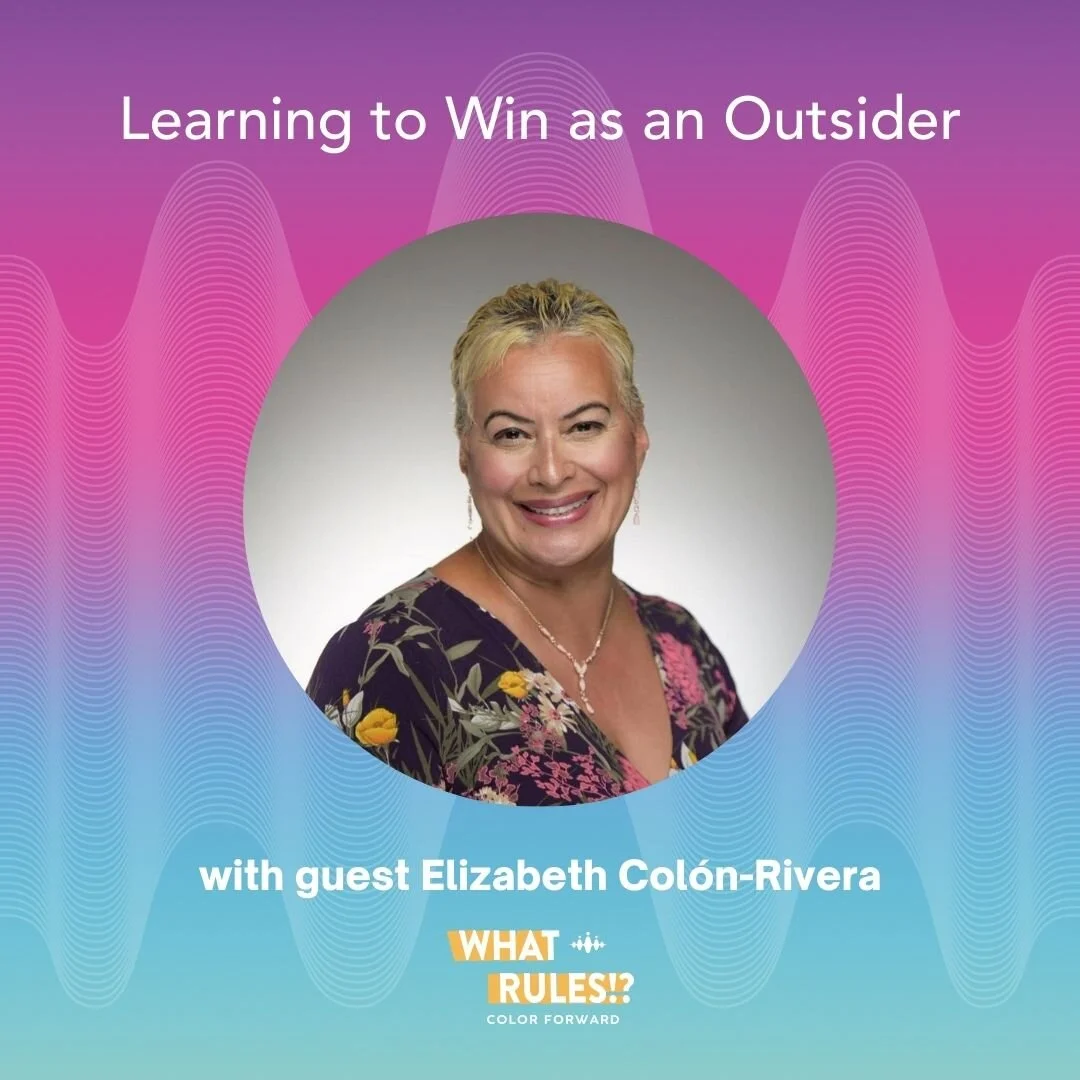
Today we’re talking about getting comfortable in our own skin and overcoming self-doubt. Being an outsider doesn’t mean you don’t belong!
Join Alisa, Rosa, and Dr. Merary as they chat with Elizabeth Colón-Rivera, President & CEO of Metaphrasis Language & Cultural Solutions LLC, about how to own your reality by reframing it in a powerful way. Or as she puts it, “You don’t have to compete with anyone. Not even yourself. You just have to be you.”
Episode Transcript
Dr. Merary Simeon: (00:00)
So this weekend I am planning to go out for actually my first five mile run in a while. Now Alisa I know you and I had talked about when you do things like that you’re always like, “I hate this”.
Alisa Manjarrez: (00:14)
Yes. That’s my inner dialogue. And I don’t care if it ever changes.
Dr. Merary Simeon: (00:21)
And I’m talking about it because I just started running again. I took a long break and decided to just chill and not do any exercise. And I started running again, I was thinking about you yesterday Alisa because it’s hot as hell in Texas. And I was on mile two and I was doing three and I’m saying, “You got this, you could do it.” and I kept hearing you in my head, “I hate this. I hate this.”
Alisa Manjarrez: (00:45)
Oh no, I’m so sorry.
Dr. Merary Simeon: (00:51)
No, no. And I’m like, I have to tell Alisa about that. Like what is the one thing that you want to do and you want to love it but it’s just hard. It’s hard, so I’m trying to convince myself. I don’t know if any of you, is there something that you really want to get good at or you want to do because you know it’s good for you but it’s just hard?
Alisa Manjarrez: (01:08)
Everything.
Rosa Santos: (01:13)
I don’t know if there’s anything that comes easy to me, you guys. I don’t think there is.
Alisa Manjarrez: (01:18)
What? That cannot be true.
Dr. Merary Simeon: (01:20)
I think cooking does. I think cooking does.
Rosa Santos: (01:21)
Oh yeah. Yeah, cooking does. Yeah.
Dr. Merary Simeon: (01:24)
And if it doesn’t, you sure do a good job about it.
Alisa Manjarrez: (01:27)
Yeah. We had a whole call where Rosa was like braiding pretzels.
Rosa Santos: (01:31)
Oh no.
Elizabeth Colón-Rivera: (01:33)
Oh that’s awesome.
Alisa Manjarrez: (01:33)
While we’re having a strategy call.
Rosa Santos: (01:36)
Yes.
Elizabeth Colón-Rivera: (01:37)
Multitasker.
Rosa Santos: (01:40)
So welcome to What Rules podcast where we outsmart the game to advance our career. I’m Dr. Merary Simeon, HR executive and motivational speaker. With me today are my co-host, Alisa Manjarrez, a vision producer and executive coach at the Happy Cactus, and Rosa Santos, a talent management executive and leadership expert. And today we’re talking about getting comfortable in our own skin and overcoming self-doubt. Our guest today is a successful CEO, speaker, and author who certainly knows about this journey.
Elizabeth Colón-Rivera: (02:10)
Well, I’m Elizabeth Colon, and I am the president of Metaphrasis Language and Cultural Solutions, an interpreting and translation company located here in Chicago. And we partner up with the businesses to provide high quality on-site interpreter services, as well as document translations. I’ve been in business since 2007 and it’s been a great journey trying to help people who struggle with communication in English and to be able to provide them with access to someone who can kind of do it through the channels, right? Be their voice. It’s been an amazing journey for me.
Alisa Manjarrez: (02:43)
I love that your career is built on helping other people have a voice through something as basic as communication. It’s something we all take for granted.
Elizabeth Colón-Rivera: (02:53)
I have parents who don’t speak English and I’m sure that many of us here probably experienced the same thing. And I also have two sisters who are from the deaf community. So I saw that, a lot of that growing up, right? Kind of disparities, closed out from the world. And you’re right, it’s simple. It’s language, right? It’s communication. But when you can’t hear, you’re completely locked out. When you don’t understand, you’re also locked out. So it was very eye-opening for me as a little girl, having to travel with my parents to translate for them, and then seeing my sister struggle in school. And I found my passion to want to do this when I actually started working in a hospital, I went into healthcare and I saw the same thing again. And I was like, oh my god, this is a repeat of what I went through when I was a little girl. And I was like, no, I’m going to fix this problem.
Alisa Manjarrez: (03:38)
Wow. Talk about having an understanding of not feeling like you belong or not feeling comfortable.
Rosa Santos: (03:46)
It’s funny as I look back on all the changes that I’ve made in my career, especially within company or outside to go to another company, I’ve kind of never felt like an outsider. I felt, probably everybody else told me I was an outsider, but I actually felt that my mandate was there to go and change things. Right? And to move things forward. But there was one time and the reason why it was so strange for me, it’s because I was moving into a new company and into a new country, back to Spain. I was so excited about this. And I thought I’ve got this because I know everything about Spain. And these are my people. And I get to Madrid, I get to this company, and I’ve never felt more like an outsider in that moment. And more specifically, I’ve never felt so uncapable of making friends. I felt ever so lonely in that massive town or city that Madrid is.
Rosa Santos: (04:58)
And I felt, I truly felt that I did not belong. Even though I had an idea and I felt that I was going to be, these are my people, this is my country, this is where I was born. I speak the language. I understand the customs. I think I was going into it with a very specific idea or mindset of what things were going to be like, and it didn’t turn out to be that way. So I don’t know whether it was, when you think about that, I felt as an outsider. I don’t know. I felt an outsider because the idea of what it was to belong was different. And it didn’t turn out to be that way.
Alisa Manjarrez: (05:39)
So what happened? I mean, you left, I guess.
Rosa Santos: (05:41)
Well, what happened, I moved to the US. I came back to the US.
Alisa Manjarrez: (05:46)
Look, I’m going to another country.
Elizabeth Colón-Rivera: (05:48)
I’m leaving, bye.
Dr. Merary Simeon: (05:51)
Forget this. Forget my people.
Rosa Santos: (05:52)
Yeah, no, it was hard. It was hard. It was disappointing. It was, at the core, I think for me, was again, thinking about my culture. I don’t know, really, truly trying to, as I said, belong and make friends and be part of the community there. And it just did not, I was not able to. The effort was too big to feel included. Let’s put it that way. And that’s why I always felt, even at work, I always felt that people forgot that I was new. I think everybody thought that because I was, spoke the language and had been born there, et cetera, that I had my own network of folks and that I had my life sorted and it wasn’t the case. So it was a very lonely time in my life, I have to say. I was very miserable.
Dr. Merary Simeon: (06:48)
I don’t remember if I talked about this before, but from a personal perspective, I remember, I have little kids, I have a five year old and in daycare they do a lot of stuff, right? That they invite the parents all the time. And in my job, I travel probably more than 50% of the time. So I wouldn’t always make the little mom and donuts, or the little Valentine’s whatever cupcakes. And I remember being excited because I was in town one time and they had one of these little events and going there and the mothers that were there made me feel like an outsider, made me feel like I didn’t belong, including one of them said, “Oh, are you the mom to one of the children, because we never see you here.” Right? Now to me that was just so uncalled for. But it really made me feel like, why am I not a good mother? Right? And they automatically excluded me instead of saying, wow, she’s probably taking the time to be here with her child. So you don’t have to go to another country to sometimes feel like an outsider.
Rosa Santos: (08:00)
I know. Yeah. But see, for that Merary, for me, because I knew that when [Laura 00:08:05] was in school and he was little, I just up front, I just said, I had no problem with going to the supermarket, getting all the cupcakes already made, and put the label. It’s like, I didn’t make them.
Dr. Merary Simeon: (08:22)
Smart.
Rosa Santos: (08:22)
Store bought. So everybody knows. Yeah, no, I didn’t have any problem with that. For me it was more, I think what made it so unsufferable, is it’s again, because I think it was something that I worked really hard at and I thought that it was going to be easy. I thought it was going to be easy because I thought I got it.
Alisa Manjarrez: (08:49)
That’s what makes it worse because you’re like, I don’t have to worry. And then you’re kind of blindsided.
Dr. Merary Simeon: (08:54)
Yeah.
Rosa Santos: (08:55)
Exactly.
Dr. Merary Simeon: (08:55)
How hard is it to just show up by your kids’ thing, right? I’m like, hey mom’s here. Who are you?
Rosa Santos: (09:04)
It’s true.
Elizabeth Colón-Rivera: (09:11)
I remember watching my two sisters, right? They wouldn’t interact with us because they couldn’t hear us and we couldn’t hear them. And we didn’t understand that we didn’t have to yell, because they were reading lips. We had to learn and we learned how to just speak to them normally, looking at them straight in the eyes, so that they can watch our lips and then be able to respond, right? And then today in society, as adults, they’re both married and have kids, but you can see the difference between their behavior and ours. And it is because they got cheated. No one recognized that they were hard of hearing. Instead, they kept on saying that they didn’t want to be participatory in class or they didn’t want to raise their hands. And no one took initiative to say, listen, you know what? There may be a problem here. And so they went up to about eighth grade, not being able to participate in school until one teacher finally recognized that there was something wrong. And then they took one of my sisters and put her in another school that actually specialized and offered ASL. And the other one, she went all through high school without any help.
Rosa Santos: (10:12)
Wow. Talk about resilience as well. Tell us a little bit about resiliency and how that’s helped you to be where you are at right now and what you’re doing, because you’re definitely impacting the community in an incredible way.
Elizabeth Colón-Rivera: (10:25)
Resilience. Well, I think that came in last year, oh my god, with COVID. I’m an entrepreneur, right?And I think in the face of adversity, regardless of what that looks like for, you always have to figure out what’s the next thing for you. Because otherwise you throw in the hat and you walk away and then you question, is it my fault? Who do I blame? In my situation last year I had eight employees, eight full-time employees, 200 plus interpreters in Chicago. And within 24 hours, I lost my entire business.
Alisa Manjarrez: (10:57)
Oh my goodness.
Elizabeth Colón-Rivera: (10:58)
Everything went into a shelter in place. And of course, fear sets in and I’m like, oh my god. I kept on getting one call after another, cancel, cancel, cancel, because we couldn’t go into the facilities anymore. I was scared. And then I just kind of sat with it. I’m like, what am I going to do, right? I had to let go of my entire staff. And I was like, well, when I opened my business, I did it by myself, so why can’t I do it again by myself, right? And I was like, I got this. And then the resiliency came in. I’m like, I’m going to do this all over again.
Elizabeth Colón-Rivera: (11:28)
And so I looked at my entire business, like I had just opened my doors and I don’t have really any business. And so I’m going to work on my processes and my policies, and sort of that’s what I did. And then I got re-energized and found that grit and slowly, when they started to open, I hired one person and I brought the other one, so now I’m up to three.
Alisa Manjarrez: (11:51)
Congratulations. That’s huge.
Rosa Santos: (11:53)
Yes.
Elizabeth Colón-Rivera: (11:54)
And my team were amazing. One said, I’ll volunteer and do your billing,” because I completely forgot how to do that. And then the other one says, “Well, I’ll help answering phones,” right? I learned that through that journey of everything crashing for all of us in the world, we had to remain resilient. And those who really got scared and were fearful of the outcome, were the ones that I think and that up paying a bigger price at the end.
Rosa Santos: (12:13)
Elizabeth, where do you think that comes? I mean your ability to continue to remain optimistic and pull off of that, what I call the resiliency muscle, where do you think it comes from?
Elizabeth Colón-Rivera: (12:26)
My husband asked me one morning, he’s like, “When are you going to throw in the hat?” I was like, “To COVID?” I’m like, no, COVID’s not winning. If I close, it’s going to be for any other reason than a pandemic, right? And it comes from my journey as a child living in poverty, right? A single mother of six, being in the line in the food pantry, asking people for help, not dreaming big as a little girl, not knowing what could be for me. And one day I just, I quit my job and I only had $500 in the bank. And I said, “I’m going to start my business and I’m going to jump into it with faith.” And I did it, right? And I grew really fast. And for me to just let it all go like that wasn’t an option for me.
Rosa Santos: (13:10)
Right.
Elizabeth Colón-Rivera: (13:11)
And because I saw the struggles that we went through growing up and I worked so hard to create the business that I had, giving employment to other people, serving the limited English proficient, the immigrants, the refugees, people from our community. I owed it to them to just stay there and work through it. And I did Zooms with my interpreters and I listen of them, because we were all suffering. I’m like, let’s just hop on a call and talk about it. They said no other company had done that. Because I care that much about them, right? They were part of my family. I’m not successful because of me, right? It’s not me. It’s them who every day they go out there and they represent my company. So I felt like when I had to let go my entire team and my interpreters didn’t have any work, that burden fell on me too. I think your upbringing, your experiences in life, really defines how you react to situations on a daily basis. It was just amazing. It was just like a story, when I think about it, like, this is crazy that we’re still here and people are like, your business is still running? I’m like, yeah.
Rosa Santos: (14:18)
That’s so inspiring to hear. And one of the things that we talk about here quite a bit is about think it, right? Think it, create it, and make it happen, right?
Elizabeth Colón-Rivera: (14:31)
Figure it out later.
Dr. Merary Simeon: (14:34)
So Elizabeth, what do you do when self-doubt sets in? Because it happens to all of us and people may manage it different ways.
Elizabeth Colón-Rivera: (14:42)
Well, like I mentioned, right, growing up without dreams, living in poverty was a beat-downer, right? For many of us, you don’t have that confidence that you should have when you’re growing up when you experience something like that. I wasn’t someone who liked high school. I didn’t go to college right away. So I lacked a lot of confidence and self-esteem. Opening my business was an opportunity for me to kind of show myself what I could do and what my potential was, right? I worked really long hours. And within three years we were a seven figure business and people were saying, oh my god, this girl is a powerhouse and she’s this and she’s that, right? I wanted to continue to grow, but I wanted to find resources that would help me get there. And so I participated in a program called the Goldman Sachs 10,000 Small Business, back in 2012.
Elizabeth Colón-Rivera: (15:26)
And I was the first cohort. And I’m proud to say that I’m first in many things. And that actually, I kind of eliminated that self-doubt that I had. But when we finished, they emphasized the importance of networking, finding an organization where you can engage with other women business owners and continuing your growth, right? And so I came across this organization called the National Association of Women Business Owners, and it’s called NAWBO, and there’s over 50 chapters in United State, and I belong to the Chicago chapter. And I remember joining, I was like really excited that I had joined this organization, and I was like, la la la, right? So I go to my first event, I walk in, and I’m like, I look to my left and I look to my right. So I’m scanning the room and no one looks like me, no one.
Elizabeth Colón-Rivera: (16:09)
And I was like, I don’t belong here. This is not for me. These women are more powerful than me. They have more money than me. They’re better than me. All these things. I felt like, in a movie in your head, it’s kind of spinning, you just freeze because you don’t know what to do. So I was just there like, and I ran out, I literally ran out of there and I laughed and I was like, no, no. No. And then I started to reflect on it. I said, “Wait a minute.” I said, “I don’t know those women. They don’t know me. I don’t even know their revenue size.” For all I know, it’s someone who had just started, right? So I just kind of started to talk to myself. I’m like, Elizabeth, you need to go back.
Elizabeth Colón-Rivera: (16:48)
You have a success story. Right? You overcame many adversities. You belong there. It’s kind of weird but when I was [big paying 00:16:56], very successful in my community, Latinos, you’re powerful. They actually said, “You’re like a little badass.” I took that and created an imposter syndrome. So I would walk into places very serious. And this line here, I have these little elevens, what they call it. I honestly think that is because I was trying too hard and it wasn’t being myself because I noticed that when I left those places, I was exhausted. My energy was completely gone. And then when I went back to NAWBO, I said, I’m going to just be myself. I’m going to pull off those layers. I’m going to release this imposter syndrome, because I don’t have to compete with anyone. I am who I am. Right? And I believe that I can contribute to this organization. And so that’s what I did. I went back, I met amazing women, and interesting enough, when I had a conversation with many of them, they all felt the same way that I did when they walked in. So it has nothing to do with the color of our skin. It’s just the way we feel when we walk into the room. So that was my first big lesson about self-doubt. Like, let it go.
Elizabeth Colón-Rivera: (18:02)
You don’t know what the other person has or doesn’t have or what they’ve gone through. Right? You could be that one person that will meet someone and make a difference in their lives. And if you go in fully knowing that you may not know all the answers because I don’t always have the answers. And I am not afraid to say I don’t know. If you could just be your true authentic self and start with a small conversation, it’s amazing how far it’ll take you. Right? I ended up joining the board in 2015. I wanted to see what board experience I could get. I was then asked if I wanted to be president then. And I was like, no, not me. I’m not qualified. Here I go again. Right?
Alisa Manjarrez: (18:38)
I remember you telling me about that. And it’s interesting that you say like, everyone thought you were so great and you’re like, well, but that’s not really true.
Elizabeth Colón-Rivera: (18:46)
That was me. I’m like, no. And I didn’t, I didn’t take that opportunity. And I guess things happen for a reason and when it’s time, it’s your time. Right? I became more active again. And then I became the first Latina president of NAWBO Chicago last year.
Dr. Merary Simeon: (18:59)
Congrats.
Alisa Manjarrez: (18:59)
Yay.
Elizabeth Colón-Rivera: (19:00)
And I am a great leader. I turned the organization around because I have a contribution and I contribute. And they asked me to do a second year, which is not the norm. Presidents only do one year. And I have a full board, which we didn’t have before. We’re the largest chapter in the US. We have grown the most members. We’ve been doing great things, and I’m often told it’s the way I lead. And it’s all leading from the heart, and it’s all about relationships and being your true, authentic self.
Alisa Manjarrez: (19:28)
We can end the podcast right now.
Dr. Merary Simeon: (19:32)
That was amazing.
Alisa Manjarrez: (19:32)
Done. Mic drop.
Dr. Merary Simeon: (19:33)
That’s all we need. It’s a wrap. When I used to be network events, it wasn’t until I really started seeing being at Latina as a superpower or having a story of resiliency because of where I came from being a superpower. Until I saw that as my strength, it wasn’t until I was able to really beat a lot of those self doubts, because when I walked in the room, I’m bringing myself, right? I’m bringing a Latina with a story that probably doesn’t resonate with a lot of people in the room. It’s not the gone to this amazing colleges and all these great things. So every time somebody would say, “Well, what do you do? Or what do your parents do?” I was always like, shrink. Like, oh, I don’t want people to ask me this. I don’t want them to, and then my accent’s going to come out.
Dr. Merary Simeon: (20:20)
So it wasn’t until I started looking at myself and bringing my whole self, to your point, as I am a Latina, I’m proud to be it. I’m proud for what I had to go through, because I probably wouldn’t be here it today. It makes me the person who I am today. So it wasn’t until then that I was able to overcome a lot of those self doubts, I would say overcome probably 90% of them because one of the big ones was being a Latina in a place where I was the only one. Now I look at it as, it is a strength to be the only at the table, and it’s what I do with that.
Elizabeth Colón-Rivera: (20:55)
Yeah. I love that.
Rosa Santos: (20:56)
It’s a little bit about mindset on the one hand, that inner voice that you both, Alisa and Merary were talking about at the top of the episode.
Elizabeth Colón-Rivera: (21:03)
Our bad example of what not to say when you’re running.
Rosa Santos: (21:07)
That’s right. That’s right. Well, it wasn’t that bad. It really is how you tame that voice, how you tame that inner voice to really change that mindset. That yes, and I think we’re all here are either the first to something or the only in something. Right? And sometimes it is easier to fall into this more of a victimized kind of mindset rather than what you just said, Merary, that it’s about like, wow, that’s such a strength, because I am the one who can only see things through this lenses.
Dr. Merary Simeon: (21:43)
That’s right.
Alisa Manjarrez: (21:44)
You guys, I have an example too. This is embarrassing, but I was thinking about how I-
Dr. Merary Simeon: (21:50)
Just tell the whole world right now.
Alisa Manjarrez: (21:54)
I should share it, but okay. So I gained like over 20 pounds over COVID, okay? And I mean, I’m not proud of it. I’m not really working on it.
Elizabeth Colón-Rivera: (22:02)
We all did.
Alisa Manjarrez: (22:02)
Yeah.
Rosa Santos: (22:03)
I was going to say we all did.
Dr. Merary Simeon: (22:05)
Good thing about that is you can lose it.
Rosa Santos: (22:06)
Except Merary. [ Crosstalk 00:22:09]
Alisa Manjarrez: (22:10)
But, okay. But this is the thought that I had the other day. I was like, wow, how cool that I’m still alive, and my body is still here and I can handle another 30. I mean, I don’t want to handle another 30 pounds. But I was like, this is cool, like how I can just handle it. And I can still have my friends and I can still help, because I think that my other work on myself in growth mindset and reframing reality and looking at the positive, I feel like if that has seeped into one of the areas of my life where I’m probably the most insecure, then there’s some work, work is happening. Right? Something is going to change there. And that is what you need to improve and grow and change. You have to have that positive mindset, knowing like, okay, I’m strong. Like, wow, my muscles can carry all this.
Elizabeth Colón-Rivera: (23:12)
I love it. Yes. That is definitely very true. I say it like you Alisa, I’m like, I’m happy with my body. It is what it is. [ Foreign language 00:23:22] We just keep on. If I lose it, I lose it. If I don’t, I don’t. Because, right, I’m still here today. And yeah, I love that too, because I think a lot of people were like, oh my god, I gained all this weight and it’s hard. Look at me and I’m like, love it, love it girl, love it.
Alisa Manjarrez: (23:36)
I know. Even my doctor was like, you’re fine. Everyone’s in the same boat.
Elizabeth Colón-Rivera: (23:39)
Yeah.
Rosa Santos: (23:41)
It’s also about the realization, I’m using the analogy, that you actually have gained weight. Right? I.e., that you are that one that different, that one that actually has that superpower of maybe thinking differently or has an experience that can be put to work in a different way. And then really doing that work to own self-awareness and understanding. Right? So then you can change and reframe, as you say, Alisa, reframe your own reality and positioning and talk about it. Not just in a different way, but in a powerful way. Right? Because it’s about how you harness that inner power. And when you show up at places, like what you were saying, Elizabeth, right? Like, yeah, I am going to own it. I am going to own who I am, what I bring to the table, and then I am going to speak to it in that way. And that makes me powerful. Right? I am in control of the narrative. And sometimes we forget. We make a different narrative in our heads based on what you think others are projecting onto you.
Elizabeth Colón-Rivera: (24:44)
And I think we have a belief that, our past, our accent, right, our culture, it’s not a positive. Right? And then people see all of us, right, and they’ll be like, wow, she’s successful. Oh, Elizabeth, she has her own a company. You have it all. Right? Nobody knows our journey to get there. And then we hide it. And I think when I talked about being your true, authentic self, it’s not only entrepreneurship or poverty, there’s domestic violence, there’s child abuse, there’s a lot in my family. Right? When I was able to really begin to open more about that and share with someone else or just with the world in general, because I do speak about that without any shame whatsoever, I became a better person, and I helped someone else rediscover themselves. And so to show up and be fake because we’re not willing to be vulnerable and say, “Listen, this happened to me,” or I’m not willing to accept this, it hinders yourself.
Elizabeth Colón-Rivera: (25:38)
It hinders that mindset and the reframe that you should be doing for yourself and for your own growth. My family, it’s funny because they don’t share like I do. And they say, “How can you talk about stuff like that?” And my response to them is I’ve healed. And I want someone else to know that anything is possible or that you don’t have to be in that situation anymore. They admire me now for it, but in the beginning, they were like, you’re crazy. They were like, they were not my supporters. They were not my biggest supporters. It was a lonely journey, but I’m like, I’m going to share it. If you don’t want me to share about you, I won’t, but I’m going to share my story, because it matters to all of us. Right?
Dr. Merary Simeon: (26:17)
A lot of that we talked about is our culture. Right? Is like, you know what happens in this household stays in this household. But we’ve realized that our people do need to hear, and that is the connection. You can go through difficult times, but you can come out of it. You can win, you can become successful, and you can bring others with you.
Elizabeth Colón-Rivera: (26:39)
Yeah.
Alisa Manjarrez: (26:39)
Elizabeth, what would you say to people who are not ready to be their authentic selves or they know they want to, but it’s so hard. If there is a small tweak that you could recommend someone to just get started on that journey, what would it be?
Elizabeth Colón-Rivera: (26:59)
If you’re going to start small, write it out, write it out and, and read it. And then when you wake up every morning, look at yourself in the mirror and say something really good about yourself. I am beautiful, I got this, I know myself, whatever that is. I used to do that very often, I’d get up and be like, I got this. And it was so I was still trying to build up my confidence, but why not mirror the person you want to be by looking at yourself every morning? One thing that we all need to understand is that we’re not always going to get it right. We’re always going to be scared. If you’re on stage, you’re going to forget something. If you own a business, you’re going to make a mistake. I still make them. But that’s okay because you don’t have to compete with anyone. Not even yourself. You just have to be you.
Alisa Manjarrez: (27:50)
Want to know how breaking the rules can help you level up your career game? Search What Rules podcast on any social media platform and join our members-only group on LinkedIn, where we discuss rule-breaking strategies for multicultural women. What Rules is a production of Color Forward. The show is produced by me, Alisa Manjarrez, with editing and fabulous sound design by Mathr de Leon. Visit Colorforward.com for more stories, events, and of course all the episodes of What Rules.