
What Rules!? Podcast - Past Episodes
48. Think Before You Speak
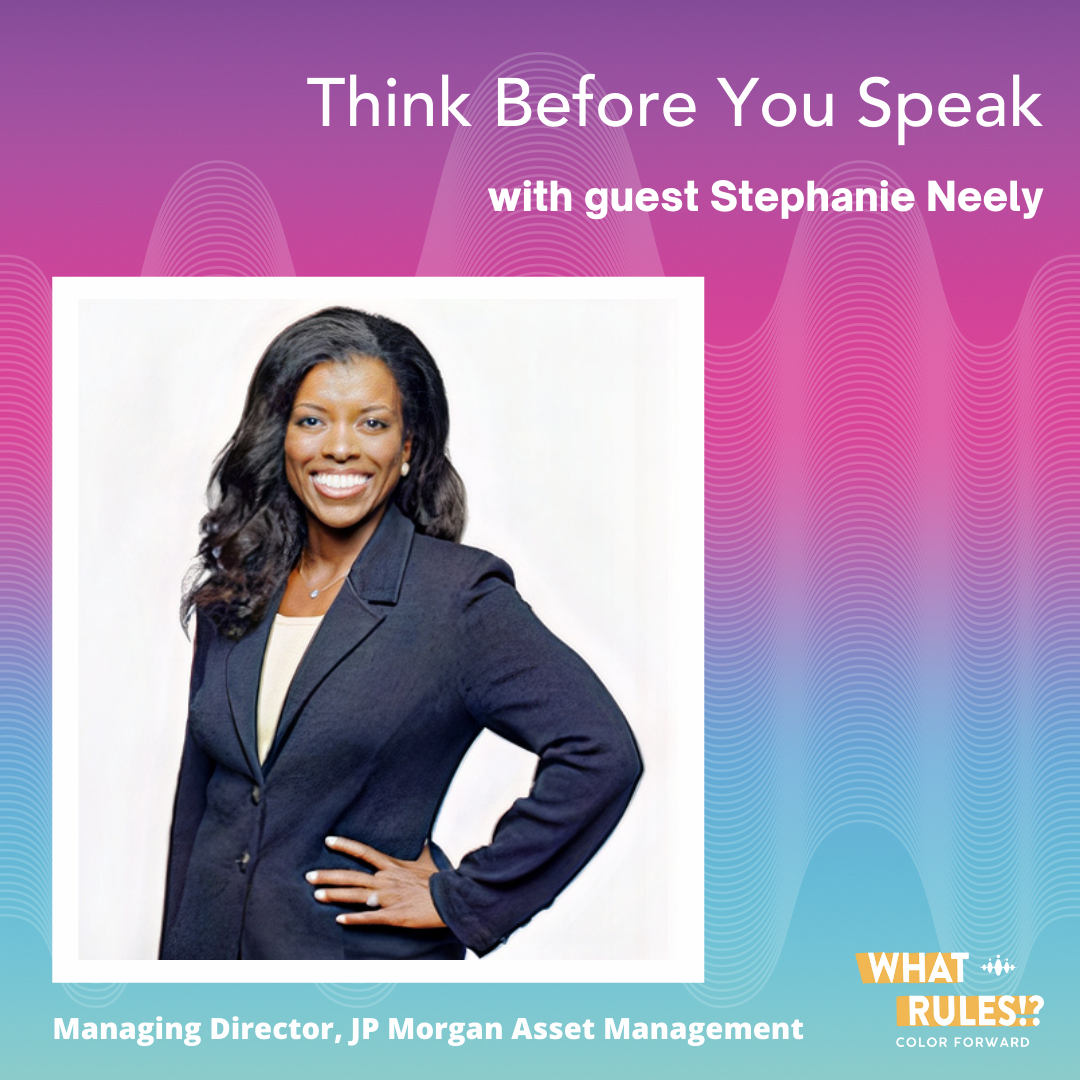
Today we’re talking about the idea of being fast to listen, slow to speak. Has there ever been a time when you really nailed that concept?
Alisa and Dr. Merary catch up with Managing Director for J.P. Morgan Asset Management, Stephanie Neely, about the idea that when you choose to speak can add volumes to what you have to say.
Alisa Manjarrez: (00:00)
So this morning, I don’t normally do anything in the mornings, I don’t normally have coaching sessions. But this morning, I had a coaching session with a woman who was trying to be more positive in life. So we were talking about transitions, like after you’ve had a long day at work and you want to be all there for your family or you’ve had a really bad day and you want to be there for someone, what do you do?
Alisa Manjarrez: (00:27)
You can really transition from one thing to another and transition your mindset by doing a quick, little, what I call mindfulness minute. Just take a couple of breaths and you think about, in true mindfulness form, you would choose a word and think about this word that I want to embody. She chose the word positivity. And throughout the course of our talking, she realized, “Okay, positivity isn’t going to work because you can’t just tell yourself, ‘I’m happy.'” So I’m curious for Stephanie and Dr. Merary, what are some things that you tell yourself to readjust into going from work, home, home to work? What are some things that you tell yourself to get yourself into that next thing?
Stephanie Neely: (01:20)
We all have dark days, sad days. I remember I was keeping a log, I was going through a really dark period, and I was keeping a log. And it would get as simple as, I am grateful that someone held the door for me today. Just the little things, just really trying to focus on being grateful.
Dr. Merary Simeon: (01:37)
Now, I feel bad. That’s really good. You know what the sad part is, Stephanie? That I actually have an app that reminds me, what are you grateful for today? And this is just a sign saying, “Hey girlfriend, I’ve been telling you, you haven’t even been listening.” I got to be honest, I don’t know that I have a good one right now. So thank you, Stephanie, you’re already giving me wisdom and I’m going to start doing that because I believe it. Just even when you were speaking and saying grateful, I felt it in my body like, wow, there’s so much that you have and you haven’t even been grateful for.
Stephanie Neely: (02:16)
It’s the power of words.
Dr. Merary Simeon: (02:17)
Yes. Talk about edifying.
Alisa Manjarrez: (02:21)
Mic drop. We’re done with the podcast, we haven’t even started. I want to welcome all of our listeners and our viewers on YouTube to the What Rules!? podcast. This is where we equip multicultural women to outsmart the game, to advance their careers. And my cohost today is Dr. Merary Simeon, motivational speaker and HR executive. My name is Alisa Manjarrez, I’m a Vision producer and executive coach. Today, we’re talking all about this idea of being fast to listen, slow to speak. I’m a trained listener and it is still hard for me not to interject and to slow down and listen. When you think about this idea of being of slow to speak, have you ever been in a situation where you did this really well?
Dr. Merary Simeon: (03:27)
No. I try it. Hasn’t been easy, especially when it is something that I’m passionate about. If I’m mentoring somebody, I feel like I do take the time to listen before I speak. So I try to listen to the whole story. However, when I’ve been in situations, in meetings, or things where I feel things are going the wrong way or they’re saying something that hits me in the right spot, it’s been hard I would say to be slow to speak. I try to, it’s something that I continue to work on. But I have to be honest, it has been difficult depending on the situation, depending how passionate I am about the topic.
Alisa Manjarrez: (04:13)
It’s hard when your brain works so fast because you’re like, “Oh, oh, I have so much to say right now.” And then just to stop yourself and take that beat. It takes a lot of self-discipline and practice, I would say. Today, we have an amazing guest.
Stephanie Neely: (04:29)
Well, hello, everyone. And thank you so much for having me. I am Stephanie Neely. I’m a managing director in institutional sales for JP Morgan. I manage the team for the Central and Canadian region. I wear a lot of hats in life. I’m an avid equestrian, I have show dogs, I’m a mother of a 22 year old son, and I’m the former treasurer of the City of Chicago. But I’ve always defined myself as J. C. And Doris’s daughter and Justin’s mom.
Alisa Manjarrez: (04:59)
I love that. Welcome to this conversation. If there is a moment in time where you are most proud of yourself for taking that beat and being fast to listen, slow to speak, what moments sticks out?
Stephanie Neely: (05:17)
There are a lot of moments. I first heard that phrase when I was in a office, it’s actually a biblical verse. I think what the person was communicating to me is you serve 2.8 million Chicagoans and you need to listen to them. So I came up with this term of, if we give the citizens of Chicago chocolate cake but they want apple pie, it’s a very nice gesture but we have not given them what they want. So really going on to listening tours. I’m a type A personality as well and I speak over people and I do all of that because I have a lot of passion. But when you’re trying to serve people, you need to listen. So it’s not when you’re not trying to debate but when you’re really trying to serve them, you need to listen to what they have to say.
Stephanie Neely: (06:07)
So I remember I was grocery shopping in my equestrian clothes and this man was following me in the grocery store. I don’t want to make it sound like he cornered me, but he got me to a point where I was face to face with him, I had to acknowledge him. And he said, “I don’t know why you’re incognito.” I said, “Well, this is how I dress on the weekends.” He goes, “I know who you are.” I said, “Well, what can I help you with sir?” And he said, “Well, there’s a pothole.” And he went on to tell me about this pothole and I wrote it down. Now, streets and sands, sanitation deals with potholes not the treasurer. But because I serve all the citizens, I had to listen to him. I didn’t want to listen to him, I want to make it sound like I wanted to, I wanted to grocery shop and go home. But you’re always the treasurer, you’re always an elected official. So I listened to him and I dealt with his issue because I was trying to serve and meet his needs.
Dr. Merary Simeon: (06:59)
I love that. I love the way that you’re looking at it. It’s about serving, it’s about looking at it in a different perspective. And then it made me think, as you were speaking, that I find that I listen more when I want to learn.
Stephanie Neely: (07:12)
But we’re always trying to learn, even if it’s just looking at the world from a different lens or a lens that you don’t even agree with. It’s important to just learn and to grow. My aunt would say, “You stop living, you stop growing.” So we need to always continue to push ourselves and to grow.
Alisa Manjarrez: (07:28)
It’s so crucial for such a tumultuous time that we’ve been in these last couple of years. Imagine what the world would be like if we were fast to listen and slow to speak, it takes a lot of discipline. And this is something that I’ve noticed with younger people that I coach are like, “We have to do something now and act now and say something today.” Some of the executive of that we’ve had on this podcast who have more experience in life and things like civil unrest is not a new concept for them, it’s been like, “No, let’s take some time and see what’s actually going on, what’s the root of all of this.” And to really get to the root and find solutions or even talk about solutions, you can’t do that in 30 seconds.
Stephanie Neely: (08:27)
No, I agree. You need to take time, understand, and really build relationships as well. If you’re trying to change people’s minds or trying to influence or to effectuate change, you need to understand so that you can meet people where they are. I think what’s key in communication that a lot of people forget is it’s not only what I say, it’s what you hear. So if I come at you in a way that makes you feel a certain way, you’re not going to hear what I’m trying to say. So that comes with also being slow to really gather your thoughts and try and get people to understand your point of view and not just talk at them.
Dr. Merary Simeon: (09:04)
And it’s about knowing your audience, what do they want to hear, like Stephanie said, and what is it that you want to say and how do you bring that together so that you could get the point across. I see that a lot. People want to hear something, they already have in their mind a bias or something that says, “No, this is what I think, that’s what I want to hear. I want you to support what I believe.” And it’s how do you say what you need to say in a way that they can also listen?
Alisa Manjarrez: (09:34)
I want to add another air to this. As women of color, multicultural women, one of the barriers that we have to face is other people’s stereotypes or expectations and bias of what they imagine we’re going to bring in to the conversation. And this is something that we all have. We all have certain biases of where I think you’re coming from. And this is the question for both you, how do you not put judgment on other people, first of all, and have the conversation when all these other things are going on, all these unseen, barriers is the only word I can think of at the moment?
Dr. Merary Simeon: (10:14)
Well, at least I know when I’m coming to a conversation, it’s like, okay, I’m already biased about this, so let me just put it out there and put it through a filter. I start with myself, what I know about myself because I think that has helped me then put things through a filter not to be biased about whatever the other person is trying to tell me. Because at the end of the day, we all have them. So I try to recognize minds and listen in a different way so that it could help me pause. Like I said, I’m still working at it, but that’s what I’ve been trying to do, is what’s out there? What are my biases? Why do I feel this way? Why don’t I don’t trust this person? And is it because of my biases, so that then I could slow down and listen and with a different perspective?
Stephanie Neely: (10:58)
Well, we’re all works in progress, so that’s not going to change. I think for me, I check myself when I recognize that I’m being prejudiced or treating someone unfairly based on stereotyped or preconceived notions, I check myself. And I find that lately I’ve been doing more. I’m like, okay, that’s just wrong. And it just helped ground me and bring me back to the center. I’m never surprised that I do it because like you said, we all have them. But at the end of the day, they are wrong. But to get back to your other question, Alisa, about being a woman of color, I acknowledge it and I talk about it. I say, please see me as a black woman, this whole concept of I don’t see color is crazy. Of course, you see color, I’m 5′ 3″ you see that I’m short. So are you going to not acknowledge?
Alisa Manjarrez: (11:52)
I love that you’re 5′ 3″, I didn’t know that through the screen. I’m 5′ 1″, candle experience.
Stephanie Neely: (11:56)
We’ll see so people will notice that, right?
Alisa Manjarrez: (12:01)
Mm-hmm (affirmative).
Stephanie Neely: (12:02)
So you need to acknowledge that that’s who I am and accept my authentic self. I want to come to work, I want to come to relationships as my authentic self. So to not acknowledge me as a short black woman with gray hair is not to acknowledge who I am, it’s to try to put me in a box that I just won’t fit in. So I try to give that same concern to someone else. I try to see them for who they are. And at the same time, as I want to be pushed and grow, I try to push and have people grow as well. But never in a mean or biased way, just to try to get people to see the world from a different lens.
Alisa Manjarrez: (12:42)
It’s interesting when we think about, there’s nothing we can do to control other people’s perceived notions of ourselves. We can help and form and guide and acknowledge when someone says something that might be offensive. We have an episode where we talked about how to have uncomfortable conversations and how each person can choose if they want to address something in the moment or if they brush it off. Is it the right time and how can you be strategic about addressing quite literally a stereotype of someone, I’ll just put myself in the example, if someone sees me as a Latina?
Alisa Manjarrez: (13:24)
There’s still people that think all my families they’re all gang members because that’s just what they think. So I have a choice if I want to address that with them and help them see that that’s not who I am or just let it slide. Sometimes I don’t know if letting it slide is making the situation on a grander scale worse or if it’s just me being wise. For the two of you, how do you distinguish those moments and make that decision?
Stephanie Neely: (13:59)
I call it out, call it for what it is. If you’re going to stereotype me as a gang banger because I’m black and all my relatives are gang bangers, how ridiculous is that? That’s like me saying you’re Italian you’re in the mob, you’re Irish you’re drunk. Please, those stereotypes, you have to call them out and point out people’s, in my opinion, their ignorance. Maybe not as directly as I just said, maybe making light of it and being funny. But there’s always truth and just. But you can’t let it, I don’t think you can let it slide. I feel that you have to be brave and bold because again, I feel we’re all called to try to make the world a place. And if you’re allowing people to go down this path, you’re not making the world a better place.
Stephanie Neely: (14:41)
So I try to get people to see it through a different lens. I just ask questions like, how would you feel if I thought, blah, blah, blah about whatever stereotype there is, how would you feel about that? I would let that awkward silence just sit there, wait for them to answer. They may not even in the moment acknowledge how ridiculous, but that’s going to sit on them, I think. I think that silence again, slow to speak, sometimes you just need to let it sit there. I can’t let some of the craziness just slide, I just can’t. It just like what? No.
Alisa Manjarrez: (15:14)
What if you feel your job is at stake?
Stephanie Neely: (15:16)
Well, that where it becomes bold, it does, it becomes bold. And that culture is not for you. I think by the time you’re as “seasoned” as I am, you’ve had many situations where you’re the first, you’re the only, and you can work hard. But sometimes cultures aren’t going to change and you have to make the decision to move on. I’m not suggesting people quit their jobs and become homeless or anything else, but have a plan to get to a place that’s going to set you up for success as opposed to holding you back. But I think with age and wisdom, you become more and more bold. I have a colleague who had a unique sounding name and people were truncating it and I was like, “That’s not his name. We’re going to learn how to say his name.” And that’s something small, but your name is your brand. My name is Stephanie, it’s not Steph. When people call me Steph, I just go, “I prefer Stephanie.” I’ll get upset like, “I prefer Stephanie.”
Alisa Manjarrez: (16:14)
And that’s a form of respect.
Dr. Merary Simeon: (16:16)
I agree with Stephanie 100%. There are microaggressions that I do not put up with now, where I look back at so many times that I put up with stuff because I wasn’t senior enough or you were just afraid. But I feel that I see that more now because people are a little bit more afraid of being straightforward, I guess, I don’t know. Or maybe they just can’t help it and their microaggressions come out. But I also feel, I’m being vulnerable, like that’s where sometimes I lose it. I’m like, “Gosh, come on now. You know better.”
Dr. Merary Simeon: (16:53)
As Stephanie says, sometimes it’s just so much. You go from place to place to place to place and the microaggressions just keep on popping and popping up. And it gets to a point where like, “Okay, I don’t know if right now is the right time because it’s not going to come out the way that it’s going to be a learning for all of us. I’m just going to prove to them that the Latina passionate about this that just comes across with fire whenever she’s mad.” Again, I’m learning and continue to learn on how to manage that. Because I see it more and more and more and it’s exhausting. Because it’s not just in the workplace, sometimes it’s in the supermarket, in the community, or it’s anywhere.
Stephanie Neely: (17:35)
That’s right.
Dr. Merary Simeon: (17:36)
Sometimes even in your own neighborhood. It’s like, “Oh, are you the cleaning person?” It’s like, “Why, because I’m Latina.”
Stephanie Neely: (17:41)
I call it out. I’m not going to pick all the battles, I don’t have all the energy to pick all of the battles but when it’s an in your face situation. I think as women, we all have that, we’re in a meeting and you say something and no one acknowledges you. And then the white man says something and they’re like, “Oh, that’s the best thing since sliced bread.” And you’re sitting there like, “Didn’t I literally just say that?”
Alisa Manjarrez: (18:03)
I feel like that happens with my mom and dad.
Stephanie Neely: (18:07)
It happens, it’s a constant thing. So I don’t typically defend myself on that but I do defend when I see someone else. I’m like, “Well, that’s exactly what Sharon just said. Good point, Sharon.” And then people look all uncomfortable. There’s a saying that me and some colleagues at JP Morgan say like, get comfortable with being uncomfortable, that’s how you grow.
Dr. Merary Simeon: (18:27)
I love that.
Alisa Manjarrez: (18:28)
The idea of amplification or as Rosa says, augmentation, when we can support the other woman in the room, if there is another woman in the room, that is taking everyone 10 steps forward. And it’s sometimes those little tiny things that are going to add up. Just like the little tiny things like Dr. happens when you were saying it adds up and it gets exhausting. Those little tiny actions that we can use to move forward by helping another woman in need or just another woman is also hopefully going to add up and start balancing us out in an ideal world.
Alisa Manjarrez: (19:03)
I remember I was leading the cross functional team and it was my project. I was very much the leader and someone else who was a little bit of higher rank than me, even though he wasn’t leading the project at all, he always felt like he needed to be the leader of the project. And I was younger. And my coach gave me a tool, which I loved, and it was just making sure that I always said his name and acknowledging what he had to say. And it helped him realize how much he was interrupting. So just me saying, “Oh, thank you, John. Oh, John, that’s a great point. John.” Because it was every time he interrupted, “John, like I said, we are going to be on time with that project. John.” And it was interesting when you can show people either the negative or the positive of how they look in those environments, it makes a huge difference.
Stephanie Neely: (20:02)
But it would help also if there was someone in that meeting who went, “Hold on, John, hold on. Let’s hear what someone else has to say.”
Dr. Merary Simeon: (20:07)
Yes.
Alisa Manjarrez: (20:15)
So for our listeners, is there anything else that is really important for people who are making the transition from manager to executive, they’ve gotten to a certain level with their skills and now they really need to bump it up and get to that next place?
Stephanie Neely: (20:33)
My little piece of advice, which is easy, is really trying to connect in your communication style. Whatever it is, just make a connection. Typically, people who are transparent and authentic make a really good connection. Or vulnerable, don’t acknowledge that they have all the answers or they’re the perfect person that I’ve made mistakes, I’ve learned. I think that takes you to the next level because it shows that you’re confident enough to be who you are. And that’s what a leader is, you’re leading by example. That’s a way of taking it up to the next level. But you’ve got to be putting yourself out there. You’ve got to be willing to put yourself out there.
Dr. Merary Simeon: (21:10)
Definitely I agree 100% because one of the things that I’ve learned is the things that I let pass, then I continue to feel uncomfortable versus facing them right there and then. I may be uncomfortable at the time, I walk through it, and I’m like, “I feel better.” Because I either stood up for myself, said the right thing, or made the right move. Be authentic and be uncomfortable being uncomfortable. But make sure that you respect you, your thoughts, and your values so that it doesn’t haunt you later.
Alisa Manjarrez: (21:54)
Want to know how breaking the rules can help you level up your career game? Search What Rules!? podcast on any social media platform and join our members only group on LinkedIn, where we discuss role breaking strategies for multicultural women. What Rules!? is a production of Color Forward? The show is produced by me, Alisa Manjarrez, with editing and fabulous sound design by Martha Deion. Visit colorfoward.com for more stories, events, and of course, all the episodes of What Rules!?.
Meet the Hosts
Archives
- February 2023
- April 2022
- March 2022
- February 2022
- January 2022
- December 2021
- November 2021
- October 2021
- September 2021
- August 2021
- July 2021
- June 2021
- May 2021
- April 2021
- March 2021
- February 2021
- December 2020
- November 2020
- October 2020
- September 2020
- August 2020
- July 2020
- May 2020
- April 2020
- March 2020
- February 2020
Copyright © 2026 What Rules!? Podcast. All Rights Reserved. Powered by Podcast Theme