
What Rules!? Podcast - Past Episodes
52. Why You Need A Professional Squad
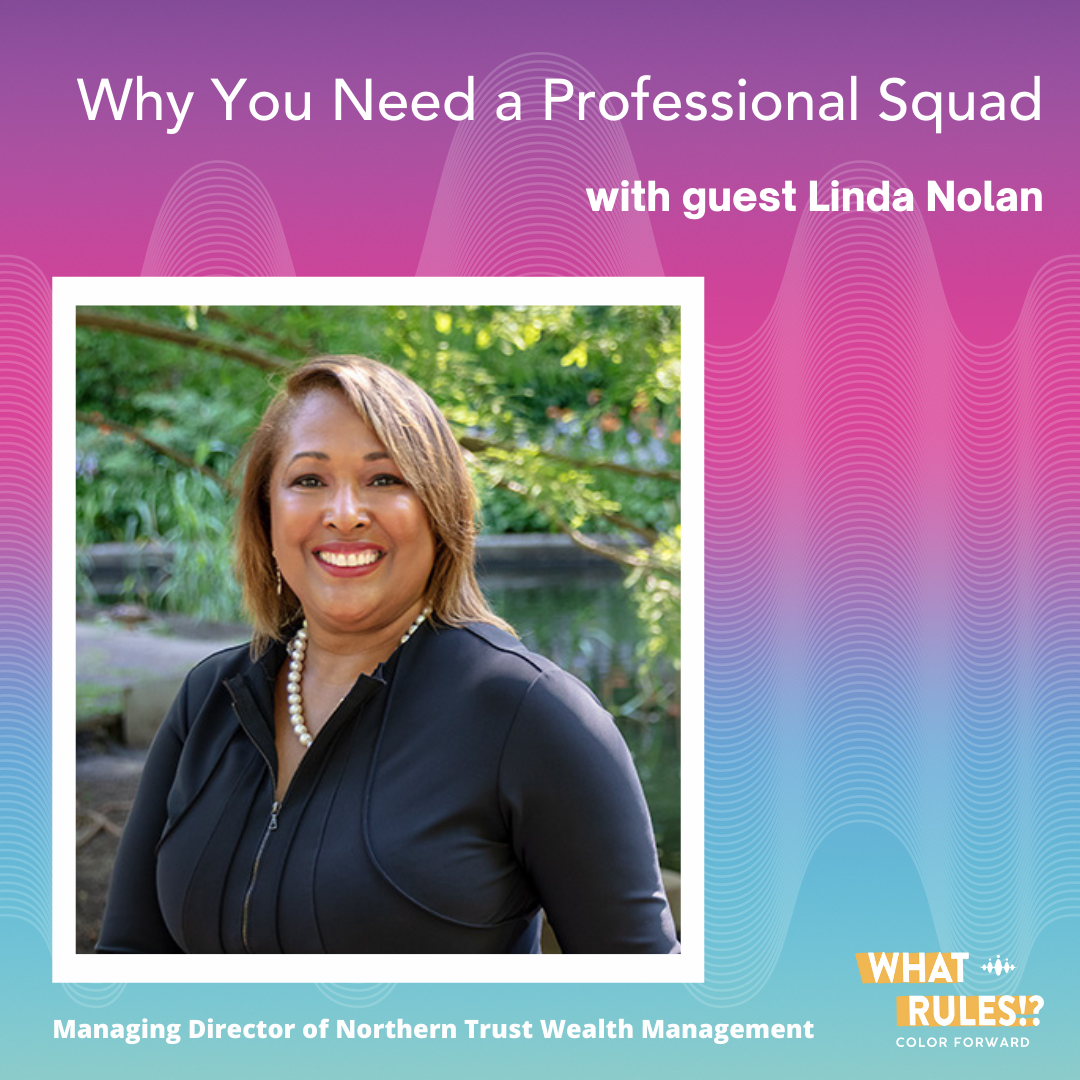
It’s been said many times, it’s not what you know, it’s WHO you know. And that’s especially true when you’re breaking rules and forging new paths. If you’re looking for strategies to advance your career, the people around you are so critical. You’ve got to squad up to get ahead, that’s what we always say (or will from now on).
This week, Alisa, Rosa, and Dr. Merary get to know Managing Director of Northern Trust Wealth Management, Linda Nolan. She breaks down everything she’s learned about the power of keeping a tight-knit crew and how it pushed her confidence to new heights.
Alisa Manjarrez: (00:00)
I remember this story where I got a raise and I didn’t think I deserved it because, I mean, of course I didn’t say it, right? But I got, “Surprise, surprise. We’re giving you a $15,000 raise,” and I thought I was doing such a bad job and maybe I had a little bit of imposter syndrome. I’m not really sure, but I accepted it, but I didn’t try, I just got it offered to me but I had all these weird feelings about it. And I think it’s interesting that we’re talking about what you deserve. And I don’t know if any of you have experienced this, where you feel like you don’t deserve something that you probably do. Does that sound familiar or can any of you relate to that?
Dr. Merary Simeon: (00:42)
I was just going to say you were probably underpaid.
Alisa Manjarrez: (00:45)
Oh, I was, I didn’t know that at the time. They bumped me up to probably the minimum, most likely, but I didn’t know I was early.
Linda Nolan: (00:54)
Yeah, like she’s under market. We better get her up a little bit.
Alisa Manjarrez: (00:56)
They’re like, “She’s going to figure this out pretty soon.”
Dr. Merary Simeon: (01:01)
Sad but right. We probably all on here have been through it at the time thinking, “Okay, this is great.” But then you realize, “Ooh, I was underpaid.” I don’t know, there’s so many, I guess, examples we could go into when it comes to things that you deserve but didn’t know you deserved or even ask for it. I know for me, I’m more of the person I don’t ask and if you don’t give it to me then I’m just going to go look for it someplace else. Which is not the right way, by the way, so let me just put that out there. I’m not saying I do it the right way and I have learned little by little to ask but it’s super uncomfortable. So I’m probably not the best to give advice but I know for me it’s very, very uncomfortable when anytime I have to negotiate. It’s so much easier for me to give advice, “Hey, this is what you should be asking for but when it comes to me-“
Alisa Manjarrez: (01:55)
Yeah, it’s so easy to tell other people, “This is what you deserve. Oh my gosh,” all of you automatically were like, “You’re probably being underpaid,” but when do you ever think about that for yourself?
Alisa Manjarrez: (02:12)
Welcome to the What Rules Podcast, where we outsmart the game to advance our careers. I am Alisa Manjarrez. I’m a Vision Producer and Executive Coach at the Happy Cactus and my two co-hosts today are Dr. Merary Simeon, HR executive and motivational speaker, and Rosa Santos, Talent Management executive and Leadership Expert. Since we talk about breaking the rules and doing things our own way and doing things a little bit differently, we thought that we would talk about a hard and fast subject today, negotiating getting a raise, doing things your own way. And so with that today, we have a special guest. We have Linda Nolan, Managing Director of Northern Trust Wealth Management, and she is not only an expert in managing other people’s money. Today, we’re talking about how she’s managing her own career and how she’s broken the rules to get where she is today.
Linda Nolan: (03:20)
One of the interesting factors is that men are much more systematic about it. That they are taking a look on an annual basis and they’re seeing where they are relative to the marketplace and where they think they ought to be and they are much more assertive around saying, “Hey, this is what I think my value is in the marketplace and I think that I’m being underpaid by X amount and I’d like to give you the opportunity to make that right or what are you going to do about that?” And I remember when I was promoted into the managing director position, having several men come to me and have that conversation and they didn’t just come with, “This is what I think,” they came with charts and graphs, “Here is my salary trend over 10 years. Here is how that compares if you factor in inflation-“
Alisa Manjarrez: (04:13)
Wow.
Dr. Merary Simeon: (04:14)
Wow.
Linda Nolan: (04:14)
“… and where things are moving. That actually is going to adjust what my raises have been downward and so I’m flat and I’m not keeping up with the pace of inflation. What are we going to do about this?” And I would go and run and advocate for them and I realized I was advocating successfully for these people who were coming to me, what was I doing for myself? Why was I a fierce advocate for them? But I was not the same way for myself.
Linda Nolan: (04:43)
And then I also noticed that I was advocating for women who were underpaid, who were relative to their peers and coaching them on… Just as we were talking about before, “Hey, Alisa, you were probably underpaid,” and talking them through how I might approach it but I wasn’t taking that same step for myself. And so it is very hard but I had to discipline myself and I actually had some great coaching around how to have those conversations because I do think that men receive that message differently from a woman than they do from a man. And the coaching was to say, “Hey, I know this was not intentional but as I take a look at where I am relative to where I believe my peers are, where the market is, here is the gap. How can we address this together?” And I had to practice, I had to script it out and actually get a good friend to role play it with me so that I could say it without emotion, per se, just a fact based conversation-
Alisa Manjarrez: (05:47)
Without yelling, “Hey buddy.”
Linda Nolan: (05:50)
“Excuse me. I’m angry.” Without… I’ve had other women who have done it with me where they act the emotion of it. Just like you were saying that, you just, “Hey, I’m done with this.” Or the tears start flowing which is just not effective but it’s a natural part. But if you practice you can get through all those emotions and so it’s still not my favorite thing to do, but I can make myself do it just because it’s like, “Why not me?”
Rosa Santos: (06:17)
We’re now taking notes and-
Linda Nolan: (06:24)
Oh, good.
Dr. Merary Simeon: (06:25)
Look at me. [crosstalk 00:06:25].
Alisa Manjarrez: (06:25)
She’s like, “What was that sentence again?”
Dr. Merary Simeon: (06:29)
I’m listening to the podcast.
Rosa Santos: (06:34)
I have a question for you, Linda. So I’m the no longer recognized generation X because as you know we don’t exist anymore.
Linda Nolan: (06:47)
You guys got canceled?
Dr. Merary Simeon: (06:47)
And you got Xed out.
Rosa Santos: (06:50)
We got Xed out. But anyway, yeah. So my generation, we were the ones like DIYs, right? You worked really hard and you expected that somebody actually realized that the work that you did deserved to be compensated a certain way, right? And I hear millennials and especially Gen Zs who are coming into the workforce right now have no issues around sharing how much money they make.
Linda Nolan: (07:18)
I think that’s true.
Rosa Santos: (07:19)
Which I think it’s amazing because I was brought up with like, “You do not talk money, ever share how much you make. Let alone asking your colleague or your peer, ‘Hey, how much do you make and how we compare’.” But that’s happening right now. What’s your advice around that? Because I think that brings about so much power, especially for women. I think women need to share what they’re making and therefore you come to discover whether to Alisa’s comment of that she was underpaid rather than feeling bad because all of a sudden somebody came and gave her a raise. And she was given what the market was saying that probably she needed to be given.
Linda Nolan: (08:02)
I think that knowledge is power and it certainly gives you more power if you’re willing to use that information for your own benefit. So if you just know that you’re underpaid and then you’re feeling undervalued, bad about what’s happening, but you don’t do anything about it. If you just hold that in and internalize it, that’s a weapon that could be used against you in a sense.
Linda Nolan: (08:27)
That whole self doubt thing. I do think that being able to leverage the knowledge that you have and then have those proactive conversations. I do find that Gen Z and millennial women are more comfortable making terms on their own and having those conversations. I also find that they have as hard of a time, right? Having the conversation sometimes as those of us who have gone before them. But I do think knowledge can be power. It’s just being willing to do something with it. And I think for those of us who are still heavily engaged in the marketplace, it’s never too late, right? It’s never too late to address something for yourself and to fix it for yourself. And some people can give up and say, “It’s not going to happen,” but it’s never too late. That’s what I tell myself anyway. Yeah.
Alisa Manjarrez: (09:24)
Linda’s like, “Let me re-listen to this podcast.”
Linda Nolan: (09:27)
Let me readdress this.
Dr. Merary Simeon: (09:31)
You said something earlier about scripting it and practicing it and I wanted to get your perspective on when you practice, you also, I’m assuming should be practicing if they tell you no. Because ultimately I go in like, “Okay, I know my worth, I’ve done my homework. I’ve received coaching. I’ve done all this,” and now they’re telling me, “No. You’re no longer going to be this or that or you can’t get A, B or C,” and even as much as you practice it, I would still believe the emotions which are not effective when you have them in certain places. So in your experience-
Linda Nolan: (10:10)
The first time that I tried to negotiate for myself, I was like, “It’s not fair. It’s not right and I’m paid this and these other women are paid that,” and the person kind of penalized me. They adjusted the other people, but not me. And just said, “You know what, you’re right but the economy is bad right now and we can do this.” It was basically, “We’re going to continue because we can,” and I was so unprepared for that answer. And then when I found out that I wasn’t adjusted but the other people were, I had the whole well of emotion and after the meeting in the ladies’ room with the tears, trying to pull myself together, realizing, wow, I was really unprepared and I felt like I lost so much power in that conversation.
Linda Nolan: (11:03)
Having planned out, if they say, “No, not right now.” You can anticipate, “We just don’t have it right now. It’s not the right time in the budget.” So then talk about timing and let’s talk about a timeline and can we get there over time for what needs to happen for this to be addressed so that you’re not walking away with nothing. You’re walking away with some sort of action plan. You’re working on something together. I think that those are all ways to retain your power in the conversation and I think that you gain more respect, that when people know that you know your worth, that they respect you differently.
Linda Nolan: (11:47)
And the heads down, I like to call that syndrome where we kind of work and just hope somebody notices us and compensate us for as that heads down, pencils up actually devalues you. I was in a women’s development course and they compared it to a branding decision where you’re branding yourself like Walmart or Target. You know, Walmart is the low cost model value. You get everything you need and everything you want but it’s at the lowest price and Target, which has a little cache or targe, where people feel like there’s a higher brand value.
Alisa Manjarrez: (12:25)
And what about Costco?
Linda Nolan: (12:27)
I know, Costco is the best. Costco is the very best. And it’s true that I think we’re willing to pay a little bit of a higher price for that experience. And the coaching was, people will feel the same way about you, don’t brand yourself as the low cost workforce because you’re not as valued in that position.
Alisa Manjarrez: (12:51)
I feel like I’ve had to learn that this year as an entrepreneur. I’m about one year into being full-time, I’m what they call a high ticket coach. So I charge more than the average coach but I could easily be a low ticket. It’s my choice. And in some ways it’s taken me a while to get to that place but there’s an audience for every level of income or of value. And it’s been like a personal journey of just being able to accept that I’m expensive and it’s feels really good.
Alisa Manjarrez: (13:28)
Just be like, “Oh, I’m expensive,” but I’m still having to ask people because there are some, when I’m working individuals, I have my pricing down but I go to Rosa a lot for when I’m working with a large corporation or… I still don’t know all the market rates so I just have to ask and sometimes I am underpricing myself and I think the same goes for when you’re in your career. There’s nothing wrong with asking other people in your industry who might work at a different firm or it helps you understand where the market is at and go to all the Target people and not the Walmart people. Is what I’m hearing you say.
Rosa Santos: (14:08)
Yeah. And I would say that by doing that as well, it’s important that you continue to own the conversation.
Linda Nolan: (14:15)
Yes.
Rosa Santos: (14:16)
Right? It is your conversation. It’s not theirs.
Linda Nolan: (14:18)
Yes.
Rosa Santos: (14:19)
And in fact, I would say, it’s not for them to have, it’s for you to create and leads and control and you need to go into that conversation always owning even the timeline, right? And at the same time say that you find, that you get to that point where you think that you are maybe undervalued or underpaid but then by doing this discovery, you find that you are actually, that you weren’t that bad. But there’s something else, right? That maybe is drawing you to having this kind of conversation. So I know we’re talking about money and salary and whatnot, but a lot of the time it’s is not just that, there’s something else, right? And sometimes that is the symptom but in many cases it is not necessarily the root cause of that symptom, right? The root cause is somewhere else. So what are some of the things, that maybe, when that happened Linda, you negotiated with or you asked for that were not necessarily salary related, but again, kept you in charge of the conversation?
Linda Nolan: (15:29)
I think, defining for yourself, what’s important to me right now. So there have been times when the most important thing to me is flexibility and that’s all been redefined for us through the pandemic and we know that there are a lot more options than we may have previously thought available to us. I can say that I have many people now, especially working mothers, who are coming to me and saying, “I need to maintain a higher level of flexibility than I’ve asked for in the past because.” and fill in the blanks. And I think that… I’m finding that many of those people are much more confident because of the dire predicament, right? They just don’t have the education, the care. I mean, I’m saying that school’s not in session, camps aren’t in session, whatever’s going on.
Linda Nolan: (16:24)
And they’re really saying that, “Hey, as a condition of my continued employment, I need these following things.” I think that’s very powerful and they are valuable to us as a firm. They are valuable to me personally and so we’re willing to make those trade-offs. So I think that it’s understanding what’s most important to you, at any given time, and that knowing that those things change over time as well, and just constantly revisiting, what are all the things that I need and how do I want to structure this to work for me as well as for the firm that I’m engaged with. So, that would be my advice. Yeah.
Alisa Manjarrez: (17:04)
It’s interesting when the stakes change, like when it’s your family then all of a sudden it becomes easier to do the things that weren’t easier when you didn’t have all those things on the line.
Linda Nolan: (17:15)
That’s very true. Necessity is the mother of invention, right? So you just-
Dr. Merary Simeon: (17:20)
And I agree, Rosa, and I think, we’re talking about how to ask for what you deserve and we said sometimes family or a need, but how do we begin to really value ourself enough to know that I deserve this. I know doing our homework it’s critical and staying on top of talking to other folks to understand what the market is or as Rosa stated earlier, talk about your salary, but there are a lot of people Linda, you mentioned it early, that it does devalue them but they’ll just keep their head down and keep on working. For our listeners, how can they just begin to understand their value? Because I think that just even starting to ask yourself that question, “What’s my value?” Whether it’s money or just even caring for the family while working because otherwise you’re going to burn out, right? So there’s just so much to it. Any thoughts on that?
Linda Nolan: (18:22)
I think you have to keep your circle small but tight. People who could be very honest with you and say, “Here’s what I perceive from you,” and you can work on some area where you don’t have the self worth or confidence. I think confidence is a huge part of the game. And some people aren’t confident in what they deliver even though they may know, “I deliver a great work product,” but they’re not as confident stating that. And then they can work on things bit by bit with those trusted mentors, coaches, advisors and if you’re lucky enough to have them on a sponsor that can advocate and push forward for you. Because sometimes it’s not just about what you say, but what those people who are in the room when you’re not are saying about you.
Alisa Manjarrez: (19:08)
Yeah. Can we talk about sponsors for a second because we have in the past… But the difference between a mentor and a sponsor is a mentor is someone who’s typically gone before you and they have that experience and they can give you advice. A sponsor is someone typically within the organization who can pull you up and skip you a couple levels even. And it’s a very strategic relationship that you have. What has been your experience with looking for sponsors for yourself and are you a sponsor for other people?
Linda Nolan: (19:44)
So my experience, I’m definitely a sponsor for other people. I want to be able to create a legacy of having helped people so that people don’t have to have the same struggles that I did, especially as a woman of color, a working mother. I want to make the path easier for other people. I think in terms of finding sponsors, that has been a struggle. So I have what I would call a fairy godmother who would move mountains for me and I know that and we’ll have those fierce conversations and be a cheerleader, be a coach and a corrector whenever that’s needed. And that has been a tremendous asset throughout my career.
Linda Nolan: (20:29)
But in terms of sponsorship, I say at this point, then I need some others added to that mix. So, as I take an assessment even now in my career, I’m like, “I need to refresh some of those relationships and networks. I need to add to the mix.” There are other people that I need to add in order to make the next step. And then I also have to be willing to say, “Is this going to happen or not? And what am I willing to do about it?” That’s the important thing that I would say for people who are further along in their career and for those that are younger, I’d say it’s those strategic relationships and constantly reevaluating, refreshing, adding to, and making sure that you’re still in that sponsor kind of relationship with that person.
Dr. Merary Simeon: (21:24)
Well, I want to fairy godmother for sure but I love something that you said is, you got to continue to refresh it because situations change, things change. And I mean, just within the last year so much have changed and you just reminded me as you were speaking, I was like, “Hmm, I don’t think I’ve refreshed.”
Alisa Manjarrez: (21:42)
And you’re growing. I mean, everyone hopefully is growing in their careers and your circle changes and now you’re at the place I know for you, Dr. Merary, you’re a sponsor and mentor for others but now who do you go to?
Dr. Merary Simeon: (21:56)
I need that fairy godmother. I’m talking to Linda after this by myself. No, but it’s so critical at any stage and I love that you mentioned that Linda, because at my level right now at your level… Hey, this is constant work that we got to continue.
Rosa Santos: (22:16)
I think it’s the same way and especially for women of color, multicultural women, it’s already hard as it is, right? We’re starting with talking about how are you asking for what you think, what’s your worth, in terms of your, just the bare minimum salary, right? Forget about all the rest. Now, what we are talking about is identify key stakeholders that you know strategically are going to be good for you to grow your career. I’m interested in hearing, how did you overcome imposter syndrome from a way of like, “Will they want to talk to me? Am I worthy of their time?” Right? To really get to know who I am, what I bring to the organization, what would be the best way to go past that for folks and map out, but then pass that step of really putting one self out there to go ask, “Can you be my godmother?”
Linda Nolan: (23:14)
I think that those have to be organic relationships. So it’s really just networking first and establishing relationships and working on deepening and growing those relationships. And you can ask for incremental steps, right? So you might not go from zero to godmother, but you can go from zero to, “May I bounce ideas off of you periodically?” And as that relationship deepens, hopefully that there’s more sponsorship there. And then I think that others can sometimes look at us and say, “Well, you’ve done so well. You are one of the highest ranking fill in the blank.”
Alisa Manjarrez: (23:52)
Isn’t that enough? Aren’t you thankful or grateful for how far you’ve come? Why would you want more?
Dr. Merary Simeon: (23:58)
You should be happy.
Linda Nolan: (23:59)
Yes. That is the unspoken word. And I had to bite my tongue with one person, like, “But you got more, you got a lot more,” but I didn’t say it. I just said, “Well, yes I do. You’re right. This is a great position. This is a great accomplishment. And I’m even looking for more.”
Dr. Merary Simeon: (24:17)
People are almost puzzled when you tell them you want more.
Rosa Santos: (24:20)
Absolutely.
Dr. Merary Simeon: (24:21)
Because I’ve been in conversations with people and they’re like, “You want more?” And I’m like, “Well, why wouldn’t I? I’m just getting started.” And I think this also just shows how critical it is to speak to other people that have the knowledge, that have gone through these situations because we will never know it all. I would never know it all but that’s also why I want to continue to do more and continue to learn. And I think being able to know your worth will allow you to continue to move on. Because people could say, “Oh, but you should be happy.” And I could believe it. And that would be sad. That would be the worst thing that I could do believe that I’ve reached my fullest potential.
Linda Nolan: (25:02)
Yeah. Then that’s it. I agree.
Rosa Santos: (25:02)
And again, we say this all the time, but we cannot underestimate power of really talking to others and check in to confirm that what you are saying Mary is the right thing to pursue, right? Because it’s so easy to undermine, sometimes, those who we look up to. They might say like three things of three word sentence that can really put you down immediately and make you self doubt. So rechecking and really going back to your own network. And that’s why having this network is so important to say, “Hey, this is still okay, right? There’s opportunity for me, right?” Because there might be a choice right at that point, if they see that you don’t have that potential within organization to say, “Hey, okay, maybe not here, but maybe somewhere else.” Right? Or doing something else completely different.
Alisa Manjarrez: (25:55)
And it’s amazing. When just talking to people, I mean, none of us work directly with each other but I feel empowered. If I had to go ask for a raise just after this little conversation, I feel like I could say, “Well, I want more,” maybe not in those… I’ll script it first, right? But it’s like this idea of when you have a community around you and Linda you were saying have that tight knit circle and Rosa you are talking about stakeholders. When you have those people and when you can have 10, 15 minute conversations, they’re great reminders for all of us when you’re feeling down or when you’re not feeling down to remember I’m not doing this alone, I have this power of people who are supporting me and cheering me along behind the scenes. And having that to go forward into that room one-on-one with whoever you need to speak to is empowering.
Dr. Merary Simeon: (26:54)
I think also as sponsors, as we learn, right? We also have the responsibility to call those things out when we are in that position of power, “Hey, I think we’re not paying her worth,” right? Or I think we’re making this different decision and we shouldn’t because the more of us that can speak up for others, hopefully they won’t have to go through the things that, that we went through.
Rosa Santos: (27:20)
Let me just add something to what you just said, Mary, because I recently had an experience in which the idea of a sponsorship was new to this person. And I was so puzzled by it because in fact, this person is a huge sponsor of a lot of people but she herself didn’t recognize that she was advocating for all these people. Now, the people that she was not advocating for were probably the people that needed a more advocacy, right? Which was very insightful for me, which is sometimes how we perpetuate against some unconscious bias in the way that we look at talent, at fellow employees and human beings at the end of the day. So I do believe that we have a responsibility sometimes of calling things out and say, “Why don’t you expand your sponsorship breadth to include folks who may not be or look like you?” Especially as it pertains to women, women of color and multicultural women. That was a huge realization and even for this person. First off, it’s like, “Whoa, this is a new concept.” And it’s like, “No, actually it’s not, it’s not a new concept.”
Linda Nolan: (28:44)
I think it’s so funny that sponsorship seems like a new concept to people who’ve been doing this for so long, right? As just the way of doing business, the boys club has existed for a long time and it is perfected in terms of sponsorship. But when they apply it outside of that it somehow feels very new. And it’s really just what you’ve always done. It’s just that you’re including, yes, you’re including different people.
Dr. Merary Simeon: (29:16)
You’re being inclusive. How about that?
Linda Nolan: (29:18)
Yes.
Rosa Santos: (29:22)
Yeah. So it’s a good reminder for everybody. And for those who might be ‘new’ to the concept that do a little bit of a self assessment, right? In terms of who am I advocating for. Let’s make a commitment to find a way to feel. Okay. Sometimes maybe calling some of these things out, if we’re in a position to be able to do that because there’s plenty of opportunity out there to pull folks through.
Alisa Manjarrez: (29:46)
Yeah. And I would really encourage our listeners to think about who’s in their circle and who has their back and if it’s time to refresh your circle or your sponsors then think about who you might want to reach out to, you know that you have four women here that are rooting for you to say that you do deserve more and you should ask for more, and people do have time for you and if they don’t, find someone else, keep going, that’s been my message lately. Keep going because it’s crucial if you are looking for strategies to advance in your career. The people around you are critical.
Alisa Manjarrez: (30:34)
Want to know how breaking the rules can help you level up your career game. Search What Rules Podcast on any social media platform and join our members only group on LinkedIn, where we discuss rule-breaking strategies for multicultural women. What Rules is a production of color forward. The show is produced by me, Alisa Manjarrez, with editing and fabulous sound design by Martha Derion, visit colorforward.com for more stories, events, and of course all the episodes of What Rules.
Meet the Hosts
Archives
- February 2023
- April 2022
- March 2022
- February 2022
- January 2022
- December 2021
- November 2021
- October 2021
- September 2021
- August 2021
- July 2021
- June 2021
- May 2021
- April 2021
- March 2021
- February 2021
- December 2020
- November 2020
- October 2020
- September 2020
- August 2020
- July 2020
- May 2020
- April 2020
- March 2020
- February 2020
Copyright © 2026 What Rules!? Podcast. All Rights Reserved. Powered by Podcast Theme