
11. Susan Baltierra, Surgical Nurse on Shooting for the Moon
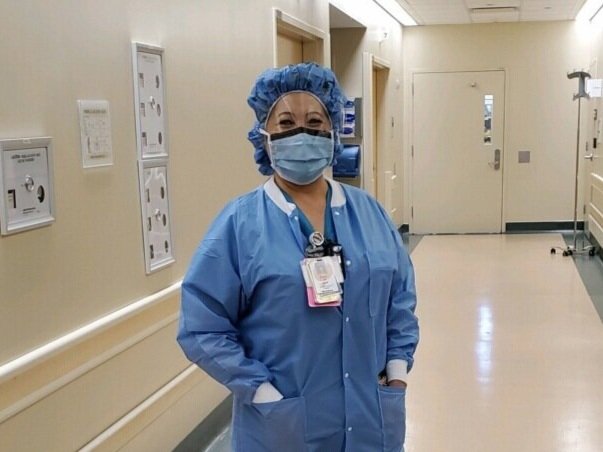
Nurses on the front lines aren’t just our heroes during this COVID-19 crisis; they’re our heroes every day. Listen to Susan’s incredible story of overcoming many obstacles in her journey and how the hospital system has been affected in this season.
Ep 11. Transcript
[theme music starts]
Alisa Manjarrez: Rosa and Merary and I have been talking so much about women on the front lines, and when we decided to talk to somebody on our podcast, I immediately called my Aunt Susan, the charge nurse of the operating room at Community Medical Center. Her father, who’s also my grandpa, always taught her to shoot for the moon, and she really did.
She is such a rock star. She’s learning robotic surgery at the moment. She has had a lot of trials and tribulations in her life, but she has a story of not letting anything get in the way of her dreams. You are going to love hearing Susan’s story. In fact, she tells almost all of it within the first five minutes.
Rosa and Merary can’t even stop her because she’s so passionate about allowing people to hear her journey of perseverance, grit, and resilience. I think you’re going to like this one.
[short musical break as theme fades out]
Susan Baltierra: Well, a little bit about me, I was born and raised here in Fresno, California. And if you don’t know where Fresno is, it’s Central Valley middle of California. Our city has about 500,000 in the city and about a million in the county. I’m married to my high school sweetheart and we’ve been married for 43 years, so I say 0-dark-hundred.
I’ve been a nurse for 41 of those years. And, I work at a level one trauma hospital, which is, the only level one trauma in between Sacramento and Los Angeles. So our County is large and we do get a lot of patients from all over Central Valley. My parents were both raised here or they were born here in the United States.
My dad was first generation born. My mom’s second generation. And I don’t know why I wanted to become a nurse. Nobody in my family has ever been in the medical field. In fact, when I was probably about eight years old I even dressed up as a nurse for Halloween.
So I don’t know where that came from. But then I realized a couple of years ago when my dad passed and I was speaking at his eulogy, I realized that, I think it came from my dad. He was always the one to stop at any accidents. He was always one to help out people in need. And I think that must have been where I had that desire to become a nurse and to help people.
I went into nursing because I wanted to help people even as I share with students, at the high school level, or when I’m inspiring other students, go into the medical field because that’s your heart.
Don’t do anything for the money. Do it because that’s what you feel in your heart. Because we do experience a lot of things. I went to our local city college here. I wanted to find out how to get into the nursing program and being in high school, I started to take what chemistry I needed to have in high school. And my senior year of high school though was a major change for me. I found out that I was pregnant beginning of my senior year, and I told my now husband, but at that time, my high school sweetheart, I said, you know, I was pregnant and we told my parents.
That was one of the hardest things that I had to do was to tell my parents that I was pregnant and we wanted to get married. So basically in six weeks we were married. We actually had to have my parents and his mom signed for us to get married here in Fresno County because we were both 17 years old.
And I knew I did not want to have an abortion that was not… I was raised Catholic at the time, and that was totally against what I believed. And when I showed my husband a picture of what the fetus looked like at that time, because he had thought that abortion would… you know, you could just have an abortion.
But when he saw that the fetus was already formed and he was like, no, he says, I want to be the father that I didn’t have because he didn’t actually meet his real dad until he was, we were married. He was like 20 years old when he met his real dad in Mexico. So that senior year, just before having our son in May, I found out I was accepted in the nursing program.
I was one of six, I think it was five or six, high school students that were as accepted right out of high school because back then 40 some years ago, their requirements were definitely not like they are now today. I delivered Michael in May of my senior year and the day after I got out of the hospital, I went to Fresno City College and registered for a one unit health class that I needed in order to start the nursing program in the fall and I took 17, 18 units a semester in order to finish, with the class.
Because my birthday’s in September I literally was 19 years old when I graduated as an RN and started working at the hospital. And so it was… I was very young and I think being so young sometimes I felt like I just went for it.
I didn’t know any better, and this is just what I needed to do. So I worked on the floor for several years, and by the time I was 23, we were having our third son. And we, had taken a drive I had just delivered and my husband wanted to know if I wanted to take a drive out to check on his brother’s house, who had gone out of town and they had been burglarized.
And so he took off and literally at a four way stop we went and turned, and we were hit by a drunk driver with the baby and our two other sons who were three and six at the time and unfortunately, he took the brunt of it and ended up with a skull fracture. And we did two EEG’s and basically found out that he was brain dead, but yet his body was functioning on the ventilator and I really wanted to donate his organs.
But back then, 36 years ago, the donor network was nothing like it is today. And they said, well, we just don’t know of a baby that needs organs. So, unfortunately we did take him off the ventilator and he passed away. So we waited seven years before we had our last child, and Gabriel just got married a year ago.
So hopefully we’ll have a few more grandchildren along the way and add addition to our four that we have now.
Rosa Santos: That’s an incredible story, Susan. Thanks for sharing your life journey with us. And I’m sure you know, one of the things that we cover with our guests is, the notion or muscle, and lately we call it DNA of resilience. I mean, you are the epitome of resilience. And it sounds like you’ve always been so determined to get through what, you know, life has been throwing at you to really achieve what you’re set out to do, or the goals or the vision that you had for yourself and your family and, and your husband. Where do you get your strength from?
Susan Baltierra: My faith. A lot of prayer, lots of prayer. That’s the only thing I think that has gotten me through from many years, many, many years and just being connected. I’ve always kind of been with our church just being connected with the women’s group and in a Bible study and, my faith is very strong in that aspect and gets me through every day.
Rosa Santos: I don’t have a religion and I don’t profess, any faith and there are so many of the women that we have in our community that find something outside of themselves to help them move forward and help them become whomever they want to become and sometimes for them, it might be like in your case, their faith, sometimes as a, a really good friend that they have that can, they can call up at 4 in the morning when they’re having like doubts and they need someone to reflect things with.
It’s always how important it is that you know how to go about pulling that energy to help you move forward and achieve your goals. Tell us about nursing, and tell us about what that looks like today this crazy time that we happen to be living in.
Susan Baltierra: Totally, totally different, I mean. And it is crazy place where we’ve never been before. Obviously I work in surgery and, we knew kind of, we had heard about this coronavirus and it just seemed like every day we were hearing different information and more information and March 27th, the hospital had decided we have 22 operating rooms at our hospital and they decided to shut down 10 of our operating rooms and prepare them for overflow of ICU patients. They had requested the surgeons that if they could only do necessary surgeries, and so our caseload went down. We were probably only doing about a quarter percent of normal surgeries, what we had in the past or previous to that.
Because of our caseload being lower, we had an excess of staff, and so we floated 9 of our RNs up to ICU so that they could help learn more about how to take care of an ICU patient and so that kind of worked to help keep our staff in with a job and have, the hours that they needed.
The hospital was really great and asking people what their skills were. What’s your skill level or previous skill level and where could you work and where could you help out? We were basically writing processes daily. There was a lot of questions and the staff would say, well, what about this? Or what about that?
And I would say to them, we’re collecting data as we speak hour by hour. We didn’t have answers. And it was just like we were the blind leading the blind, and we were just going by what other hospitals, what things were happening. Obviously in Washington State seemed to be the first one that was hit really bad with his coronavirus.
And then our ER parking lot turned into a tent city basically. So we were nowhere like New York is, and thank God to this day, we still are not anywhere near what they have been experiencing.
Merary Simeon: In your 40 plus years of experience as a nurse and just being there in the frontline, really dealing with it, how is it even affecting you personally, as a nurse, as a wife, as a mom, having to be there at work. How does that look for you, for somebody in the front line?
Susan Baltierra: You know, as a nurse, I didn’t go into nursing with the fear of being hurt or being sick or something happened to me. Of course the coronavirus has been the worst thing that I’ve experienced, I guess because I’m a little older, I think.
I don’t have young kids at home, so I’m not as worried bringing it home. But some of our staff that have little ones at home, they’re really afraid. They’re really scared, because obviously they want to protect themselves so that they’re not going to take it home and expose this virus to their families.
Rosa Santos: What does it take or how do you guys go about putting that aside when you’re in the frontline and all of a sudden you know that you are there for your patients and you’re there for the families of those patients who cannot be there with them this situation?
Susan Baltierra: We’re a little unit separated where people can’t come in any way. So we have little contact with the families we do at the beginning, and we just let them know that, we’re going to do the best that we can for your loved one. And of course they also have to trust us, because we’re taking their family members under our wings and basically putting them to sleep and caring for them.
And I think when at work we just kick into this mindset of, it’s all about the patient, and we are the patient’s advocate because when they’re asleep, we’re watching out. As a nurse we’re watching out and we work as a team.
There’s obviously anesthesia providers, there’s a surgeon, the nursing staff in a room, the minimum of four people, and we’re all working together. And so, we want obviously the best outcomes for every patient. So I think working as a team is really a plus for us.
Rosa Santos: Help us understand how you compartmentalize, ‘cause I think that’s very useful for us and interesting for us to hear. It’s hard for us to put things into perspective. One of the things that I admire the most about the medical professional is their ability, to be able to compartmentalize and move on and be in the moment, whatever that moment might be. Can you take us through that process for you and how that works?
Susan Baltierra: You just have to get in that mindset. When the adrenaline kicks in, first of all, especially if you have a trauma and you’re just doing. It’s doing what you’ve been trained to do. And I think obviously it must’ve started even in the nursing program itself as a student you’re learning, then that’s when you start to realize that the patient comes first and we’re just there to take care of the patient and we just go from the head down and decide what needs to be done first.
Obviously there’s no class to learn how to compartmentalize it.
Merary Simeon: It sounds like it’s something you were born with, right? It’s just the instinct that this is what must be done. Now with everything that’s going on with COVID we hear obviously there’s a lot of nurses that are on the frontline and there is exhaustion ,but I also have been hearing that there are a lot of hospitals who their employees are on furlough or that have lost their jobs.
And a lot of the times we don’t talk about how that is impacting also our frontline caretakers who do not have jobs and how that it’s impacting even the other people, to your point, that may need surgery or that are sick. Can you tell us what that really looks like out there and if that’s even a true statement? Because right now that that’s not a lot of something you hear about.
Susan Baltierra: I know even on the news, you’ve seen care givers or medical professionals picketing at the hospitals because they don’t have the proper PPE, proper personal protective equipment. Our hospital fortunately has provided that. We’ve learned that we’ve had to, not be as wasteful. I think if anything, I realized how wasteful we were. Like using a mask for instance, I mean, sometimes we put on a mask on just to go into the operating room for a minute, and then we throw that mask away and we’re realizing now we’re calling on the phone more instead of actually having to put a mask on and using technology more. But our hospital, thankfully, rolled out a program. We had staff that worked 8, 10 and 12 hours, and what they did was basically made everybody work a 12 hour shift. So then that way you’re only there three days a week instead of four or five days a week. So you had less exposure at that point. And last week, the hospital rolled out a program and they said that if you’re being furloughed, you could actually, jump in and use some of your extended sick leave to compensate for those hours that people were losing. They were also being floated to other departments to help, but I think the hospital has been really helpful in trying to help people stay employed.
Rosa Santos: Yeah, it’s interesting, Merary, you brought that up because I think that’s an aspect that we don’t talk about and it’s very interesting how we potentially can see the medical professionals now as heroes, but they’re having to endure also the impact of not having the level of hospitalizations and procedures, et cetera, and their revenue that that brings. That is another added layer of stress for these professionals who are trying to care for us on a day in day out basis.
You know, our podcast geared to amplify the voice of women who have this life stories from which we can learn. And the medical profession is a very heavily female profession. There are a lot of women who are doctors and nurses. What are your reflections around that? How is this impacting our fellow women?
Susan Baltierra: You’d be surprised. Actually, when I first started nursing, there was, in the nursing category, I would say probably 99% were women, and there were some males. For the physicians, I would say 99% were male, and like 1% female. It’s changing. It is really, really changing. In fact, we have more female trauma surgeons than we do male surgeons right now at our hospital.
And we have a lot of males, in nursing as well, and more females. Like the switch has flipped. And I don’t want to say it’s 50, 50, but, you know, there’s a lot of women still, I think the majority is still women in nursing, but there are still a lot of males that are now entering, the nursing field as well too, and a lot more female surgeons.
And I think it seems both women and males they’re both very concerned about their families. I even saw a newscast where the husband and wife both were physicians, and they sent their children to go live with the grandparents for, I don’t know how many weeks, so that they would not expose their children to this virus. There was a doctor actually in Loma Linda, a cardiologist, and they were talking about patients that they haven’t seen, like the people that have had heart attacks and that are having strokes and things, where are they going? We’re not seeing them come to the hospital and we’re thinking that they’re afraid to come to the hospital and unfortunately some may even be dying at home because of the fear of just coming to the hospital.
And what we’re saying is, you need to come in, you need to get checked. Don’t be afraid, we’re obviously taking precautions, with healthy patients versus the ones that are potentially rule-out COVID. We’ve definitely put up barriers, and try to separate the healthy from those that are potential, COVID virus patients. So, everybody’s onboard, I think, and it can affect anybody.
Rosa Santos: I always think that of medical professionals as being so selfless. but I think that is the most supreme act of kindness, that you’re willing send your children away from you during this time so you can continue to give through your craft. Susan, one of the things that we like to ask our guests is about the rules that they have broken in order to get to where they are at. What are those rules for you? How you think about that?
Susan Baltierra: I think I’ve broken a lot of rules from, just being a teen mom. Definitely I broke the rule there in having success and a marriage, for my husband and I both. My husband has his masters in education and became a school counselor. And, of course, in any marriage, there’s peaks and valleys and definitely, the main thing for us was just the commitment.
We wanted to stay committed to one another.
Merary Simeon: But it was done, right? Maybe if there is a young woman out there right now who’s just had a baby or is thinking about having a family, what advice would you give her? Especially somebody like you that has been successful in both having a family, being in the frontline in this type of job.
Susan Baltierra: Usually when I go and talk to young high school students generally I let them know, if you ever find yourself in this position your life is not over. Is it going to be easy, no. It’s going to be one of the hardest things you can do, but you can do it.
You have to persevere. You have to set your mind on the goal. And know that, I’m going to do this no matter what, and nobody can stop you. I always tell students, don’t ever let anybody tell you that you can’t do something because you can, and just prove to them that you can make it. One of the things my dad always told me was shoot for the moon.
And he would say, just go for it. I think he had that phrase before Nike, just do it, you know?
He would always tell me that, shoot for the moon. And so just persevere through and don’t let anybody tell you that you can’t do something.
Rosa Santos: So nicely summarized, and so nicely said, let’s shoot for the moon and let’s make sure that we keep those dreams alive and we put ourselves first, to be able to do so.
Merary Simeon: What you do is so critical to saving lives. Whether it’s COVID or whether it is anything. You are truly the frontline when somebody comes in and needs help in the health arena. COVID is something that has scared a lot of people, and I’m sure a lot of nurses are thinking, I didn’t sign up for this.
Susan Baltierra: You can’t be afraid. We’ve gone through many other viruses, the bird flu, the swine flu.
When I first started nursing we didn’t even use gloves to start IVs. We had blood on our hands and it was like, oh, okay, this is blood on her hands. Let’s just go wash our hands. Going into the medical field is because you’re doing it with a heart to want to help others. Not because, you want to have a paycheck.
Merary Simeon: We can’t thank you enough for the lives that you saved, that will never really get to know your name. We need more people like you, because there are people like me and like Rosa, that will never be able to do something like that.
Susan Baltierra: It’s so cool to see. The community has been tremendously a blessing to us because they’ve provided food. They’ve provided hand-sewn masks to provide for family and just people out there. So we are grateful too, for the community.
[short musical break transitions to recap]
Rosa Santos: This idea of compartmentalizing I was reading quite a bit about it, especially right now, like how do we compartmentalize, emotions, problems, friendships, work, in an environment in which, you know, there are no boundaries right now.
And I guess this comes from being married to someone who’s a physician. And one of the things for many years Fran was an emergency room doctor, we got to an agreement of actually not talking about work, because his line of work was always, awful. I guess sometimes not being able to save somebody’s life.
I used to joke a lot ‘cause I said like, yeah, I cannot compete with that no matter what we’re doing we’re gonna go, “how was your day, honey” like, it would be impossible. You would take everything personally. Everybody would be your friend, everybody would be your relative and you would not be able to perform your job as a doctor. that is a muscle that is so powerful to exercise.
And as I was thinking, Susan, how cheerful she was in the conversation and in the interview, how optimistic. That’s what I was thinking, like how do they get to always have that joy and optimism no matter what?
Because what they’re going through, it’s tough.
Merary Simeon: Our listeners who have been commenting on IG about what resilience means to me, for many of them, is the way that they choose to think, and kind of keeping that glass half full. I read one that said, the way I choose to think reminds me that this too shall pass.
I read another comment that said, surround yourself with people that bring out the best in you. So it’s almost like during these difficult times how are you embracing your strengths, by being self sufficient, but also by being humble enough to recognize when you’re struggling.
There was another person that posted that said that she had been physically and mentally abused, a broken home, no childhood but yet, her resiliency has come with thinking positive and to break out of that mental oppression it must be difficult. How do you do that? Unless you think positive? And it made me think even of Susan, right when she said she was a teen mom, and became a nurse, graduated at 19. She did not let her circumstances stop her from becoming the nurse, from becoming a professional. Those are not stories that you hear when you hear of a teen mom or somebody that got married at, you know, 16 years old.
But when I look at the theme is about thinking positive beyond what’s happening today.
But the reality is, Rosa, and you and I both have experienced this, that there will be hard times that we will go through. And it’s a process, right? These hard times will make us stronger, and that’s the way that we got to think about, and if we’re going through a difficult time, how do you find the joy in those moments or do something else that brings joy?
Like, you know, for her it was her faith. For other people, it may be interacting with your friends, but finding that one thing that takes you out of that norm of misery.
Rosa Santos: I started the chat with you about this compartmentalize, and I came across this article actually, which was not what I was expecting. It was about productivity and how you manage yourself, right? But it was about how you compartmentalize and it was fascinating.
Just simple things like put time in your calendar and block time out so you can actually, think about that one thing that maybe you’ve been putting off or…
Merary Simeon: Be intentional, right? After this is done, are you going to look back and say, what did I do with my time? Were you actually intentional with the time? Did you do something as simple as what the people did in that hospital that Susan mentioned that they went outside and they would chalk. They wrote, thank you’s and you’re our heroes and that brought her a piece of joy. But somebody was intentional about going to buy that chalk, going to the hospital and writing that down. So it’s, not just about yourself, but also bringing joy to others. I love that, being intentional.
Rosa Santos: The other thing, and I think we’ve talked about this before, but I mean, going back to your point that you were making about positivity is how you reframe the problem into a possibility. And a good way of doing that is framing the problem or framing the issue that you’re wrestling with, that you’re trying to compartmentalize, right, into a question. And it’s something like, what would it take me to do X, or to solve X. Just the framing of the issue and coming up from a, sometimes it’s whining or complaining into more of a possibility. I think it helps with how you’re approaching whatever the issue might be.
Merary Simeon: So there’s two things that I’ve been doing during this time. One, you probably all heard, I love working out, so I have an accountability partner and she, works with me in the morning to make sure, because I know my weakness.
That’s a huge weakness, right? I need an accountability partner. The other one that I just started doing recently is, I said I want us to start this Bible studies, and I could tell you it was falling off my calendar. So now we’ll have a partner that during the week we’re supposed to read and when we get on Sundays on zoom and talk about it, and honestly, Rosa, I’m like, I need to do this because she’s holding me accountable.
Because sometimes it’s easy for me to do things for others and is so much harder to take care of myself. It is so critical for us to take care of ourselves and do those things that bring us joy. Because you said it earlier, like I love working out. I love reading scripture, but I don’t do it.
I just don’t do it. So holding myself accountable has been working. Now, if somebody could hold me accountable for not eating cake every day, we’ll be good.
Rosa Santos: Going back to Susan, I mean, if you think about it, I really enjoyed hearing her say she was putting herself first when she decided to go to school despite the circumstances. It was like, oh, of course I have a child. I’m newly married. I’m still a teenager, but you know what? I’m going to do this because this is what I always wanted. I always wanted to become a nurse, and in doing so, she put herself first.
Merary Simeon: So critical to think about yourself, because it brings joy to you. And it allowed her to be a mother and a wife at such an early age, because she was doing what she loved. That is so critical. How many of us out there are not doing what we love?
And that actually translates into how we interact with our own family or how we even think about ourselves or our day to day actions.
[theme music starts]
So I would ask our listeners, are you doing what you love? And if you’re not, start today so that that can help you elevate the voice that you already have inside.
[short musical break]
Alisa Manjarrez: That was Rosa Santos and Merary Simeon interviewing Susan Baltierra registered nurse at Community Regional Medical Center in Fresno. For more inspiring stories, please subscribe on Apple, Spotify, or wherever you listen to podcasts. If you have a guest you’d love to hear on the show, send us a DM on Instagram @ColorForwardPod.
I’m Alisa Manjarrez, producer of Color Forward. Thanks for joining us and please leave us a review.
[theme music ends]