
15. Amplifying Women of Color Voices
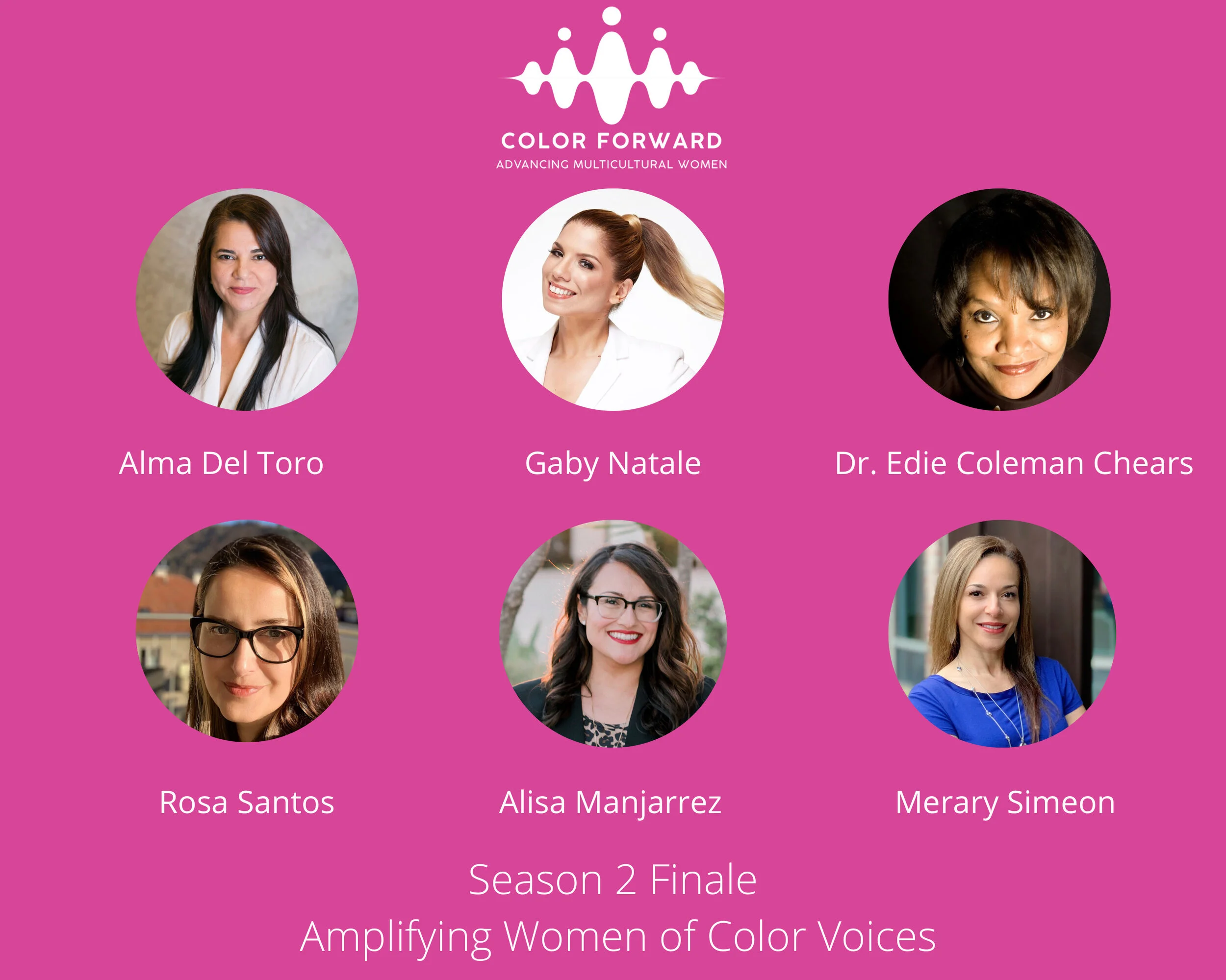
In this tumultuous time of the Coronavirus still spreading throughout the country and civil unrest, now is the time to amplify the voices of women of color and continue to tell their stories of overcoming cultural barriers and pioneering new realities! Listen to Gaby Natale, Alma Del Toro and Dr. Edie Coleman Chears in this special episode.
Ep 15. Transcript
Alisa Manjarrez: It’s the season two finale Merary and Rosa, can you believe it?
We started a year ago talking about this, and then we launched in February hoping to amplify the voices of women of color, multicultural women, and we had a great season one. I would call them our early adopters, the guests that we had. We had Alma Del Toro, she’s an energy strategist, visionary president of Blue Bull Energy. We had Dr. Edie Coleman Chears. She’s a woman of color, a leadership expert, author, and president of Mind Over Matter Instruction. And then we also had Gabby Natale, three time Emmy winner, bestselling author, and CEO of Welcome All Beauty.
And we had the pleasure of bringing them back for season two, just to talk about how they’re adapting to this new normal, all the changes that they’ve been going through, how we talk about difficult situations. And one of the themes that we really saw was, all three of these women talked about how this is the time where we can emerge stronger than ever before. We’ve gone through a worldwide pandemic. We’ve gone through civil unrest. Just so that our listeners know, the interviews that we had with these three women were before the killing of George Floyd and before all the protests, but we really believe that it’s important to bring all of that into this conversation today.
Rosa Santos: It’s interesting for our season two, we started with COVID and now we’re here. It feels like we’ve been preparing for this all our lives. A lot of people talk about resiliency and how much, you know, now coming out of this our resiliency muscle is being exercised. And I would argue again, our guests and our listeners and ourselves, we’ve been exercising this, muscle for quite awhile.
Merary Simeon: We’ve been functioning in the uncomfortable for a very long time. So this is not new. Like you said, it started with COVID. Even being in those situations we are used to always being uncomfortable and fighting and looking for ways to resolve things. Because the system or whatever, it never was prepared to help us.
So we just kind of had to figure it out on our own. And then even now with, the social injustice, it’s… it feels the same. It’s like, yes, I’ve been going through this my whole life. So it’s interesting that now people are talking about it and how they feel uncomfortable talking about it when it’s something that we live every day, at least as a Latina woman I have experience.
Alisa Manjarrez: Yeah, and it’s not new. We’ve been talking about this more than the last year, but the three of us in particular have been having conversations around making sure that the narrative for women of color is changing. And that’s what we’re here to do is to really showcase the women that have made it, the women who have overcome those cultural barriers, and the women that are doing amazing things to literally change the world. And these are multicultural women.
Merary Simeon: This is the whole reason we wanted to elevate the voice of women, because we didn’t see it being done anywhere else, because I saw the struggles. Also because we live the same struggles, whether it’s at home or work, in our community, even with the families. We began this journey before it was popular, but now more than ever, I feel that we have to continue to amplify those voices and show the country, show the world, the amazing power and talent and potential that women of color have.
Rosa Santos: Our guests have helped us understand what’s been the impetus within themselves to move things forward, to move themselves, their communities, their businesses forward to really become who they are. I am very hopeful. I’m very hopeful that I think we’re at a point right now where there’s more listening to understand what it takes. And I do sincerely hope that remains coming out of this, beyond all the actions that everybody’s taken, beyond posting and declarations and commitments and investments and so on and so on, which is all great, but that genuine exercise of allowing folks that in the past haven’t had the platforms to express not only who they are, but the challenges that they have to go through and they’ve gone through to become who they are. I am very hopeful that coming out of this is not just color forward, but there’s like color forward times a thousand. It’s like, Hey guys, I think we’ve made it, right?
Merary Simeon: We feature many women who have overcome all this adversity and have worked and been uncomfortable for years and they are impacting the world in amazing ways. I can only imagine how much more amazing they could be or how much more impact they’re going to have now that a lot of this, I’m hoping, is being lifted off of them.
I think if these women are able to function in a place where they’re given the equal opportunity, Oh my God, it would just be so impactful that… I’m just loving it. And looking forward to the future of women of color this country.
Alisa Manjarrez: And that’s one of the things that Alma reminded us when we talked to her, she said this is the time to push forward. Now that we’re so virtual, where technology is really a main character in all of our lives this is our opportunity to talk about what matters in a way that more people can understand, listen, and join in the conversation.
[downtempo background music plays]
Alma Del Toro: How can we reinvent or adapt what we do that may or may not apply going forward depending what the circumstance is or this new normal will be. But what about of the things that we currently do can operate in the new world more than ever?
You know, how more than ever in our industry, the energy sector, you know, being carbon neutral, carbon negative, it’s a mandate. You know, it’s, it’s not anymore like, Oh, aspirational, we should all get there. It’s kind of like, no, we’re late. You know? So how do we get there? So jumping into those things I mean, just to get towards that direction, you know, not as something you may want to do later, but like something we need to do now. And so for me, it’s been able to accelerate those things that I had like I’ll get to that, you know, I want to think or do something as to be more, more aggressive towards those things. So that’s what it has opened to me as a professional, you know, and I’ve seen so much entrepreneurship pop. You know, human beings are so creative and adaptable, you know, so I push my brain to think like, well, what about what I do, my skill set, can adapt. How do I fit in this whole new environment?
[downtempo background music ends]
Rosa Santos: It’s interesting because during the last, I want to say three weeks, four weeks, maybe, I have had so many people come up to me and saying things like, how not ready they are to have these kinds of conversations. And it’s been very interesting to me to get to hear that from a perspective of, from your vantage point, how can you help me?
How can you create a strategy or a toolkit for me to be able to have this conversation. And whilst that is really good, I would like that coming out of this folks are not asking for a toolkit to be able to engage in a meaningful conversation, to wanting to learn about their fellow human beings, going through life. And while they do that there they suspend judgment and truly listen and trying to understand where they’re coming from. And in this way, for us as women of color, where we come from, what it is that happens and to be able to walk sometimes very fine lines. And that’s the one piece that worries me that that fine line will not get to disappear entirely.
Alisa Manjarrez: We’re talking about getting comfortable with the uncomfortable, do you think it’s because people are not comfortable having real discussions about race? I’ve been coaching a lot of people on this and with some of my white clients, I am one of the only people they can talk to about what they really feel, because they’re afraid to have those conversations with other people and it shouldn’t be in that coaching conversation. What do you think we should be doing differently to give people a place to talk about real uncomfortable issues?
Merary Simeon: I think you have to own it from your personal perspective. I don’t think it should be completely put on the individual or the other human being to teach you. I think you have to own it. Ask those questions and read, educate yourself and get involved. I think you have to be uncomfortable. We all know that transformation begins with, you know, stepping out of your comfort zone. If you don’t step out of your comfort zone, you’re never going to transform. You’re never really going to learn or want to understand or have that impact your life. So I think people are uncomfortable because they’re not used to being uncomfortable. As women of color we’ve kind of mastered this and are a little bit more comfortable, but then this is where I think I play a role you know, I said this before, sometimes you just get tired of having to explain to people, but we do have to play a role and we do have to… if we really want to change the game, I think it goes both ways. I have to stay open, to educating, and people need to step out of their comfort zone and to be open to learning,
Rosa Santos: I was in a conversation yesterday with a large group of people. And here’s what I said to that, every day is a new day, it takes practice. If listening is not your strong suit, I’ll just say, try it. Try it and allow yourself to be surprised, open your ears, your heart, to what folks are sharing with you right now, because I don’t think there has been a moment such as this one where I think folks are definitely also ready to share from a very vulnerable perspective and point of view and experience like never before.
[emotional, downtempo background music plays]
We’re all human, right? We all want to be safe. We all want to be able to feed our family and have a roof over our heads and have opportunities to create a better lives for ourselves and our children, not just here. I think that that’s across the board.
Alma Del Toro: I don’t think the waves are ever going to stop coming.
As the world changes, we’re just going to keep getting more waves. And so this is just training, you know, to get the muscle ready so that when something else hits you, you just realize, I can do this, you know, a day at a time and just create my own Lala Land somewhere in my brain that keeps me and pulls me through and keeps me sane and motivated.
You know, like every human being, I get scared just to think about, well, what is it going to be like? What is going to happen? But somehow, you know, it works for me to quickly move from that to actually get into action. And so then I leave that concern a bit behind, and then a day at a time, you know? And how can I be kind to myself, kind with my words and kind with my actions and kind of that little mantra, just use it throughout the day.
I think you almost will not have to be human not to feel that, but it’s almost that a part of you have to be in this slightly little bit of denial to still imagine and be creative is to… okay, maybe my next next that I thought it’s not going to be there, but there’s certainly a next that I can still paint and, you’ve got to paint some sort of positive picture going forward.
[emotional, downtempo background music ends]
Alisa Manjarrez: When we talked to Dr. Edie, she was reminding us about the women around the world who have shown up in an amplified way because I had heard about the Prime Minister of New Zealand a while ago, but only from my ultra feminist friends who were aware. And now because of her achievements through COVID-19 now way more people know about her, people are talking about women of leadership in other countries. And Dr. Edie really got me thinking about the role that women in leadership can play during this time and, and post pandemic.
[soft, chiming background music plays]
Edith Coleman Chears: There was like a deafening silence. It reminds me of that tune, The Sounds of Silence. Well, those were the sounds that have come over businesses, organizations, homes, the world. No one is exempt from it.
With all the thank you’s and all of the things that we realize in this new normal. We forgot that the most important position is that of leadership.
Yes, we thank the nurses and we thank the doctors, and we thank all the essential people who have arisen to be essential. But the most important thing is leadership. And we’re seeing where good leadership takes us and where poor leadership takes us. So we looked at some of the national… the women in the world in Germany and Thailand, their leadership has been critical to how their countries are recovering. We look at some of the female leadership here in our country, in our house of representatives, in our States and local governments I think we don’t know exactly what we need to do but I know that we need to start looking at post pandemic characteristics of leadership now. I’m writing my last chapter of my book is going to be on that. Of course I encourage everybody to, you know, check me out from time to time, but I think that’s how we can imagine that we need to have a reset.
And it doesn’t take us back to the old. It actually propels us into the new, of being creative, innovative, being able to motivate people online and to be tough to do the transformational work that has to be done in the workplace, but also do the transformation and the transformative stuff that needs to happen underlying with people who are out there in the sound of silence, screaming for things that they need.
We need to be visionaries. We need to have imaginations. We need to imagine what to do next and how to make that work. I think most people will not go back to work. The companies that actually have this kind of technology will in fact, probably keep people at home for a longer time and they’re going to be more assured now that creativity and productivity can happen here.
[soft, chiming background music ends]
Rosa Santos: I think we need to be careful with the narrative as well, from my perspective.
Merary Simeon: What do you mean? Tell me more.
Rosa Santos: Yeah, so I think the narrative is women leaders are more… they are more empathetic because they’re women. Women leaders are really more about consensus building, because they’re women. Women leaders listen more, because they’re women. I’m sure they’re true, but I can tell you, there are many women out there in positions of power that are none of the above. So here’s my insight on this, particularly for those women that Dr. Edie talks about, I think what’s highlighting is during this time a different kinds of leadership is needed. And we’re all thirsty for that kind of leadership, from an organization or corporation perspective, but also from a country and government perspective.
We’re in search for leaders, both men and women, who are showing those traits that many women are more prone to be able to exercise. I think that is the insight that we need to see that kind of leadership.
All those things that I named, I think in the past, they would have been quoted as opportunities or weaknesses and generally applied and tact to women for them not to be able to be successful. And I think the difference in the narrative is that that’s what we need and is not necessarily seen as a, as an opportunity or a weakness, but the contrary, the strength, the strength that has yielded real tangible results.
Edith Coleman Chears: There is rhetoric and narratives that we need to grab onto now that will blend our organizational families together or tear them apart. We need people who are saying the things that inspire us and that work. People don’t want to just be inspired. They want to succeed.
So folks have to understand that your logic makes sense in this time. So I think we have to stop listening to what disturbs us and we have to start finding and creating rhetoric that, puts us in, you know, the new world order. No matter what people say about when things are opening up we really don’t know. Other voices say that this will be around for a while, so we’re forever changed. We can stop thinking about going back to normal. There is no normal to go back to. We have to be visionaries. We have to be innovative. We have to have agile ability to operate in a new normal.
Alisa Manjarrez: This is a time to consider what type of leadership is needed today. And I think that this could be a time for, as you both mentioned, this is a time for women to come out, essentially, and come out and be their full selves.
For so long we’ve been silenced and muted ourselves, just as always women have been. If we actually make a choice to show up and to show up fully without regret without restraint the power that we already have, this is the time where it can come out and truly make a difference. This is a time where we can make a change.
Rosa Santos: It’s been very hard for me to make that choice. You feel vulnerable, right? And you don’t know, or in this case, I don’t know to what extent everything is sincere. I may choose to show up the way that I am or the way that I, you know, based on whatever the choice is, and you don’t know how you are going to be perceived or received
Alisa Manjarrez: What are you afraid of?
Rosa Santos: I think their fear is their sincerity with wanting to engage in the right way. And you don’t know whether it’s truly sincere getting done the path of, we want to make a change with you, be a partner and an ally versus, maybe being used to help amplify other voices that are not this one’s, right?
I think everybody’s thinking right now that we flipped a switch and everything is different.
And I think for me, the fear is that really, have we, have we? I think we’re in the… As I said, I think we’re on in the right direction and the right path, and I take responsibility as we three have been taken responsibility with putting this, this platform out are there to continue to make choices, to support each other and to advance the conversation.
And I don’t take that for granted. I think this is the time to click, right? It is the time to click and make the change. And I think it is happening.
Edith Coleman Chears: What are some of the new skills that we need? What are some of the new technologies that we need to lead? How do you lead online? I started focusing not on the sounds of silence, but on the sounds of change. What’s changing? What now? I imagine you having a magical remote. We’re looking at each other right now as we talk, and if I could click that sound, the click, is the change click to change the channel from what was to now. Click to change the rhetoric that most fits what is needed at this time for women leaders. Click to change the behavior that mends and heals an organization and that unites them. And we need to just continue to click away from what was to what can be.
Merary Simeon: I think there’s a lot of people including myself, right, that we’re afraid to see, okay, is this real? Is there really going to be change or is this just going to be a trend? And is it going to go back? This has been building up for years and years and years. So for us to think that it’s going to change overnight I think we’re kidding ourselves. However, I do have hope and I’m very optimistic that even if we all just start having one conversation is going to make some type of movement forward. And that is the hope and optimism that I have.
But to think that it’s going to happen overnight, I don’t think so. I think that that decision it’s going to come differently to many people at different times and different experiences in their lives.
Alisa Manjarrez: Some of the hardest conversations that I’ve had during all this time have been with people I’m related to and other Latinos. And there’s so much focus on the black community, and rightfully so, I’ve been having conversations with Latinos who are like, but what about us, and why should we care about them when no one cares about us? And it’s really difficult because the conversation really should be focused on the black community, but it is interesting, you can’t ignore the fact that people of other ethnicities this also brings up the idea of racism towards themselves with each other, within communities. There’s a lot going on in the Afro Latino community, how they’re like, well, where do we fit in?
It’s like, we all got a huge electric shock and we’re all experiencing the aftereffects in different ways and it’s not done.
Rosa Santos: No, it is not done. And that’s where my reticence came from a little bit, especially when addressing our fellow women who listened to us. You know, some of us might feel absolutely a hundred percent comfortable showing up as who we are, but for some other women, it may not be even a possibility yet. I think that’s worth the change, right? And changing that channel, right, that Dr. Edie talks about, is all about. We are trying collectively to change the channel. I think the speeds are going to be different and I think we are in some level or some of us may have, or might be positioned in a way that we can help speed up how you change the channel.
Merary Simeon: It’s a human race issue and it’s going to take every single one of us, Black, White, Latino, Asian, it’s going to take every single one to move this forward. And like you said, change the channel. If we’re not all on the same channel it’s going to be a lot of noise and a lot of chaos.
[chill, uplifiting background music plays]
Edith Coleman Chears: I think this whole thing about click to change is not just click to change what we see and what we want to see.
It’s click to change who we are to adapt to what is now. So keep in mind that the click to change is for you too. Click to change how you look at things, how you view tough and difficult situations. Click to change your confidence levels in yourself and click to change what is going to be the new 2020 post-pandemic seriously bad-a leadership, okay?
[chill, uplifiting background music ends]
Rosa Santos: We’ve talked a lot about what it means to be flexible and what it means to adapt to the situation and how for us, we’ve had to change so much and we have to adapt and, and really observe and quickly do situations, assessments on the go so you can be something or somebody that will allow you to get to where you are heading, to achieve your success however that has been defined. And I think Gabby is the absolute example of that.
Gaby Natale: How can I be happy with the new rules?
Right here, right now with whatever I have going on, whether it’s a lot or it’s a little we’re going to have to live through these weeks, months, and at some level, in some things, maybe years? Whatever my frame is right now and right here, how can I be happy?
Because life will continue to go. This will continue to happen through time for at least a while, and you cannot put happiness on pause. You cannot put dreams on pause. You cannot put wellbeing on pause. Joy on pause. We have to make ways for it to work for us.
And I know all of us innocent people using our money to buy a planner 2020, we wasted our money. Those plans are not happening. We have to create new plans.
Rosa Santos: That ability to adapt and reframe and help others reframe how they look at things and how they enter into spaces that again, call them uncomfortable, but that is the nature of change. That is the nature of, you know, moving things forward is being able to adapt what’s coming your way. And it doesn’t matter if you’re a woman or man or Black, White, Asian. It does not matter. That’s such an innate skill that around this time is definitely needed no matter how you look at it.
Merary Simeon: And I think that’s the important part of getting to know yourself, right? I keep saying this, but when you know yourself, it’s not that you’re here competing with the black lives movement or why we’re not worrying about Latinos. Get to know yourself and then you can understand what other people are going through, because at the end of the day, when we understand ourselves, we could be so much more powerful on how we impact the people around us and ultimately the world.
Rosa Santos: We also need to take care of ourselves. We need to allow ourselves to realize that we’re not okay. Sometimes we’ve talked about those micro aggressions that we all suffer and especially as women of color, right? But we are probably more prone to take everything more personally and maybe getting even more upset than we would usually get, right? So understanding all of that in light of what’s happening and just saying, Hey, I need time to pause and I need time to take care of myself. I think right now it’s more important than ever.
Alisa Manjarrez: This is an opportunity that we don’t want to miss where we can create new possibilities. I mean this whole season, Rosa, I think that’s been a theme for you. We’re creating our future. There are so many possibilities.
This is a huge time for all of us, but if we’re not okay. And we’re not taking care of ourselves then we’re not going to be able to do anything.
[downtempo latin guitar music plays]
Gaby Natale: First, I think you have to do whatever is good for you and your wellbeing, because we are living in extreme times. What we’re facing right now is very hard. It’s painful, and we shouldn’t judge our emotions or push ourselves to become the next Olympic medalist, just because we have more time.
Today I am speaking with you from what once I used to call my dressing room closet in my home, and now it’s turned to a TV studio slash dressing room closet of my home, because I believe that we have to somehow make it work. We’re in a new reality with new rules.
So it’s a humbling experience that brings you back to the basics. I’m alive. I’m here. My people are alive. We’re here. We’re fine. And it brings a lot of clarity, because what you find out is that if you have that, which is the basic, you know that hopefully you are going to have time in the future to do whatever you are not doing right now.
Whether that is financial reconstruction, getting to see your friends or your family later in the future. This is unexperienced, that is humbling and that it really puts your priorities in order in a very fast and ultra efficient way, whether we like it or not.
And you know what, that’s where we are… we all are now. So in a way, you know, put the camera, do the most you can with what you have and see what happens. You know, we’re all in the trying to figuring it out. But that’s what I’m talking about when we talk about building. Building so that you emerged stronger after this.
Rosa Santos: She talks about how you can reframe the paradigm. How do we reframe this paradigm and recover from years and years and years of this status-quo, right, and just seeing things in a very specific way.
Alisa Manjarrez: When we were talking specifically just about COVID-19, she was like, this is not my first rodeo. I’ve had adversity before I’ve had trials and tribulations before. I’ve been locked down in other ways, maybe metaphorical lock down. And so she’s a great example of how you can still overcome.
You can still launch a company. What this is doing is it’s narrowing her focus a little bit more.
[downtempo latin guitar music ends]
Gaby Natale: In an objective way of looking through my life this is probably my third rodeo to call it in a way, you know? The first one was when I graduated in Argentina in the year 2001. And I can relate so much to class of 2020 because there was 20% unemployment when I graduated in Argentina.
And it was not as sanitary crisis, but it was a deep political, social and economic crisis. So you have this feeling of wanting to take over the world, but the reality is there and you cannot do whatever your impulse is. So that was the first one.And I endured almost two years of unemployment.
Then the second one was in the year 2008, and I was an entrepreneur starting my business and all my sponsors for my TV show canceled, because of the, uh, 2008 crisis, the first rodeo in Argentina that open the door for an opportunity for a job in a new country was a life changing experience, one of the most positives in my life. The second one was the one that allowed me to have a platform that went from local in a small city to force me to expand and look for new opportunities in other places and eventually allowed me to have a national platform.
Rosa Santos: A few years ago, I used to work with a woman that would ask you a question every time around success. Instead of asking how you define success, she would say, how many people have you made successful this week?
(Crosstalk.)
I was like, Oh, wait a minute. Like how many folks can you make successful this week? And that can be rather powerful if you think. And when you enter into a conversation you enter into it with a very powerful way of engaging. How am I going to enable you to move forward and be successful in whatever it may be?
Alisa Manjarrez: These past couple of weeks I’ve been a little bit more quiet but we also have a role to play in educating others. And I think that’s a form of giving success. And when I have a voice I personally sometimes feel convicted that if I have tools to share with other people and I’m not sharing them why would I not use it now when it’s the most important? I think I kind of like shrunk back a little bit. And so hearing all of this makes me want to really get intentional about sharing what I do know and helping other people become successful, because we’re all in this together.
Merary Simeon: We can easily have this whole podcast and just feel horrible about everything that’s going on, which it is horrible, but I want people to leave with hope, being optimistic and trusting themselves. Even the people that are not a color, look within you. There’s a strength in there that you can use to make this world a better place, know that you have that. You just, you just gotta look it’s there. So don’t think that you should feel bad about all this. There’s history, but right now you have the opportunity to make change.
Even me as a Latina, I have an opportunity to make change. And honestly, that’s what I’m looking forward to. I’m looking forward to taking action, to making a difference, making this a better place. And just being able to one day look back and this be history that we no longer have to try to fix. So I’m looking at it very hopeful, very optimistic, and yes, don’t get me wrong there’s time to morn. There’s many things that are sad and upsetting that are going on in life, but we also need to be around those people that are going to be like, okay, what is it that we’re going to do to make a change? Let’s go make it happen. And let’s go bring joy. Because if not, we could stay in this mode and get depressed over everything that’s going on.
Like I say this sometimes, right now I’m laughing because if not, I will cry, but you know what, it’s time. It’s time to do something different. It’s time to stop talking about it. It’s time to be about it. It’s time to level up. Everybody needs to do this. And I think, you know, when you do something that’s impactful, you get happy, you feel joy.
So I think the more that we do that, the more that we start acting on it. We could continue to talk about it or we could just be about it. And I think that’s a choice that we all have to make.
Alisa Manjarrez: Preach it!
[group laughter]
Rosa Santos: I was going to say, amen.
Merary Simeon: I told you, I’ll get you to say amen.
(soft piano chords play)
Merary Simeon: You know, one of the things that Gaby talks about is, she always keeps a bag packed in her luggage, so she could be ready to go to the next place. I think it is time now that we redefine what freedom looks like for each of us as an individual. Because the minute we define our own freedom and we understand what our strengths are, we can absolutely help the next person achieve their dreams.
Gaby Natale: My lifestyle was always coming from a trip and getting ready to leave for the next trip.
It’s a lifestyle. So there’s always a piece of luggage there with, you know, my clothes and different things. I haven’t been able, yet, to open that piece of luggage and put those clothes back in the drawers. Why? Because unconsciously I’m scared like when it’s going to be my next time that I’m going to open a piece of luggage and put it there? Because for me, in my life, traveling planes, flying, my suitcase was always an equivalent to freedom. I am flying. It’s freedom.
But, you know what, we have to redefine it. You know, freedom can come in very different ways, you know? And I cannot anticipate what the next chapter is.
Why am I holding on to that piece of luggage when I don’t know if the next chapter of my life is so much bigger than that piece of luggage in my garage.
It’s hard to let go and to trust that something better is going to happen. And now, after a lot of weeks, and processing and everything I am ready to undo that piece of luggage.
(soft piano chords continue four bars then end)
Alisa Manjarrez: For more inspiring stories, please subscribe on Apple, Spotify or wherever you listen to podcasts. If you have a guest you’d love to hear on the show, send us a DM on Instagram at @colorforwardpod.
I’m Alisa Manjarrez, producer of Color Forward. Thanks for joining us and, please, leave us a review.