
17. JuE Wong, Beauty Industry Exec on The Power of Knowing What You Want
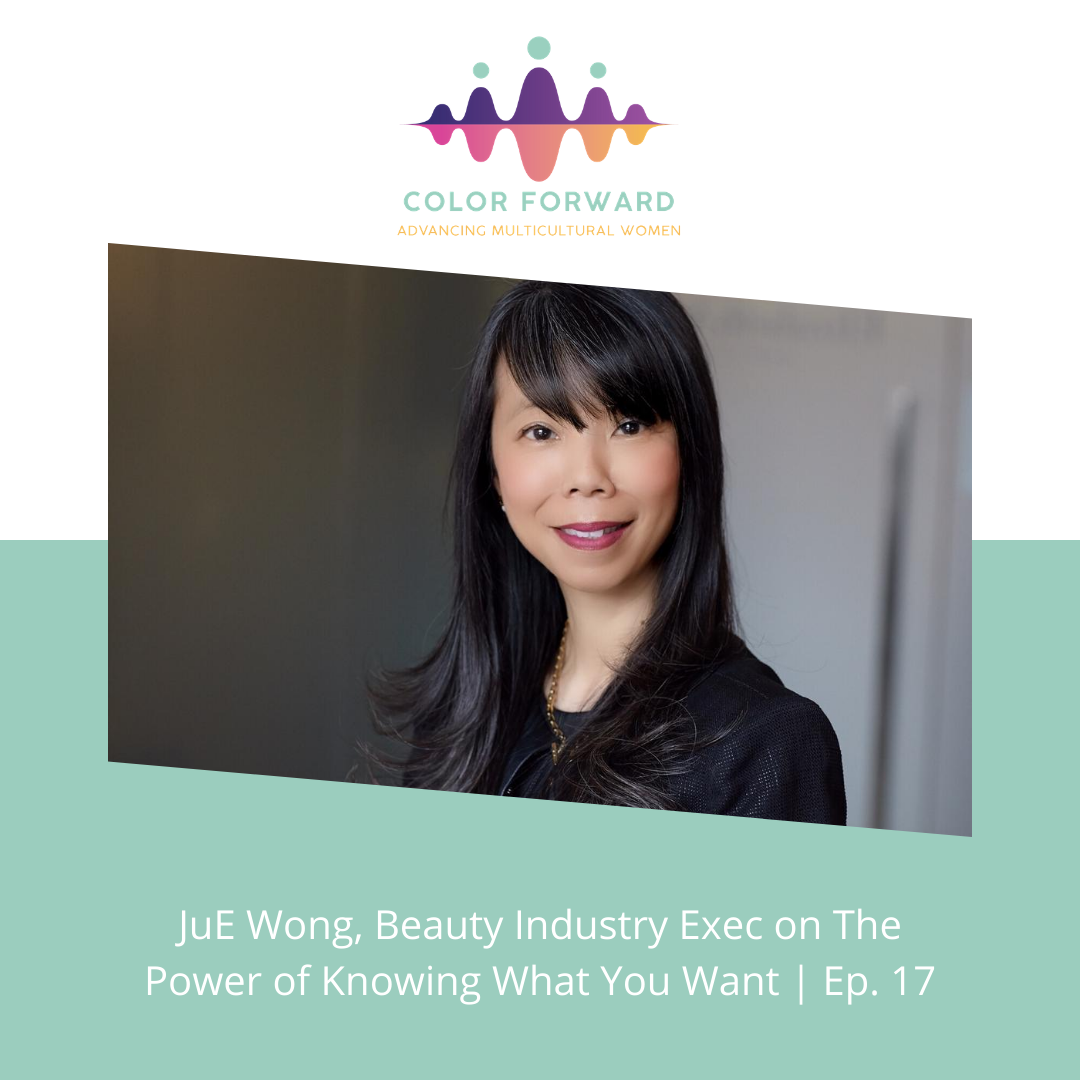
JuE is a 5x CEO with experience and exposure in four continents and seven countries. Her path is anything but traditional, yet everything about being intentional. Currently the CEO of Olaplex, JuE talks to Rosa, Merary and Alisa about outsmarting cultural stereotypes, the shifting tide of work/life balance, and staying focused on your goals.
Ep 17. Transcript
Alisa Manjarrez: There’s so much power in asking yourself the question, what do I want? And that is something that I really loved about today’s guest, JuE Wong. She is the CEO of Olaplex, it’s a hair treatment company. And her journey is so inspiring because she doesn’t have a traditional beauty industry background, but what she’s done time and time again is that if she sees a new opportunity that she wants, she goes after it.
It really inspired me that I too can change and adapt and move and think about what I want as I go along in my own journey.
[chill latin music plays in background]
Even before JuE started her career, she went from country to country, from Singapore to Australia to the US. And then she continued that journey taking her family from country to country.
It was very normal to her because she really took ownership of what she wanted.
[chill latin music ends]
JuE Wong: I started in Thailand and got transferred to Hong Kong and then the US but my family was in Arizona and I was doing the commute from Scottsdale, Arizona to purchase in New York, Mondays, and then Thursday a turnaround.
And a couple of years after that I joined the Dial Corporation and that was my first entry into beauty and CPG. And that was when I started working for beauty brands, indie brands, private equity backed brands, turn around situation. So long story short, I know ultimately my background has been not a traditional beauty background.
And I find myself very fortunate because instead of choosing the traditional path, I chose the turnaround path and that got me a lot of notice with private equity investors and when they needed somebody to really take on a turnaround role, my name get thrown into the pile.
And the good news is, I have never looked for a job since my first private equity role in 2009. Every time just before I finished or as I’m about to be done, I get a recruiter or I get the private equity calling me, and that gives me a lot of equity in the space.
Alisa Manjarrez: What’s really incredible about JuE is that she comes into a company for just a short amount of time. She turns it around, meets all the financial goals and then goes into another company and does the same thing.
And I really think it comes down to her, understanding her strengths and understanding her desires. Even though her path was not a normal path, she seemed very confident in the idea that her path is what she chose.
Rosa Santos: I think it’s incredible to find someone who has such clear goals for herself, for her life, for how she conducts her business and her craft. And that really shows through, including how she recognized her toughness on raring her kids, and really have really high expectations of her own children, let alone her, I imagine, her teams and the folks that she works, with. So she irradiates, even through the line, she irradiates this sense of, I may not know what I want right now, but I will find it out and I will get there and I will get it done.
Merary Simeon: She knew what she wanted, and I think many of us, sometimes we may choose our careers or choose the way to live life because of what we know. And a lot of the times people may be in a career that they may not enjoy because that may have not even been their purpose. It’s just that, we just took that, versus what I heard from her is I may have not known how it was going to do it, but I knew where I wanted, and I was going to get it done.
[chill music starts]
JuE Wong: My late husband passed away in 2009, but I remember coming home one day and just saying, we were in LA, and just telling him we’re moving to New York in like three weeks and we’re going to go look for a place. And he’s like, great, let’s go and let’s do this together. So I’ve never had this notion that I needed to check in, I needed to stop and think, I just kind of did it because I felt like it was the right thing myself, for my family. And that since it’s the best thing, there’s no need to discuss it further.
Merary Simeon: She had all the confidence in the world to do it, but not once did it sound that she’s like, I did this because that’s what’s the right thing to do or, or society thought I should do, or my parents thought I should do.
[chill music fades out]
Alisa Manjarrez: We talk a lot about parents influencing our lives with all of these guests. They talk about their parents and what shaped them and what shaped her was empowerment
JuE Wong: My mom was very busy as a career woman. She started off with a nursing degree. And then was in Malaysia, went to Singapore and started working for Exxon Chemicals and went from a stenographer to the head of the IT department.
I was her daughter, and I always thought that, Oh, all women can be successful like her. I looked at her and saw, I would say, that’s how should be.
And then my father was in the civil service and really retired quite early and took care of my brother and I. So I grew up in a household where roles were reversed, but I never thought anything about it.
In fact, I was always so proud that the fact that my father was at every school event and was always there for me while my mother was doing all the travel. And I thought, Hey, I like to have a little bit of both. And I think because my parents left me and my brother in a way that you decide for yourself what you want in life.
We will give you a safe environment. We’ll give you a home and you will never want, but, you know, you make those decisions. So I make the decision to decide to go to Australia for school. I make the decision that in between Australia I wanted to go to UCLA as an exchange scholar.
I mean, if you think about it, nobody told me what was the right path?
Rosa Santos: When I first left home I was very young, I had a part time job and I wanted to go abroad. And it was funny because my parents said, Yeah, as long as you can pay for it, you can go do it. I was like, okay, I’ll do it.
And I remember I saved up the money. I got myself a ticket to London, an airline ticket, and then I came home and I say, Hey, I got it. I saved up the money to get the ticket. I think my parents didn’t, didn’t think I was going to do it. And rather than saying, Sorry, no, we change our minds, even though it’s ever so painful for them to let me go in my early teens, I don’t think I would ever do that with my own son, they followed through with their promise and what they had said to me that I was okay to do. So I think we need to find folks in our lives, and sometimes it’s our parents, sometimes it’s a friend or a sibling or a mentor who is empowering you to think bigger than you think you can.
And who’s empowering you to propel you to at least initiate that discovery or that process of becoming.
[soft piano chords play in background]
Not many of us know what we want to do or what our goals are or where the ultimate purpose might be for us in life, but we certainly need to really get on and take that first step to explore it.
Merary Simeon: In life, many of us are still looking for somebody to give you that permissibility. But I asked myself, why do we give that power away? When at the end of the day, we’re the ones that make the decisions, we’re the one that lived that journey, we’re the ones that have to take the actions.
We’re waiting for somebody to give us the permissibility to do something, when in fact we had the power all along.
Alisa Manjarrez: I just had a coaching client, a man in his mid forties. He came to me trying to figure out what his next career move was, and I don’t hold back when I’m coaching. So all of the stories he told me, like, people basically put him in positions where they thought he could succeed.
And I said, you know, It sounds like you don’t have boundaries, and that stems from not knowing what you want. So I gave him this homework assignment to ask himself what he wanted. And he said, I’ve never asked myself that ever in my life, how am I 45 years old and I’ve never done that?
And so three weeks later, he changed his relationships. He figured out his career. He said every single day he asked himself, what do I want, what do I want, all day, even when it came to ordering food, like, what do I want to eat instead of what’s available? Or what’s easy? Just the act of asking himself, what do I want for dinner, he had never done before.
[music ends]
Rosa Santos: It’s a bit paradoxical for us as women to think about ourselves, because many of us that would be a trait of being selfish rather than selfless.
I even find myself as like, Oh, can I ask myself that question? Because otherwise it feels that I’m putting myself ahead of everybody else. Ahead of my child, of my husband, of my friends, my coworkers. It’s very counter to the way that many of us have been brought up. That you’re always there to give. You’re always there for others and for your community, for your family, for those who you care and you put yourself last, right? So changing that paradigm, there’s a lot of struggle to be able to take ownership, to ask yourself the question, what is it that I want, and you may not know immediately, but at least allowing yourself to entertain the possibility. that you can achieve what you want.
It’s the sense of regaining your own power to fulfill your desire as a human being.
JuE Wong: When you are at the workplace, No one expects you to be a superwoman. Everyone has their vulnerabilities. And in fact, in the past, people used to say, don’t get emotional at work, you know, just keep a stiff upper lip. You know, if you want to cry, I go to the bathroom and cry.
I mean, how many times have we heard of that? But I think today as executives and the rank and file, people who work for you do appreciate that you have empathy. That you understand what they’re going through and that you are only human. You will make mistakes. In fact, if you don’t make mistakes, there is a problem because you know, recruiters have told me, don’t tell me only of your successes, let us know about your failures, because how you handle your failures will actually tell you what you are as a leader.
Everyone can deal with success, right? Failures are the ones that really bring out the true person. And obviously you also have to have a bit of sensibility, tenacity is great, but stupidity is not.
Alisa Manjarrez: What you want doesn’t necessarily mean you’re being selfish. So I could want to change the world. I could want to impact lives. I could want to give back. So asking myself, what do I want, doesn’t mean I want a million dollars so I can go splurge on a shopping spree.
I mean, yes, I do want that. I’ll claim that right now.
Merary Simeon: Hello, take me.
Alisa Manjarrez: Right? But I think that we immediately stop ourselves because we don’t want to be selfish, and that’s not true. Asking yourself what you want is part of your identity. It gives you agency to move forward.
And if everyone asks what they wanted and walked into that power, if you think about all of these women who are listening to our podcast, who are guests on our podcasts, we’ve seen it time and time again, when someone owns who they are, they own their voice. They ask themselves what they want.
They make a difference and they move forward in exponential ways.
This is all about overcoming barriers. We don’t know what she was expecting, for example, when she moved to Hong Kong. And any time anyone moves their entire lives to another country, there’s no way you can say, I know exactly what barriers are going to come.
Like you just can’t. And so I think what you were saying is that JuE really understands that they’re there and knows how to navigate around them.
JuE Wong: I think barriers are always there. It would be a lie for me to sit here and say that my life was smooth sailing. Breaking those cultural barriers that says that woman has to make choices at the very beginning and that you may have to take a backseat in your career. I never felt that I did that. If anything, because I have empathy in knowing what it takes to balance both a family, and also being an expatriate, it wasn’t just being in one country at one time, it was literally in seven years with Cargill, I was in four different countries.
And had two kids in the process. I tend not to talk a lot about my family. So for eight years everybody knew I was married, they knew I had children very few people realized how I was juggling things.
Merary Simeon: She is constantly moving out of her comfort zone, because she knows what she wants. So it doesn’t matter what the barriers are. She’s not a slave to a job, to a company, to a country, to anything.
And she’s moving forward where I think a lot of times many of us get comfortable where we are, and it’s so difficult to move out of the position or situation we’re in. And we become slaves to that. And we forget our North.
Rosa Santos: Staying in a comfortable position sometimes, is it because you really want to stay there or because there’s an expectation as well to stay where you are? And at the same time, you can get a little complacent in that situation.
But to what extent is really that pushing you to grow as a human being, as a professional, or as a partner, it’s qualifying want in a way that truly is going to make a difference for yourself.
And that will allow you to then take on anything that comes to your way because you know, that’s only gonna make you stronger, more self confident and is going to increase the possibility of you getting to what is going to bring you joy and growth in whatever you desire.
Alisa Manjarrez: Even when it came to overcoming cultural barriers, JuE owned her power, then. She recognized the stereotypes against Chinese people, and she used them.
[music starts]
JuE Wong: I think, you know, people tend to kind of have certain perceptions of certain cultural groups and perception is 99% of reality. In my case, you know, being Asian and being woman and kind of petite, I think people look at me and sort of say, you know, in Asian, in general, you are a great worker. You are very respectful and you basically will get the job done in such a way that we asked you to.
And you’re very good with numbers, you know, you’re very data driven. So that’s what they really generally think of Asians. I may not be that at all, but I let those stereotypes work in my favor. And then what I do is I showcase that I actually can work smart. I don’t have to just work hard. I do have a point of view and I will share it with you, but respectfully.
And more importantly, I am also very creative. I’m not just a numbers driven person. I have empathy and I can build a team. And I think when they have that conception of who I am, and then I’m able to kind of change that perspective, not so much that I’m no longer good at what they thought, but I’m also good at other things, I then come across as a complete package. I always tell people it’s great to be underestimated because then you surprise people, and it’s a little bit like, you know, under promising and over delivering.
[music fades out]
Alisa Manjarrez: Oh, you think I’m analytical and really good at math. I’m going, going to show you how creative I am and how strategic I am.
And she ended up taking the stereotypes and reclaiming them in a way that helped her to leverage it for power. So when people learned that she had these other gifts, they’re actually her natural talents on top of what they assumed. And it just made her look like a rockstar.
Rosa Santos: Absolutely. Because of who we are, either women or women of color, there are so many stereotypes that are thrown at us every single day, not just at work, but everywhere. And it’s so easy. It’s like when someone is throwing at you something bad and then you just take it and you keep it and it’s hurting you, but you are just not doing anything about it.
On the contrary, you are taking it personally. Whereas JuE did completely the opposite. What could have actually taken away her own power? She outsmarted the way that they were coming at her, but really owning it and then showing it in a different way that would demonstrate that she was way more. So in a way she was being incredibly strategic.
Merary Simeon: Actually made me think of situations where I’ve been stereotyped. Oh, you Latina, you are so passionate and I’m always like, I drive for results. But besides the point, uh, I feel that there were times that I had an opportunity to demonstrate how strategic I could be, how impactful in different other ways that I could be, and I didn’t, because I was so cautious to make sure that people didn’t just see me as a passionate person, that it blocked me.
I’m like, I just wasted that time, because I was so busy worrying about the stereotypes that people continue to remind me of. And I could have just done what JuE did taking advantage, be at that table, and really prove to them and show that I’m more than what you just think of me.
Rosa Santos: We can’t underestimate that it’s not easy. I think we’ve talked before about micro aggressions, and how hard, even in the moment, it is to recognize what is happening to you is exactly that. Somebody is even more tactful and smart to do it in a way that you don’t even notice that is, you know, but it’s poking at you and at your core or that it’s really making you… or diminish who you are, let’s put it that way. So… And it’s tough. It’s tough to be on your game all the time to say, you know what, when you call me passionate, I’m going to say, yes, you’re absolutely right. I am passionate. And that is why the way that I am thinking is going to bring you X, Y, and Z.
It’s tough. It’s exhausting. And at the same time, I think we need to push ourselves to outsmart what’s coming our way and again, leverage it in our favor as much as we can, and own it, right? Own it to give us that self confidence and, and to the extent possible, put it aside and just push through.
Merary Simeon: I think that’s where the knowing your North or knowing your why comes in. It’s so difficult, because I don’t feel the micro aggressions are gonna go away anytime soon, you know, unconscious bias is on everybody. And I think now that because of everything that’s going on around the world, we’re more conscious of it when we see them, right? So I think it’s really up to each individual to say, Hey, am I going to call that out? Or am I going to let that stop me? Or am I going to use this to my advantage and really make an impact in what I want, versus thinking about what they want, which could seem selfish. But at the end of the day, it’s something that’s going to continue to help us move forward, to impact the world in a better way.
Alisa Manjarrez: The exercise you did of reflecting back on the times where you didn’t use your power, you didn’t say, I’m passionate and… I think that’s how we get through, because I started thinking about the times it wasn’t easy. And for me personally, it’s when I felt impostor syndrome and someone called me out.
[music starts]
I remember I was leading a project I wasn’t qualified for, and this man came in, and honestly, I was doing a good job. But he said, why are you here and why are you leading? And I just shrunk and I let that feed into my own imposter syndrome. And later I still like, you know, I still went and was successful with the project. But I am mad at myself for letting it get to me in the moment. And so I think that what you’re talking about is really reflecting on those moments and becoming aware. So that the next time you don’t shrink.
[music ends]
Rosa Santos: We’ve talked a lot about balance. It means so many different things, depending on who you speak to balance can be health, right? Balance can be, again, having a successful career while you raise a family, Balance can be being able to squeeze everything that you want to do, be running a marathon while you travel the world for work. It’s one of those higher order terms and concepts that it’s very hard to pin down. And what I liked about what I heard from JuE is this evolved way of referring to balance based on where she was at in her career and her own journey.
JuE Wong: you can have everything, just not all at once. I knew that if I did not have kids young, I probably would not, and so I was a very young mother, which means that I had to be responsible and a very young age.
I also felt like my kids did not have everything that they needed from me. And I know it, you know, from things that has happened. And so I’m fortunate now they are able to take care of themselves. They have their own families. I feel like they are more my friends now than they are my children.
I’m a tiger mom. And I probably always will, because even when they were little, they come home with a great report card, the first thing I would say is you know better you rank. And they say, we really don’t know. I say, if it’s so easy for you to get so many A’s, obviously the classes were not that difficult. Or if they didn’t come home with straight A’s, I’m like, what’s wrong with you? I am pretty tough. And I think, you know, they kind of joke about it now.
Rosa Santos: I am ever so glad now to be able to talk about my child with my coworkers, cause I know, 14 years ago people weren’t talking about their children. When I, when I was pregnant, they weren’t talking about their children at work and it wasn’t common to be able to even have those conversations, unless it was just about work, but not about you as a fulfilled rounded human being that has the life outside work, right? So that evolution has happened because I think the expectations have also changed. So that sense of balance is a little bit of, again, I think balance nowadays is more, What makes you sane and fulfilled and healthy, rather than, What can I do now versus what can I do later?
Going back and thinking through the way that we are stereotyped about being women who work and have successful careers is the fact that you may have defined all that you want to achieve. You may have defined, and you’re very clear about your goals.
And you may think that everything is attainable at once. And she very clearly said, absolutely, you can have it all, but maybe you have to, bearing in mind, that you cannot have it all at the same time all at once. Which I think it resonates more now, because I think folks are more willing to give up certain things for the sake of their health and their sanity and wellbeing of those who you love.
Alisa Manjarrez: I had a boss who would always tell us, you know, we’re doing marketing, this isn’t rocket science. We’re not curing cancer, if something is going on in your family, Yes, please drop everything and deal with it. And I think that that’s kind of a relatively new… and even… it’s been interesting for me as a single person, because I can’t say, sorry, I have to go pick up my kids.
Sometimes for me, it’s just, I need a break. And I don’t have the excuse of a family that someone can say, Oh, okay, we get it. Like, but to have coworkers, bosses, friends even acknowledged that wherever you’re at in your stage of life, you are still important. You still have value as a person.
Now when you think about retaining employees and all of the programs that are in place, balance is part of the package sold to attract people. Is it real? I don’t know. Does every buddy do it right? I’m not sure.
Merary Simeon: She was doing what she wanted to do.
And I see it all the time now that if organizations do not meet the balance it’s going to be very hard to retain people, but I’m also wondering how many people have asked for it.
Rosa Santos: I don’t think nowadays any organization, any potential employer, could take the risk to say, Hey, I don’t care what’s happening to your family, I need you here. If they’re seriously about sustainability of their business and wanting to grow as a business, having that kind of way of leading and being is no longer acceptable. Our guest alluded to how she is leading the chart in infusing goodwill through her organization, and really getting to realize that the well being of her own workforce is truly the well being of the organization.
Because as the future truly involves exercising and activating programming that infuses that goodwill into organizations, because those are the organizations are going to succeed coming out of this.
[plucky guitar plays in background]
JuE Wong: One of my very first inclination, even though I am not from the professional beauty space, like I have never really worked in a professional hair setting before, I came in with fresh pair of eyes and I also questioned if they need money and they need income because their salons are shut down, Why can’t we as the brand, offer an affiliate program where their customers can open, you know, can buy products from us at full price, and we give them a commission up to 35%. Which is a lot, because we essentially gave almost all of the commissions to them.
And everybody’s kind of saying, but why? But my answer was why not? If we can do well and do good we will make money, and think of the goodwill that we will create. We generated close to $400,000 worth of commissions to a cohort of professionals. And you should see the way they responded to us on social media. They said, when we receive your check, that was my grocery bill. When I received a check, that was my ability to pay part of my rent or my car payment.
And it’s pretty heart warming that you could make that difference. So I think, you know, that social aspect, that empathy aspect is going to come back and at retail, we’re going to treat each other with a lot more respect, because we had a world without them, and we realized we could not survive without them.
[plucky guitar ends]
Merary Simeon: A lot of the times we think about being empathetic or even having mercy, and I think about as mercy is not just an emotional, Oh, I’m sorry you’re going through that. Oh, I’m sorry that you can’t come to work or that you’re not getting paid. I think it’s more about including an understanding the pains and the struggle that the community or your employees or that person is going through and demonstrating action, which I feel is something that JuE did in a macro way when she leverages the power that she has as a CEO to really take action in those communities.
First she thinks through it, understands their pain or what their struggles are, and then she’s like, Hey, I can help. Let’s demonstrate some action.
Alisa Manjarrez: She started really looking at the industry as a whole in her community, how COVID is affecting hairstylists, and she came up with a solution to help everyone. And it ended up being a win-win for hairstylist and Olaplex.
JuE Wong: If you want to be successful and you feel like you need to kind of put your point across and get the message across, sometimes it’s not that easy, because common sense, like they say, is not that common and you need to kind of persevere and push through, not because you just… you’re pedantic, not that, but you, if you believe and data does point to the right things sometimes you’re not hurt, not because nobody would wants to hear you. It’s because you don’t have loud enough of a platform or a megaphone. So you need to network with people and connect with people that can give you that platform.
And, and I believe that as women, certain things are very natural to us. You talk about muscle, you know, it’s a muscle memory. I mean, nobody has to really teach us how to be maternal, and the maternal instinct become very much how we work with our teams, you know, and you develop empathy. I mean, I have talked to several executive coaches and they are telling me that great number of men coming to them, and wanting to have coaching on how to be more empathetic. I mean for a woman, I mean, I hate to say this, it’s probably, you’ve got to be coached to be a little bit less empathetic because otherwise, you know, you’ll end up, you know, giving everything of yourself and nothing is left.
In order for us to be worthwhile for the people that we want to help, we need to also reserve energy to continue on that pathway.
Rosa Santos: Unfortunately common sense is not that common. I absolutely laughed how she referred to it. ‘Cause it is true. Sometimes it’s when we say it’s not rocket science, or it doesn’t take a rocket scientist to think through it, but it does take the action. You can think through it, but if you do nothing about it, nothing happens.
Alisa Manjarrez: Yeah, and her approach is how can we win together?
And the cool thing about JuE is she takes that from company to company. So she’s like spreading goodwill. Where if she serves on a board, if she serves as the CEO, she mentioned that for her leadership it’s all about stewardship and it’s about stewarding her position and then stewarding the people around her so that everyone wins in the end.
JuE Wong: I think as leaders, we have three p’s, purpose, people and product. And you can always articulate what your purpose is for the organization and you don’t sway from that purpose.
You can then really rally your people and you can take care of them and really be authentic to them. Because people will return your business to you, a hundred fold, and then your product will be the best product possible because you have people who are passionate and your purpose is right. So to me, those three p’s will be my guiding principle.
Purpose is key. People are even more important. And then because we are a business, you’ve got to have a great product.
Rosa Santos: What am I doing every day too steward others to be or become successful?
Merary Simeon: And you don’t have to be in a position of power to do that, right? When you ask yourself that question, it could be at home, it could be a stranger, it could be, you know, your friend, your peer, your family. So I really loved the way you framed that because you don’t have to be a big executive to make the impact. However, when you’re in a position of power, you can influence even more.
JuE Wong: We’ve got to break through those stereotypes before we can even be seen as having a seat at the table. And I think when we have a seat at the table, it behooves us to actually bring other women along. And I think if each one of us lend a helping hand and is committed and pledge ourselves to do that, we will have enough women in the pipe to be in the C suite to be in on the board the rooms. And to be able to kind of say, I will give back. I can do well and do good, but we all got to start doing that, because I think there are certain instances where we feel like, I worked so hard to get here. Nobody helped me. So you can go fend for yourself. But that’s not the point, the point is if you can, why not?
Rosa Santos: What I would add to that is that I think when you’re in a position of power it becomes your responsibility. And, that’s, I think the expectation that we should create of, of everyone who has a position of power to influence in a way they can have an impact and really, truly steward others to be successful, because by doing that, I’m quoting JuE, then we will all win together. We will be something that we are truly in it together.
[dreamy music starts]
JuE Wong: Retail services are going to be places of experience rather than just places of transaction.
And when you are then going to be in those places of experience, you want to be able to maximize your time and to optimize your interaction.
The beauty industry, especially in beauty salons, about 90% of the business is owned by women. And of that 90%, 16% are African Americans, 23% Asian American, 16% Hispanic. This is an industry where you can really effect change. And all we have to do is to avail our platforms for them and when we all win together we all float the boat. Your public stock value is going to be judged by how you treat your people.
So I’m very hopeful that we are going to walk away from this with changes that are material and that all of us, whether we work for smaller companies or bigger companies, we are all judged by the same KPI’s.
[dreamy music ends]
Alisa Manjarrez: In it to win it.
Rosa Santos: In it to win it. Uh, so Alisa, what’s the homework? Because you wanted to leave us with some homework today.
Alisa Manjarrez: I would like to invite our listeners to ask themselves, What do I want? And ask yourself, What do I want in any situation? So whatever your day looks like today, find an opportunity to ask yourself, what do you want?
Merary Simeon: And analyze if your actions reflect what you want but really scrutinizing it, why do I want it?
For so long, we’ve been doing what the rest of the world thinks that we should do. It’s almost like you have to break out of that routine.
Alisa Manjarrez: So often we live in the land of shoulds, I should do this, I should do that. Instead of just doing what we want and taking action. In that process we stop playing the victim and blaming the world on our lack of progress or our lack of not having what we want.
And instead we have an opportunity to claim our power by asking ourselves what do I want? And taking actions based on that instead of taking actions based on what other people tell us to do.
[theme music starts]
Alisa Manjarrez: For more inspiring stories, please subscribe on Apple, Spotify or wherever you listen to podcasts. If you have a guest you’d love to hear on the show, send us a DM on Instagram at @colorforwardpod.
I’m Alisa Manjarrez, producer of Color Forward. Thanks for joining us and, please, leave us a review.
[theme music ends]