
20. Samira Saffarzadeh, D&I Champion on Taking a Stand for Humanity
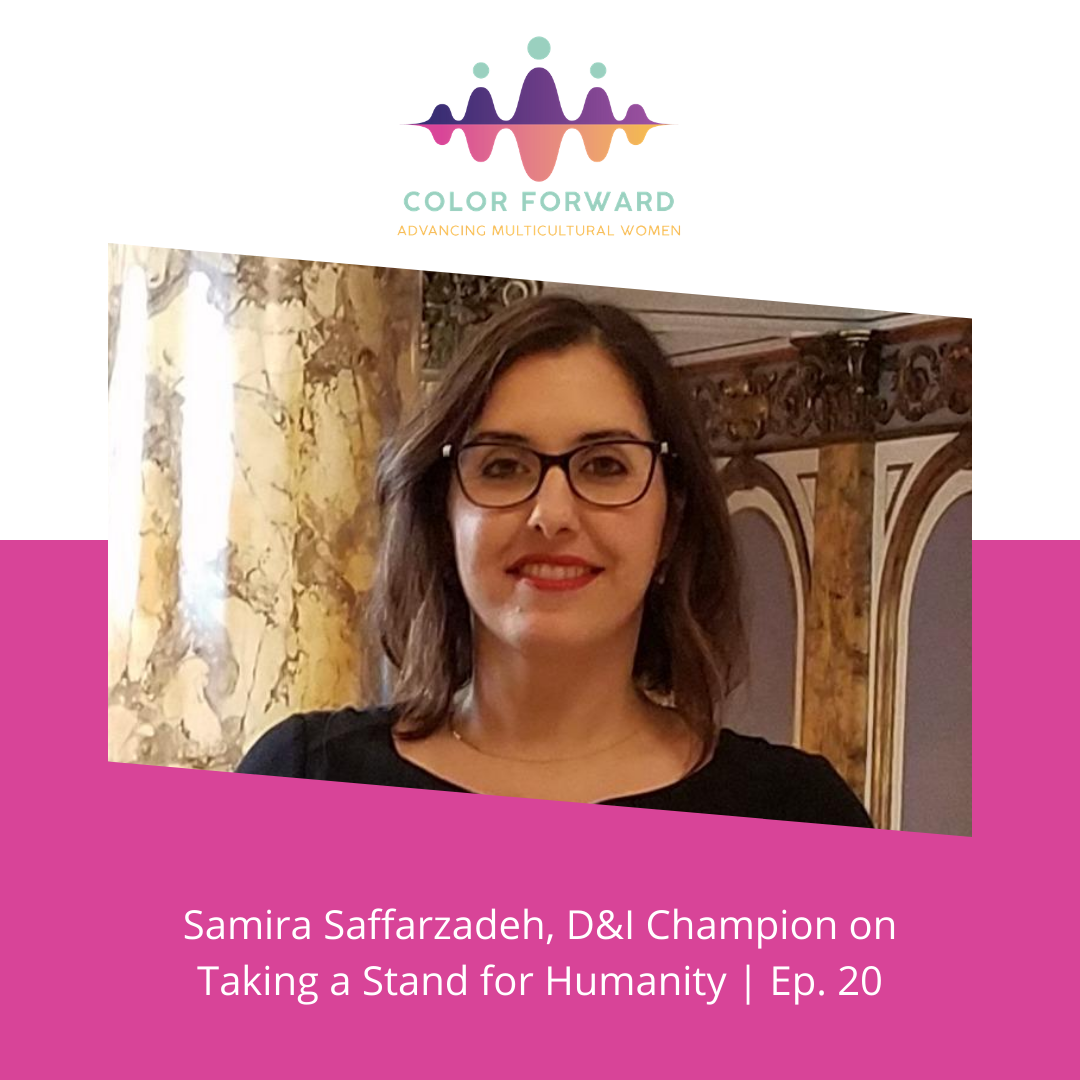
Told by her Iranian grandmother that girls shouldn’t play outside, Samira Saffarzadeh grew up always trying to be one of the guys. Now, as Supervisor of Capital Delivery Systems at Pacific Gas & Electric, she’s creating a culture that values representation and support for people in the Middle East, Europe and North Africa. Listen to her talk to Rosa, Merary & Alisa about her journey to embrace her identity as an Iranian-American woman.
Ep 20. Transcript
Rosa Santos: Are you guys always true to your purpose?
Alisa Manjarrez: When I have something in front of me, there’s so many external distractions that come along the way, and it’s like the idea of whatever shiny gets your attention. And sometimes if you pay attention to too many shiny things, you completely get off track and you forget why you’re there the first place.
So, do I always stay true to my purpose? Sometimes.
Rosa Santos: Hopefully often.
Alisa Manjarrez: Yeah. I hope. That’s the goal, right? I mean, and I put structures in place to help keep me in check. So whenever I do have something that I’m working towards I have people in my life to keep me in check, to say, Hey, why are you doing that? You said, you would never do this, and now here you’re going and doing exactly what you said you would never do. So I try to put systems in place so that I stay aligned with my values.
Rosa Santos: That’s very important, isn’t it? It’s important to recruit folks who know who or what you’re doing so they can check in with you or keep you in check, right? And then maybe you can change your mind along the way, but, but having that kind of overall partnership or accountability partner, if you like, to keep you in check It’s definitely a great strategy to consider. Merary?
Merary Simeon: I was just thinking about my character, and how, no matter what it is, whether it’s my purpose, whether it’s my marriage, whether it’s my school or work, you know, I’m very driven. I get it done.
There are people that waiver depending on the situations, right? They may go back and forth and attack things differently. And there’s nothing wrong with that. However, I feel like I know where I want, I’m going after it, how I get there may be different even when it comes to my purpose, but everything that I go after I go after the same way. I make up my mind, I’m going after it, regardless how I get there, but I’m going to get there.
Rosa Santos: And I tell you, I think what works for me is telling it, you know, sharing it and not keeping it. I always say if I don’t share it doesn’t happen. If I don’t bring it up I won’t get it done. So just by the mere, you know, action of speaking it out loud to somebody, and sometimes I say, like taking it out of the drawer and putting it out there, then it is actually enough for me to want to get it done.
And if I lose sight, I am like you, Alisa, I think enrolling folks in just reminding you, like, why are you doing this? Why I’m in this line of work, right? Why have we embarked into this project? Why… Like trying to get it back to the original intent. So you stay the course. So you get there. It’s, critical.
[cue theme music]
Alisa Manjarrez: I grew up around Samira Saffarzadeh, because she lived on the block with all my boy cousins and all her brothers would play with my cousins and we would all see each other. And I remember her being this super tough, don’t mess with the girl, and fast forward, 20 something years, and now she’s this eloquent woman, mother of two, completely different from the tough girl that I saw way back when.
Samira Saffarzadeh: I’m a very sensitive person. I was the only girl on the block. My grandmother lived with us, and again, I said, I’m Iranian. So there’s a lot of things that go with that. Although my parents were very westernized, very openminded, they had no problem with me playing with the boys or playing sports and whatnot. My grandmother the other hand had a different perspective.
There were many times where, you know, my brother would go out to play and I’d be like trying to run right after him. And she’d grab my hand and she would say, (speaking Iranian)… like girls don’t go outside to play. And she would make me sit in the house and clean or something very boring, and I hated it so much.
Alisa Manjarrez: Growing up she faced a lot of adversity. You know, she was really tough on the outside because of a little bit of bullying that went on in her household, but it informed her purpose.
Samira Saffarzadeh: My brother and I, we were very close in age. I was daddy’s girl. He was a mama’s boy, right? So there was a little bit of that competitiveness that went on. My brother’s friends used to call me “the man” growing up, like in high school, like they would say, she’s the man, ‘cause she hits hard, like a guy. And you know, they would just talk trash.
And I was a girl and I was sensitive. I would talk back and put on a front, like I’m tough, I’m strong and I’ll fight too, and things like that. But, inside I was hurting.
Alisa Manjarrez: Samira is so much about giving everyone a voice and giving them a chance to speak and giving them equal footing, because she didn’t experience that growing up. And she did not want to continue those patterns.
Samira Saffarzadeh: I don’t want people to feel like their voice doesn’t matter. I don’t want anyone to ever feel like they’re not enough. Or that they can’t do something because of what someone else said or some fake rule that somebody created out of nowhere and imposed on us as if it was true. And so I think that’s really kind of where it started was just, I don’t like the way this feels and I don’t ever want to make anyone feel that way.
And so that’s, I think, where it started to grow from.
[music cue]
Alisa Manjarrez: Today she works at PG&E. It’s a utility company in Northern California, and she’s a supervisor for Capital Delivery System. She’s a Six Sigma coach. I don’t even think she told us her title because it doesn’t matter to her. And that’s a value that really came across when we spoke to her.
Samira Saffarzadeh: My career is not my motivating work, which is interesting. I took some classes a while ago all about, what gets in your way, what are you doing to get in your own way? All of the neuroscience that goes into how our brains are wired and how to rewire them.
And so one of our exercises was about getting aligned with your purpose and really getting in touch with why we do the things we do, what inspires us. And in that, just really got connected with the fact that what really drives me is people. I am a stand for humanity. I’m a stand for a world that works for everyone, a humanity united, and that’s really what drives me.
What does give me that feeling in my career is when other people give me feedback saying, wow, you helped so much, and we’re so grateful that you’re on our team, or, Will you please help us with this project and come work for us? I’m making a difference in the professional capacity as well.
So I think that’s kind of where I’m at. It’s never really about the title. It’s about what type of impact am I making.
Rosa Santos: Isn’t that a great lesson of true self awareness? And rather than just, you know, keep it all within yourself, just putting the experience to good use. And you know, it makes me think about, if we all did that, what a much better world we might be in, if you think about it. Although I know it’s hard, really, it’s hard to break through and being able to then being concrete as to what you can do to impact others in the way that you would have liked that somebody did for you in the past, right? But I think what she’s doing, it’s, it’s amazing.
Samira Saffarzadeh: so I’m Iranian and Middle Eastern and we’re not represented. So we get classified when we fill out paperwork as white non-Hispanic, however we… you know, when people see our names on a resume job application, or, or even know that we’re Middle Eastern, we still get discriminated against, right? We still get bypass for opportunities. We still get lumped into this group of terrorists and all of those crazy things that you hear and you get when you’re not represented in media, and when you are, it’s always negative. And so, you know, creating, the employee resource group, we called it MENA.
We represent the Middle East. We also included Europe, because we felt like there was a gap there that wasn’t being, represented and we wanted them at the table. And then, also North Africa. Probably my proudest accomplishment is setting that up, because it has made such an impact to our community at work.
And it has made such an impact for new employees coming in. Like when a new employee comes in and they learn about the employee resource groups. And for a second, they’re like, Oh, you know, where do I belong? You know, where do I go? And they’re like, Oh, hey, there’s this one group it’s called MENA, and literally I, was talking with someone last week, they’re new to the company, and she was like, I was in tears when I heard about you guys, because we are never represented. We never have a group. And to know that I came to this company and I have people that I can go to, I have a community, I’m seen, I’m heard, I’m represented. She was like, I made the world of a difference to me.
And so when I hear stories like that, I just can’t help but just be like, That’s… that is… it makes me so proud. That’s what I’m here for. That’s why I worked so hard to get it. And that’s why I do the things that I do. So that is definitely my proudest moment. I actually got an award for that and some other work that I do outside of the company I work for, and they rewarded me with a diversity and inclusion award. My peers nominated me, and that was a very validating feeling. Like it felt really good to be recognized, and it felt even better to know that people were learning about my community from our perspective, we were controlling the narrative.
We were saying, this is who we are. This is what we actually represent. It’s not what you see on TV. We’re just regular folks. We’ve been here for a really long time. And, you know, we just want to contribute. We want to help, and we want to be, uh, you know, be part of the community and that’s really it.
So it was really nice to be able to share that with them.
Rosa Santos: Creating an ERG, or an employee resource group, about a group that not many people know about or have any relatedness, right, to it’s somewhat breakthrough as she did.
Alisa Manjarrez: Yeah, and it’s interesting how, for her, the idea of bullying was something from her childhood, but she still does currently today encounter bullying in the workplace from professional people.
Samira Saffarzadeh: Bullying is a huge problem, and it happens all the time.
And you know, even at work right now, we started a series of conversations at work. We started a task force of me and a few colleagues and it’s called Strategic Allies Leading Transparency, and we are having conversations about race. And it’s interesting to see how, when people are responding and providing negative feedback towards it, they don’t want to participate in it.
It’s really like in a bullying kind of way. Like this makes me uncomfortable so therefore you need to stop or, you know, or else. And it’s like, it’s interesting to see how it still happens, but not in the obvious way that you see on TV where it’s, you know, kids at school getting pushed into a locker or someone obviously being called out of their name.
There are really like little micro bullying and micro aggressions that happen that you’re just kind of like, you’re just tossing shade at my way, like, what was that? What just happened? Exactly, exactly. And it’s like, did she just say that? Wow. And it’s interesting to see that people still kind of do that, whether they’re pulling rank or seniority or something like that, people still do that.
It’s interesting, but it’s also something that needs to be addressed, and when we’re talking diversity inclusion, especially.
Alisa Manjarrez: I consider you both experts in diversity and inclusion. And I have heard from other senior leaders that there’s a fear in bringing some of these things up, like racism, cultural issues, because they’re afraid of being political. Where do you think that line is between like humanity and politics and what you should say to make people feel welcomed?
Merary Simeon: Everybody’s entitled to feel and believe on what they want as long as they’re not trying to impose that on somebody else or hurt somebody else while doing it. Believe in whatever you want to believe, I respect your thoughts. I respect who you are, but don’t try to impose that on another individual. Everybody’s open to be who they are.
Rosa Santos: I think it has to do with our innate human ability to judge and pre-judge others. I actually don’t think it’s about imposing my beliefs on somebody else, it’s that innately because of my beliefs I’m already pre-judging you on what you’re thinking. And I think that inherent fear of what you might think about me because of who I am is what breaks down that communication.
Merary Simeon: If I say something that I believe and it’s against the hottest thing going on out there right now you are now not inclusive. Oh, you got to take sides. And it’s gotta be neutral and from a diversity perspective, that I’m always looking at is we gotta respect other people’s opinion. Again, I go back to, if it’s not hurting you, then whatever that person beliefs are, we need to allow them, because you know, you talk about, being able to get over the fear of what you want to say, but I think right now, what I see the most is people are very fearful of saying what they think. Because they’re judged immediately. If you say something or if you stay quiet, if you say something that is not popular, if you… whatever it may be or whatever the topic of the week is, it is very hard to be yourself.
It’s what I see. And it’s very hard to speak your mind, because it’s almost like you just can’t. You gotta be very… If you had to be careful before, about what you said, you have to even be more careful today.
Samira Saffarzadeh: And you want to do it effectively, because I think one habit that we have nowadays is we are very reactive as a society. So if we say this is bad, therefore it has to be gone or this hurt so therefore we have to get rid of it completely. You know, there is no gray area. There is no room for compromise and it’s… that’s where we fail as a society, right? You’re either a liberal or you’re a conservative, right? You’re either, you know, Democrat or Republican or you’re either God fearing or you’re an atheist, you know, you’re going to hell, and there’s no middle ground.
There’s no room for real compromise. There’s no room for people to just be people. People are quick to react, and it’s like, look, if we just slowed down, took a breath, like relax and just kind of like see things for what they really are, we’d probably make a lot more progress, we probably wouldn’t be fighting so much.
Rosa Santos: No matter what, and no matter what you say or how you say it, we are judging each other constantly, right? And in order for us to break that barrier and just accept, ‘cause I think what you’re saying, Merary, is that, what would it take for us to accept who we are for who we are, what we believe and what we do?
Merary Simeon: Yes.
Rosa Santos: And it would only happen when, when it is okay to bring it to the open and you suspend that judgment.
Alisa Manjarrez: That is diversity of thought, right? You have multiple perspectives that everyone is welcoming and listening to. It doesn’t mean that you have to change your mind.
Merary Simeon: That’s right.
Rosa Santos: Exactly it does not mean that you have to change your mind. I think it’s you need to catch yourself and suspend your judgment on the other person. Listen, to understand, so you can raise your empathy by doing that, and understanding where the other is coming from. Now we’re at a moment, I think in history, that everything is taken to the extreme. And there’s not even an opportunity to dialogue around anything, because anything has a very specific meaning that either one side or the other is appropriating and then therefore there’s no opportunity ‘cause it’s like head to head rather than dialogue.
I think we’ve talked here before about even our own experiences on how even in the positions that sometimes we hold, we feel that it is challenging to actually to get your voice across. And, now we have different names or language to address it. Like what you said, Merary, they’re micro aggressions, for instance, and in fact, it’s interesting, you bring it up from a cultural perspective because sometimes when you call it out and you say, you know, do you realize what you are doing is… just putting this extra burden on a person who’s already struggling. They’ll say, more often than not, they’ll say, Oh, I didn’t mean it or it wasn’t my intention.
Alisa Manjarrez: Or, I was just joking. They minimize it like they…
Rosa Santos: Yeah, Oh, I was joking. Exactly.
Alisa Manjarrez: They give themselves permission to be a bully.
Merary Simeon: TI think it’s also the environment that people… ‘Cause I agree. I think there are really mean people who use that… those words just say, Oh, I didn’t know, but I’ve also just been witnessed to certain, you know, some children or youth that grow up right here in the backyard, in South Dallas, right, where that’s the way the families speak to each other.
That’s the way that their environment is. And as they grow up and they get to high school, they’re just like what? It’s not okay to talk to each other like that? And then as they go on to college and so on, and then they get into the workplace and it’s something that unfortunately has already been ingrained.
So then when they grow up, it’s, it’s tough and it, I mean, you don’t even have to go to so far, you could just look in your backyard as some of these places where unfortunately, that’s, that’s the way that people are growing up. And 20 years later, they take it into the workplace.
Rosa Santos: Yeah. And that’s why, I mean, just piggybacking on the conversation that we were just having about culture and if it’s okay, if it’s not okay, if it’s second generation biases or not, I would say it needs to be called out because as soon as that actually hurts somebody or makes somebody feel not counted or diminished or plain depressed it’s not right. It’s just not right, and it needs to be called out.
And I think we talk a lot about empathy here. We talk a lot about our ability to push through and be resilient and we can only build that empathy muscle sometimes if you have somebody who’s actually forcing you to look at yourself in the mirror and say, this is not okay. This is not the way to treat people, even if it’s just… even if you think it’s a joke, it might be a joke for you, but definitely it’s not a joke for them.
Alisa Manjarrez: That’s where those teachable moments come into, because of the cultural aspect. I know people who have said, why aren’t you making fun of me? That’s what my family does. That’s how we relate to each other. It’s like this, yeah, just a dysfunctional love language. And you almost have to say, no, that’s not how, that’s not how we treat people.
And if that’s all they’ve grown up knowing people on the outside, it’s kind of like our collective responsibility to help each other out, because if you grew up like that, there’s nothing wrong with the way you grew up, but there is this idea of teaching each other how to be respectful.
Merary Simeon: Absolutely, because it’s gonna hurt them in the long run. If they’re lucky enough to have somebody that would talk to them and actually edify them, right, with love and tell them, Hey, this is what this means. And this is how you’re making me feel. Or this is why you shouldn’t say those things. It would be a game changer for a lot of people.
Alisa Manjarrez: One of the things that I loved about Samira’s former CEO is she actually called out what was happening in the country when there was a travel ban and Iranian culture was being villainized. Her CEO brought it up at a town hall.
Samira Saffarzadeh: It literally just started as happy hour. A group of people getting together to hang out. We didn’t have any intention of creating the employee resource group. For us it was just, we just wanted to hang out and have fun. And what changed that was the travel ban. And it really impacted our community. And we felt like we were vilified for no reason and being punished for something that we didn’t even do.
And our CEO at the time it was, she had just started. She was conducting an all employee town hall. Somebody asked her about the travel ban, ‘cause she was an immigrant from Cuba, and she was sharing a story about her best friend who was actually impacted by the travel ban and was stuck in Iran.
And she was just saying how hard it was and how she sympathized and how she was, you know, supportive of the immigrant population and of, you know, Iranian people and even, you know, all of the countries impacted and she didn’t think it was fair and, and whatnot. And when she said that, I mean, we were like, wait, what?
Alisa Manjarrez: That’s bold, right there, but what it did was it helped an entire group of people feel seen and loved and recognized. And I can’t even imagine the ramifications that it can have on an organization.
Samira Saffarzadeh: Like a whole new world opened up for us. Like that’s how important representation is. I didn’t know how unrepresented I felt until she shared that story.
Rosa Santos: Absolutely. Because all of a sudden you realize that you’re not unseen, that you’re not blending just in the background. That people do care just by acknowledging what you might be going through. You all of a sudden you feel seen, you feel you belong, you feel you’re part of that team of that place.
And until that happens, it’s easy just to feel like nobody cares about what I’m going through. And those are sometimes the small gestures that have incredible impact on people, on human beings, it might feel it’s just tiny and it might be a sentence, but a sentence can actually mean a lot and can definitely get people to feel so differently in a very positive way.
Samira Saffarzadeh: I was almost in tears, and I was born here. So I can’t even imagine how someone who is like… who was raised in Iran felt. So from… for us, it was just like, Did you hear that? Like we were… she gets it, like, she totally gets what we’re saying, what we’re, what we’re going through. And then that’s when we were like, we need to make this official, like, we need to be represented. We need to show up. And then that’s kind of where we went, but everyone’s going to have a different path of how you do it, but figure out what the rules are. They should have a policy in place in order to be able to create these types of groups, and if not reach out to your HR and diversity inclusion department.
And if you don’t have that, just start creating it. That’s kind of what we’re doing right now with our Strategic Allies Leading Transparency task force, we call it the SALT taskforce.
It was basically our CEO said, okay, after the Black lives matters movement really, really kicked off this year, he said, you can hold me accountable that we are going to make a difference. We’re going to change how we work here. And that’s all it took for us. And we were like, bet.
We got a group together. It was just the four of us. We put a framework together and we’ve already conducted sessions with, I think, almost at least seven or eight different lines of businesses. And over 3,000 people at the company and we have about three or four more scheduled for next week with one group in particular has thousands of employees. So I’m not sure how many are actually going to show up. And, you know, we’re talking to them about making this at least a temporary full time position for us so that we can continue the dialogue and, you know, make that difference. You have to just kind of do what you’re passionate about.
It’s a lot of work if you’re going to be pulling double duty, but you just have to keep at it and just keep going and don’t give up, and it’ll just kind of organically flow.
It did for me. And if not, I mean, feel free to share my contact info, happy to coach you through it and give advice because every environment is different.
Merary Simeon: She’s in a position where she can absolutely impact the people from her culture or single women or however it is, and sometimes we lose sight of the mission because of the difficult paths or roads that we cross and is so critical to have those people around us or celebrate those small wins so that we don’t sacrifice our position.
Samira Saffarzadeh: When I see something that isn’t working or I’m in a room and I’m hearing conversations and I hear gaps and I hear something’s missing, I immediately want to fill that gap. Again, it goes back to my humanity united, we gotta be connected. We’ve gotta be on the same page. So when I look at something and I see the problem when you’re solving that problem you want to be very much aware and pay attention to how everyone is being and not just what they’re saying and doing, right? There’s a lot in words, but there’s so much more in what is not being said, right? There is so much in the energy of the room. There’s so much in someone’s facial expressions or someone who is not talking, someone who’s not paying attention. And when we’re talking about really identifying those things or when we’re looking to create something out of nothing, that’s really the space that it happens in.
That’s really where all of the transformation comes from is when you take someone who’s not willing to share who doesn’t want to open up or who is saying one thing and means something else. It’s that ability to kind of hear what they’re saying, hear what they’re not saying, and then pull it out of them through questions and reflective questions, asking why, how might it be if… you know, consider the possibility of this happening. And, and do you know, these types of open ended question that forces them to reflect a little bit, kind of helps lead people into that space.
Rosa Santos: We get so focused on like the day to day, like the smaller steps that it takes to get to the bigger prize, right? And then we get lost in the smaller steps rather than seeing, you know, the bigger picture and just lifting up and looking. It’s always a good exercise, and you might just decide to throw in the towel for what we know, but, but just as stopping and doing that exercise of where is it that you were heading and why you’re heading there, it’s actually refreshing just to make sure that it’s, it’s what you wanted in the first place.
Samira Saffarzadeh: When I talk about like personal transformation, right, it’s a lot about self awareness and being aware of where you are. You guys did an episode “Mappin’, Trappin’, and Zappin” it was those three, I don’t remember the order.
[music cue]
Rosa Santos: “Trap it, Map it, Zap it.”
The “trap it” aspect is, you feel a strong emotion coming on. Whatever it might be, you might feel anxious or there’s something like rage inside, whatever it might be.
So you feel it. Pause right there.
[1s pause – ambient music fades in]
Engage in reflection and ask yourself, what am I feeling?
Once you’ve done that, “map it”. Really identifying where that emotion is coming from. What’s causing it?
And then you “zap it.” What you’re doing is challenging that negative thought and really just trying to get out of it. Like, okay, I got it, I’m feeling it, I know what it’s coming from. Now I need to “zap it” and I need to tell myself what can I do about it?
Samira Saffarzadeh: And so when you do that, when you go through that process, right, the zapping part is where you have the opportunity to create, right? So if I’m identifying that this is my feeling, like I’m feeling sad. Well, I’m feeling sad, but how am I being? Like can I find a word that aligns with being, that’s bringing the sadness?
So I’m being resentful. I’m being unforgiving. I’m being, you know, close minded. What am I doing? What… how… Where’s this coming from? And then to create that transformation, you start to say like, What’s missing that if I had it would have me go into this new space that I want to go into.
I want to feel empowered. I want to feel joy, right? And then what be… what way of being? I’m going to be confident. I’m going to be inspired. I’m going to be motivated. I’m going to be vivacious. You know, I’m going to be energetic. And then you start to bring those things in. And then that’s when the transformation starts to happen. Because it’s very, very, very, very fascinating and amazing how much power we really have as much as I say, Oh, I’m Muslim and I’m spiritual.
I’m also learning that I am very powerful as it being in the words that I choose to use. In the thoughts that I create, and it can go either way. The negative talk is extremely powerful, but so is the positive talk.
[music cue]
So if we can retrain our brains and our minds to be positive and hopeful and kind and loving and compassionate and generous, I mean the whole world opens up to you.
Alisa Manjarrez: Something that I’ve been exploring a lot is I’ve changed my language around the idea of having difficult conversations. And now I call them meaningful conversations. So I have to talk about it. This is meaningful.
If we continue to shy away from difficult, nothing’s going to change.
Rosa Santos: Yeah, but, but I think what, what you’re doing by doing that, Alisa, is changing the narrative altogether, and creating a completely different possibility that was in there before, because when we name something difficult, therefore you’ll react against it and you won’t want to deal with it. When it’s meaningful, it really… there is a lot behind that. Like, no, we need to get on and have this conversation at this moment in time. ‘Cause that’s gonna result in something on an outcome that we hadn’t considered before, and the predisposition and attitude towards having a meaningful conversation versus a difficult conversation is so different that I… if anything, if anything out of this episode today what you guys get out of it is, how many meaningful conversations are you getting into and how they’re going and which ones you are creating? I think we’re already changing the world.
Alisa Manjarrez: That gives me goosebumps.
Rosa Santos: I love it. I’m, I’m, I’m stealing it big time.
Alisa Manjarrez: Yeah, definitely.
Rosa Santos: Merary, I’m going to get on our Thursday meetings and say…
Merary Simeon: Meaningful conversations is the new word. I love that.
Alisa Manjarrez: Um, I really think this is something that we can all take home with us, think about what previously has been a difficult conversation and try reframing it. What if we all changed our conversations from being difficult to being meaningful?
[cue outro theme]
Samira Saffarzadeh: It does take discipline and it also takes a lot of grace. Because as you’re going through it, you’re going to discover things about yourself that you may not like, right? That you’re embarrassed about or that you’re ashamed of, or you wish you had handled something differently or even just not making yourself wrong about it.
If you have that grace, you allow yourself to be human, right? You allow yourself to be perfectly imperfect, just the way you are. And from that space, you can just be like, This is the life that I want to create. And it’s a beautiful thing when we can get into that space. And it takes a lot of work to get into that space and stay in that space, because girl, I’ll tell you, that negative talk and the world and everything just comes at you.
Alisa Manjarrez: For more inspiring stories, please subscribe on Apple, Spotify or wherever you listen to podcasts. If you have a guest you’d love to hear on the show, send us a DM on Instagram at @colorforwardpod.
I’m Alisa Manjarrez, producer of Color Forward. Thanks for joining us and, please, leave us a review.
[background music ends]