
24. Myrna Castrejón, Education Equity Advocate on Earning Your Joy
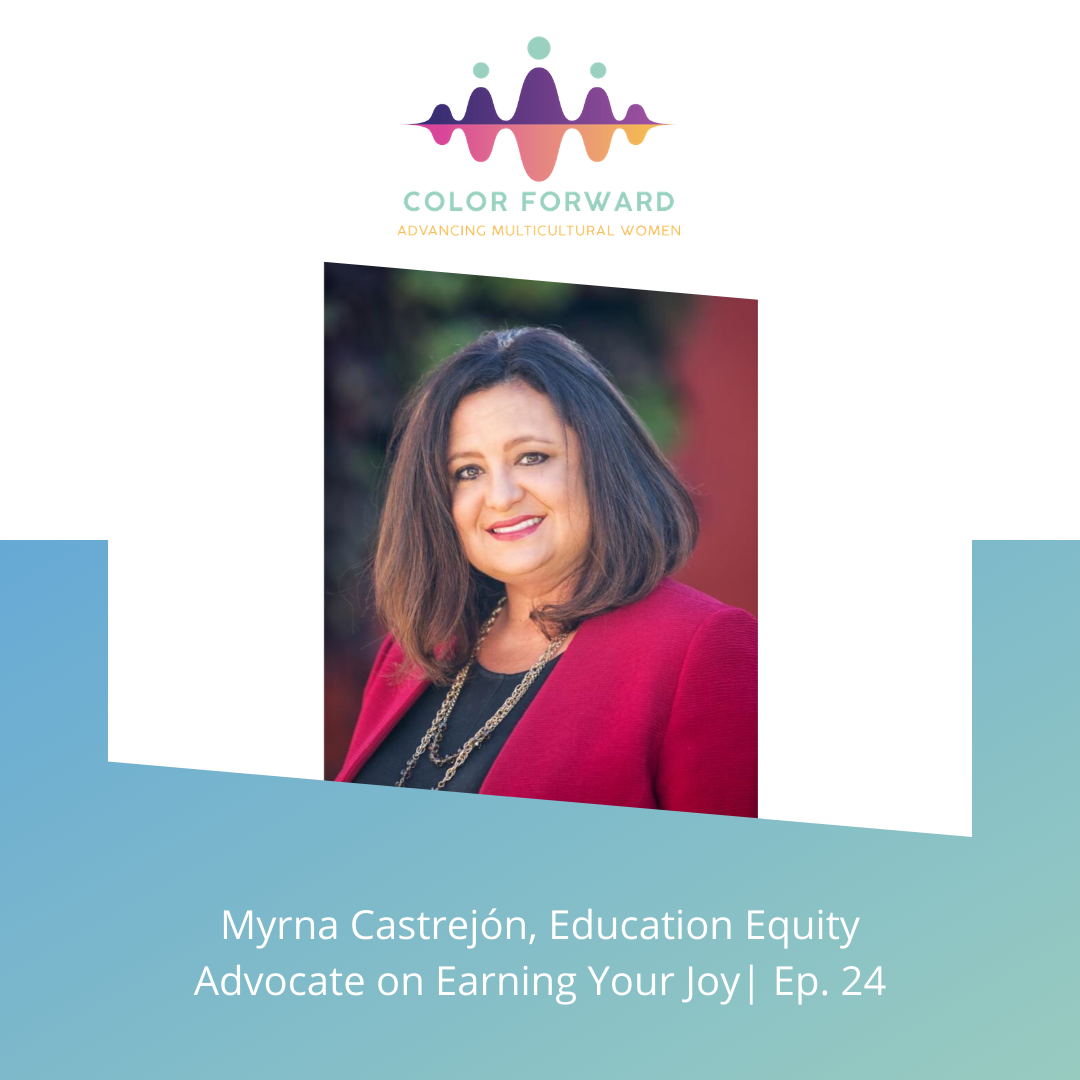
In her life as an advocate for education equity, Myrna Castrejón knows that in order to be truly happy, you can’t avoid the pain that often accompanies growth. But through hardship, we earn a lasting joy. For her, that joy is rooted in service. Listen as Rosa and Alisa discuss what they learned from chatting with Myrna about what real happiness looks like.
Ep 24. Transcript
[short theme]
Alisa Manjarrez: Rosa, we’ve had previous conversations about the idea of women having it all. There’s been articles written, there’s lots of discussions and our guests today…
[cue music]
Myrna Castrejon: My name is Myrna Castrejon, and I’m the president and CEO of the California Charter Schools Association representing about 1,350 public charter schools across the state of California.
Alisa Manjarrez: She is a power woman. She’s a leader. She’s education equity advocate, and I loved talking to her because when we asked her about all the hats that she wears, she talked about her son.
[end music]
Myrna Castrejon: You know, the best hat that I could possibly lay claim to is that I’m a mom. I’m a single mom. I have a boy who’s about to turn 15. You know, it’s been an incredible journey and a joy to be his mother and discover what that role looks like, which is frankly, a role that I actually never really thought I wanted until I was 41.
As I was growing up the expectation was that I would be a wife and a mother, and there was like a little protofeminist in me that steered me in a different direction. And, you know, later in life I realized that that was really an experience that I wanted. And so, I think it certainly positioned me in a very different way than if I had had him very young. Because I wanted him desperately and we’ve been an amazing little team.
Alisa Manjarrez: I think it’s a great reminder to us, how complex women are, that we have so many roles that we play on a daily basis, and here’s a woman who really is doing it all.
Rosa Santos: I think we are afraid to recognize that we have complex lives and we manage a lot of different things on a daily basis. So at some point you might be like, Myrna, this president and CEO and powerhouse, and then the next moment your child gives you a call and you have to pick up the phone and completely change, and in that very moment be somebody else and show up in that moment to your child in the way that you’re expecting, because for the child you are his or her mother.
It makes it very difficult, I think, to even share unexpressed, sometimes all that you go through and how you compartmentalize your brain to be able to manage it all, right? Because you have the work little piece of your brain, then you have your child, you have your friends, you have your spouse, you have your career, you have the shopping that you have to make for tonight, you actually have to make dinner, like all of those things. And I think when you add them all up that way, it’s so overwhelming, and then those questions keep popping up. Like can we truly have it all?
Myrna Castrejon: I think a lot of the time we’re taught that either you can have everything or you can’t have everything, or there’s a false sense of choices, you know, especially for someone that grew up in a slightly different generation from me. I mean, I grew up in Mexico, so there was that layer as well, right? I didn’t realize that I could have it all. And to me, now, I’m very settled with the idea that you can have it all, just not necessarily at the same time. Not necessarily going a hundred miles an hour on all fronts at all times.
Alisa Manjarrez: It’s interesting that we hear so many stories of overcoming cultural barriers that start in the home. And it’s disheartening when some of your greatest challenges come from how you grew up, the people you grew up around, and I was really inspired by Myrna’s story about how she took criticism from her father completely flipped it, and said, Oh, you know what? I can do this.
[cue music]
Myrna Castrejon: When I was 14, my dad, God bless him, he didn’t realize he was doing me a favor. He said to me, You know, it’s a good thing you’re smart, because with your luck you’re never going to find a good marriage. And if you do get married your husband’s going to leave you for a younger, better looking model. And you’re going to need to fend for yourself. Come one mija, you got to get a university degree. And I tell that story sometimes and people are like, Oh my God, your dad was such an ogre. Or how did you deal with that trauma? I didn’t experience it that way.
What I heard was my father validating that I was smart, that that’s where I needed to find my self worth. That was my superpower. And here I come to the US for college to get away from that sense of limitation. And I’ll tell you, one of the great gifts of my journey was that I expected to be treated with respect because I was smart. I believed that about me, even when the system, entre comillas, treated me as if I was not supposed to be smart, as if I was not supposed to be a high achiever, but I had that sort of self confidence in me that, of course, I’m smart. What are you talking about?
[end music]
Rosa Santos: I think you have two choices, right? You might just kind of own it and say, Yeah, that’s exactly it. But I think it’s always good to challenge those assumptions and the expectations that others have of you, and then make the decision whether that is truly what you want for yourself.
Alisa Manjarrez: It truly is the definition of rising above. You’re rising above other people’s expectations, other people’s rudeness, sometimes, and doing things because you want to do them.
Rosa Santos: I think what you’re saying, Alisa, it’s easier said than done. We just bite the bait. We just take it. So it’s how you break that cycle of not biting the bait of taking it personally. But it’s how you let go so that doesn’t actually impact and make you feel diminished or different or that you’re not worthy of, and I think it starts with rising above and really fulfilling into the dream that you have for yourself. You just need to own what that dream is. And if you don’t have one go off and create it.
You know, you know who you are, and what you want to do, and what you want it to be. And I think Myrna was like, yeah, I got it. I got it.
Alisa Manjarrez: And she got it when she was 14. I mean, that’s one of those things that probably would have ruined me personally.
Rosa Santos: And that’s what I admire the most, in this case of Myrna, because I’ve been so fortunate to have such a supporting mother and father growing up. They made me believe that because I was a woman, because I was a girl that in fact there were more possibilities open to me, and I realized that wasn’t the case for everybody else. So…
Alisa Manjarrez: Yeah, what an incredible way to grow up.
Rosa Santos: Right? I owe to that how I’ve conducted my life. So to your point, I don’t think I would have been strong enough to even being able to discern at such young age what the impact of that could be for me in the future. Probably I wouldn’t be here, to be perfectly honest with you.
Myrna Castrejon: Growing up to a very conservative, very religious family in Mexico, the 1970s, right? Like put all those layers together, very different rules applied to what I would characterize today, are like sort of my professional experiences in what rules I would go by.
Part of my journey into the US had to do with push and pull factors, right, in what really pushed me out of that comfort of the culture and family that I grew up with was a really clear sense of limitation, that I was expected to be a wife and a mother and not have a public life.
Alisa Manjarrez: Unfortunately, it didn’t stop with her father, as she grew up in her own journey things happened, and she’s really, really good at taking a look at everything that has happened, and choosing to make that part of her own resiliency.
Myrna Castrejon: I do believe that every time that we experienced trauma and loss and pain, we have an opportunity to take lessons from it, to heal from it and to come out stronger. I recently was talking with a girlfriend about that and I said, you know, it’s really your choice in the end, how you respond to what life throws at you.
Alisa Manjarrez: And it’s made her stronger as a result. I mean, she is a true testament to taking those bad and turning it into something that fuels her to keep moving forward.
[cue music and thunder sound effects]
Rosa Santos: It’s growth mindset. I think that’s the difference between those who have a kind of mindset to continue to have curiosity and wanting to learn and always find, no matter their situation, no matter the issue, no matter the trauma, the loss, they just turn it into a learning moment and they use it to get much better out of it that they went into it, and that’s truly the embodiment of this idea of growth mindset.
Myrna Castrejon: Scar tissue is stronger, you know? That old Japanese idea, you know, you’ve seen those cracked clay pots that they fill with gold. Sometimes life’s trials are precisely that gold that strengthens us in those crevices where we feel the weakest or where we have been broken before, we can choose to see that as an enhancement of our beauty and our resilience. We can choose to cave in on ourselves or to use that scar tissue to remind ourselves of everything that we can endure and be made stronger.
[cue rain sound effects]
Rosa Santos: If something awful happens to you if you’re in this fixed way of looking at it, you think that you are confined within that assumption of those elements. Then it’s going to be very hard for you to take on anything else. So breaking through that mold and breaking through that box and start looking at possibilities for growth, no matter what those are. And I know it’s hard. I know it’s hard. Today’s a new day, and I’m going to take it on in a very different way. And I’m just going to see the sunshine, even though it’s raining.
[rain sound effects stop, music stops]
Alisa Manjarrez: When your emotions have overcome you and you feel defeated, depressed, discouraged, it is so challenging to look at it from an optimistic perspective, and see it as an opportunity for growth instead of something that’s going to make you shrink. That process could only take a couple of minutes or 30 seconds, but it is a hard 30 seconds.
Rosa Santos: And at first it will be hard, but then you’ll do it so much quicker and then you’re going to be able to bounce back really much faster.
And I know happiness was something that it was important for her, and being able to get into that sense of happiness comes from that attitude and that mindset that, you know, you can go through it, and you can see the positive aspect of whatever situation and you can actually lead yourself through no matter how hard and how challenging and how traumatic that was, you can see the light. If you’re not allowing yourself to see the light, you will never be as happy as you could potentially be.
Myrna Castrejon: If I could look back and give myself advice at a younger age, I would definitely have said, to not try to avoid the pain or to expect that happiness is a state of permanent, I don’t know, giddiness. That’s not really what happiness is. Happiness understands that you build upon that foundation of trauma and pain that you have overcome. And that no matter what the pain is or what the struggle is, that you do get to the other side. Joy is something you earn something that you work towards. There’s a certain balance and peace that helps you even out the peaks and valleys. It’s not a permanent state of bliss without suffering.
Alisa Manjarrez: Growth mindset starts before you get into that situation. So if you want to choose to be happy, choose it now, so that when you’re in that moment, you remember of what you chose.
Rosa Santos: I love Post-its. If it helps, put it in a Post-it and look at it.
Alisa Manjarrez: Yeah, and remind yourself what you told yourself.
Rosa Santos: Yeah, find a way to remind yourself. Absolutely. Right? Find a way. Why are you doing what you’re doing?
Myrna Castrejon: You may have guessed by now that somewhere along the line in my thirties and early forties I really started exploring Buddhism as a practice, not as a religion, but as a practice. Not something that you are, but something that you do, you know, and it really helped sort of my journey and give it sort of a sense of coherence and has really sort of helped me navigate those ups and downs. Because my life is fairly dramatic, you know, in terms of the things that I’m dealing with, like politics is ruckus, running a massive advocacy organization is ruckus, oftentimes your results are binary. You win an election or you lose an election, and the results can be catastrophic or incredibly energizing. And you need to have something that really anchors you to your Why.
Why am I doing this? What’s different in the world because I chose to act? What does service mean in this moment, and in this time? And those are questions that I ask myself constantly.
[short musical break]
Rosa Santos: I was very impressed with her advocacy around equity and what that means and how she brings that through.
How does that resonate with how you conduct yourself, Alisa?
Alisa Manjarrez: I love that Myrna has an attitude of service in everything that she does. We could look at where she is today. She is overseeing over 800 schools. I mean, she has really climbed the ladder, but she’s always done it with an attitude of service, and that’s her heart.
It’s really inspiring for me to see someone who really follows their heart. She has a love for education. She has a love for underserved communities. I love that because of her passion that is how she got ahead. She never said, I’m going to be a CEO. She never thought she could be that, but because her vision for herself was so strong, her impact got larger and larger.
Myrna Castrejon: I believe in the small and daily acts of heroism. It isn’t about grand gestures or getting to a particular salary level or title or anything like that. I honestly never in my life imagined that I would be a CEO of an organization like this. And it is, you know, it is a tremendous responsibility, but it’s also an amazing opportunity to do what I can to leave a mark, to help where I can and, become a better person because of it.
Rosa Santos: And I wonder how often we stop and think, What is my vision? And what do I need to do to fulfill into that vision? It’s worth exploring. It’s worth taking a few moments, and that maybe the same thing that you’re doing now, and you’re there, but if it’s not, give yourself permission to create that dream then work against it.
Myrna Castrejon: They’re not separate. It’s not career and private life. It’s all the same. It’s all the same. Just, just live, just live.
[cue music]
Alisa Manjarrez: One of my favorite questions to ask is what do you want to create? And when you start thinking about what you want to create, it’s interesting how your vision appears, that you didn’t even know was there until you started asking yourself.
Myrna Castrejon: I never really imagined that I would end up doing education except that, you know, right around the time when I experienced my first divorce, grad school, went off to the US/Mexico border in El Paso, Texas, and all of the sudden I find myself really having to, once again, redefine and reinvent who I was. And I literally almost accidentally stumbled onto an elementary school that was beginning to do some work with parent organizing for the purpose of improving educational outcomes for Latino kids right on the border.
And it was an incredible privilege to really sort of throw myself into that task and really develop an appetite and stretch my skill set. It was a way for me to get out of my own head and get out of my I own pain and project that energy onto building something that was beyond just my own ego, my own limitations, my own personal needs. I really credit beginning organizing and advocacy in education with really saving my life. I think in retrospect, I’ve come to realize that divorced spun me into a depression, and this was my way of self healing and reconnecting with my community and learning about how interconnected my fate is with that of all of our families and the kids, you know, providing better opportunities in life is really our collective responsibility and I’ve never looked back.
[music stops]
Alisa Manjarrez: Speaking of asking yourself questions, one of the questions that Myrna asks in regards to education is, What is learning? If we take the situation of COVID, it’s really caused all of us and multiple industries to question everything.
Myrna Castrejon: Well, you can’t do it all, and certainly not at the same time. But you take the opportunities that you can to advance either certain concepts or ideas that you know will work, when the time is right. I’ll give you an example, this whole issue of blended learning, where you learn some of your content in an asynchronous manner. You know, you go at your own pace, to strengthen or compliment the synchronous learning, which is, all kids with one teacher at the same time progressing in the same way through a grade level. Blended learning or hybrid learning marries those two.
It was unthinkable to the system that we could use that in a broader way. All of the sudden we’re in a moment where it’s exactly those schools that got it done well. That are better equipped to deal with some of the questions that many districts are just asking themselves now, like, Do students have to stay seven hours in front of a zoom in order to demonstrate progress? How do teachers you do that?
Alisa Manjarrez: What is learning? What can it look like? What should it look like? How can we make it easy for kids to learn? This is an interesting time for us to think about things that were so normal and now are not, and education is changing as we speak.
Myrna Castrejon: How can you catch students up or let others advance? These are questions that we’ve been dealing with for 10 years, but that question, those issues, it wasn’t the right time. Because it was coming from our sector, and they weren’t ready to hear it, but now we’re certainly making sure that all of those lessons are shared, that we are running webinars and supporting districts and partnering with the small schools district association, for example, to help bring folks along about, how can this be done and how can it be done well?
It was an idea that we piloted, but now it’s the time for it. And I think, you know, you choose your priorities and you find the right time and the right moment.
Rosa Santos: I think everything is changing as we speak. And I think that’s why I feel so strongly about really changing our predisposition to learning and relearning everything because things are not the same as they were in February. Things will not be the same as they are now, that we know for sure. So today is the last day they will be the same.
It’s changing at a pace that either we keep up and we get into a mindset of, Life is about learning. Life is about growing. Life is about putting effort into designing and defining what makes you happy. And the one thing that we know today is that things will change and will continue to change.
And that’s true for education. It’s true for work. It’s true for the way we work. It’s true the way that we do this podcast. It’s true for every single aspect that touches our lives today. So really getting into that curiosity, and you can look at it in two ways, You can say like, wow, that’s so overwhelming. Or you can actually say, Hey, what can I do? What can I explore? What possibility all this change is going to bring for me and my family and my life. And then just jump, jump into that. The journey starts with the first step.
Myrna Castrejon: All throughout my life, I mean, I’ve lived in so many different places done so many different things. I never set out with a very specific journey, but the kinds of things that I was involved in really, you know, doing parent organizing, doing education reform, I’ve always really defined myself by the kind of work that I do to leave an imprint in the world, not for me, but like to do something for others.
Rosa Santos: There’s been a lot of research actually being done now for years about how your brain… in order to keep your brain healthy and to keep your neurons working and sending electronic waves between your, your neurons and keep those chemicals the way that they should is by continuing learning, putting yourself in uncomfortable situations that you can learn from.
So the fact that you might feel uncomfortable about something, it’s actually, it is then when the learning is occurring.
Alisa Manjarrez: You’re building dendrites.
Rosa Santos: Yes. You need to feel comfortable with the uncomfortable. That’s when you’ll know that you’re learning, because otherwise you will stagnate and those neurons will just get complacent.
Alisa Manjarrez: I love the idea of creating possibility through times of discomfort, especially if we’re thinking about things like inequality in education, which is Myrna’s passion. What possibilities does this pandemic bring to solving our problems that have been there forever?
Myrna Castrejon: What is learning really? I think one of the things that this pandemic has really uncovered, and it’s not a surprise to those of us who work in community, right, and who’ve been working on equity issues and quality of education issues for a really long time. And that is that we live in a society that masks a lot of really profound inequities, and doesn’t really make them visible. For those of us in education reform, especially those of us who’ve been at it for about 20 years, I think this pandemic has been a reminder that we can’t fundamentally fix income inequality, for example, only through education and better access to education.
Education is really important, but, broadband access, folks living in unaffordable housing, homelessness, quality levels of education are very much marked by access to resources. And it’s a stark reminder that we don’t come as human beings as a collection of separate issues.
You know, people don’t have issues, they have lives, and their lives are impacted by our policy choices on education, on healthcare, on workforce development and so many other things in public life that are really deeply, deeply interconnected.
Alisa Manjarrez: I think that if we can look at these issues that she’s been working on for 10, 20, 30 years, and now we have this pandemic, it’s like, Oh, actually, it’s a time of innovation.
Rosa Santos: And I think it’s the time of, of being confident about what you bring to the table to innovate, to create that possibility and to be confident that what you have is exactly what we need now. You just need to find where you want to put that effort and go full force.
There’s that possibility that a lot of things that were not being addressed are now bubbling up to the surface. And now we’re having and really forging these conversations, that before never happened in big, big meaty subjects.
Alisa Manjarrez: The entire country is talking about huge issues.
Rosa Santos: Exactly. Exactly. So I think that’s exciting. That’s uncomfortable, we will only create a new possibility out of the discomfort in which we are right now. And we’ll make a much better future out of it.
[cue outro music]
Alisa Manjarrez: I really am excited about the possibilities for the future, and these women that we’re talking to, they’re creating possibilities for others. They’re opening doors for entire generations of people and having people like Myrna choosing to live a life of service. Choosing to live a life of joy. It’s such a great example to all of us to embrace our vision for our own lives and embrace the possibilities that we can create every day.
Myrna Castrejon: I slept and dreamt that life was joy. I awoke and found that life was service. I acted and I discovered that service was joy.
Alisa Manjarrez: For more inspiring stories, please subscribe on Apple, Spotify or wherever you listen to podcasts. If you have a guest you’d love to hear on the show, send us a DM on Instagram at @colorforwardpod.
I’m Alisa Manjarrez, producer of Color Forward. Thanks for joining us and, please, leave us a review.
[outro theme ends]