
25. Can Women Have It All?
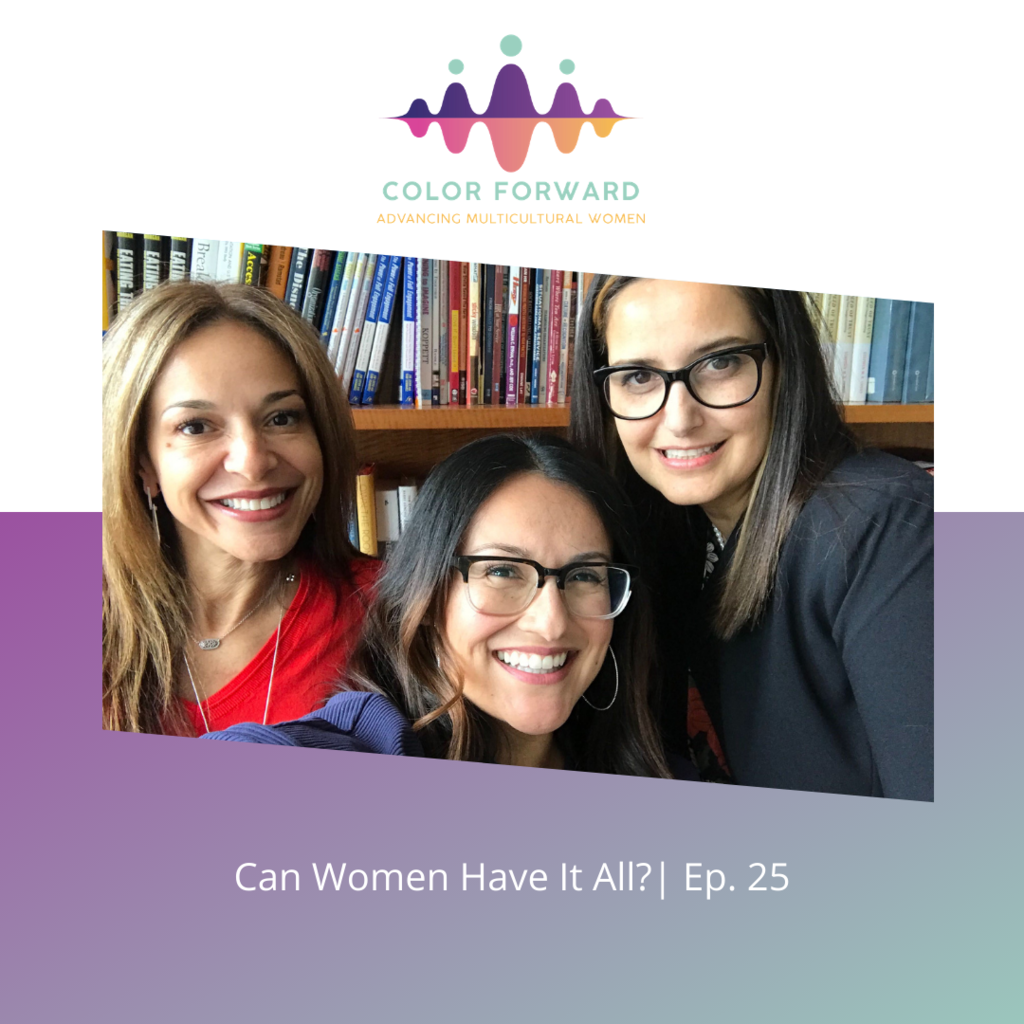
On the road to an amazing career and a fulfilling life, at what point are you ready to slow down and start a family? And where’s the rule that says you even have to slow down at all? This week, Alisa, Rosa, and Merary reflect on the wisdom of past guests and discuss the age-old question, can women have it all?
Ep 25. Transcript
[cue short theme]
Alisa Manjarrez: Rosa and Merary, I have a question for you guys. You are both women who broke your own rules on how to start families. You did not start your families when you were in your twenties.
Rosa Santos: It’s funny, my son has been complaining lately, quite a bit about how old I am. Obviously, he’s a teenager now and I think, he’s looking around and his peers parents are maybe 10 years younger than me. Just this week he asked, he’s like, Why are you so old?
And I said, Well, let me tell you why. It’s not that it was necessarily planned. I think I never thought of motherhood and becoming a mother as my only and one objective in my life. And the one thing that I do always remember from my parents as they raised me was to make sure that I was able to self support and that I would have a career that would make me happy. They never actually said to me that the role of my life was to actually just be a mother. It was part of something bigger. That played into it, that played into the fact that by the time I felt that I was in a place to be able to even be thinking about being a mother, he probably, as my son says, it was probably a bit too late and therefore the chances of a woman my age at the time, which I guess it wasn’t that late, it was in my mid thirties, the reality is that your chances of getting pregnant when you want it does… you know, they, they get, they decrease and it takes you longer to realize that dream, right? So I don’t think it was by choice, I think it was, I always thought that there was something else for me than just becoming a mother. Unfortunately, for us women, it gets to a point where you have to make certain decisions to become a mother because you know, it won’t ever forever be available to you even though these celebrities and everything keep on having babies way past their fifties, right? But that’s not the reality for the normal woman who’s out there trying to do it all.
Merary Simeon: I think I always knew that I wanted a family, I guess I just never met the right one. So I was actually willing, at one point, and I remember telling this to my mom saying, I am going to have a kid and I’m going to have the baby by myself. And I’m just going to go to one of those places and do it that way because I knew I wanted a family, but I also knew that I had not met the right person. And then when I met my husband, he was like, okay.
[cue music]
Sabina Ewing: You know, what I love about my husband has always been that he’s even a bigger cheerleader for me than I am for myself, because he has always recognized that, you know, I have a type A personality. I’m an extrovert, he’s an introvert. And I have what some might say is a bit of a dominant female type of personality, but he’s always loved that.
He and I, early on, when we got married, we actually talked about what we wanted for our family. And we did want the opportunity, if we could afford it, for one parent to stay home. You know, I was in technology as a technology leader and he was a social worker and he did a phenomenal job and he was a leader, and he’s made that sacrifice.
There are spouses, who take on different roles, contrary to what society has defined. Take away income part of it, right? Talk about who’s doing what chores who’s doing the cooking, who’s actually, you know, doing certain aspects of, of home and family life? And you do what works for you.
[music stops]
Rosa Santos: I don’t think I had purposely ever said, I want to have a child. I think it was there. It was always that possibility was there, like, Yeah, when the time comes I’ll have a child. I actually, because of, I think, the way that I was raised, like focusing absolutely my independence and the ability to take and make decisions for me and my body and my life.
I even never thought I needed someone to have a child. I think it was like, yeah, I can do all this. I can, you know, be successful, have a career and then maybe I’ll meet the right person with whom I may want to have a family. And if I don’t, whenever the time comes and I’m ready, I’ll have a child. That’s, that’s… in my mind, that was the assumption that I worked, against all those years of my life.
Alisa Manjarrez: At what point did that change for you?
Rosa Santos: I think it changed when I thought like, Okay, I got it. I got it. This is good. I think this is the right time. You know, I felt that my career was heading in the right direction. I thought that I felt that it was a time when I was prepared. And also I was with Fran, my husband, and I don’t know, we had been in the US now for a while. We knew that we would want to, just put roots here. And we decided this is the right time. Let’s have a baby. Problem was that by the time we decided that that was the case, I could not have children. I never contemplated that that could have been a possibility. And for me that was a big kind of a slap on the face. Because, again, it was one of those things that you always think that you are, as I said, I was in control. I knew what I was doing. I was successful. I was traveling the world. I was… He’s great. And then something that it was like, so routine and so, you know, so simple. I was told like, Oh, by the way, you can’t have children. For those women who might be listening to me that were told that, that news at one point in their lives, the world collapses.
Because again, it’s not that I had never said no to having a kid or yes to having a kid. But when I make my mind to do something, I’m all in, right? And it’s like, okay, I’m ready. I’m going to have a kid. And then I was like, Oh, no, what? You can’t, you can’t have children. What are you talking about?
Alisa Manjarrez: You didn’t realize that it may not be a possibility?
Rosa Santos: Exactly, and all of a sudden… That’s exactly right, because all of a sudden that possibility was like completely like, you know, a rug pulled under my, under my feet. And I tell you, of course it was tough. It was all the things that you guys can imagine. But I think what it was the toughest was to find out so late. I was an educated woman. I was a woman who had been having checkups and going to the doctor and talking about how you make babies and how you not make babies. And all those since I was 12. So they’re like how did this happen?
How did this happen that nobody had ever talked to me about the possibility of not being able to have a baby, considering that I am married to a doctor as well. So it was like, where, where was the breakdown? And I did a lot of self assessment and reflection and to then go back and find that, that, levels of specific hormones that detects and defines whether you are eligible to have a kid or not were non-existent. And that the way to go about being able to find that out was as simple as taking a blood test and no one, in both sides of the Atlantic had ever, ever mentioned that possibility to me to even warn me.
I felt it was one of those things, How did I miss it? That, that really got me. And then I went into this more of a, I guess, activism to get all of my girlfriends to have this blood test and make sure that they knew what they counted on, so they could actually plan it as part of their lives, right? We, you know, take certain things for granted or work under certain assumptions and everybody around you also does the same. And then that includes really having a partner who knows quite a bit about how the body works.
And I don’t think that happens in other cases. And that’s why I felt a bit robbed of the possibility, because it was because I was a woman. I don’t think anyone felt that this was that kind of information that you… that I needed to know to, to be able to continue to make my choices and my decisions in life, and that was truly devastating.
Sometimes in, in our society, our Western society, there’s a lot of that power that is taking away from you, even in the moment that when you choose to have a child, right, the system, there’s a lot around you just being, you know, a carrier body of somebody else’s life and what you think or what you might feel or how you go about, you know, taking the next step to be able to conceive a child is sometimes, or at least that was my experience was a little bit, taken away from me it was tough. It was tough. It was a very tough time in my life.
[cue music]
Merary Simeon: You know, I remember one time I had a dream. And in my dream, I was walking with a baby in my hands, a boy. And he was a baby and had a little white blanket over him and running in front of me was a little girl, just running. And all you could see was her hair jumping. And I saw that vision right before I got married with my husband. So when the doctor told me that, that there was a possibility that I couldn’t have kids, I was like, there’s no way.
There’s no way because you know, to me, I had seen already God’s promise that I was going to have those two kids. So when my first child passed away, before he was born and it was a boy. I was like, Oh, my God. Then we had, Neryah, my daughter. And I kept going back to that vision that I already had.
I was like, no, there’s one more, got pregnant again, lost the other baby. And the other baby was a girl. And I was like, Oh, my God, like, this is it. But I kept holding onto the promise. And, you know, to tell you today that the vision that I had, it’s, it’s incredible, but that kept me going, knowing that my faith and that vision that I had seen, that was a promise that God had given to me. And I was not willing to let it go.
[music stops]
Going through the process was extremely painful, because I was like, Why would you give me this vision? And then I don’t have it. But today I look back and I’m like, wow, exactly how my vision looked. That’s exactly how I have the children. The other two were just not meant to be, but, you know…
Alisa Manjarrez: Oh, my gosh.
Merary Simeon: I’m still a mother of four.
Alisa Manjarrez: And all before you were married, you got this?
Merary Simeon: The vision was before I got married. And then two years later after we got married and we decided to have kids, I had forgotten about the vision. And I remember being in a women’s conference, and there was a woman talking about, um, not being able to have kids and adopting. And I, and I remember crying and saying, God, you promised me, like, I saw it. Then I was like, well, I didn’t know if what I saw were my kids or adopted kids, right? So I didn’t know what it was, but I was ready for whatever it was. I remember that was in, March and saying, Okay. You know, it is what it is, but I feel like that vision was too powerful and I just felt like they were mine.
And in April I went to the doctor and they were like, yup, you’re pregnant. And you’re having a baby in December. So, faith kept that going. Was it easy? Absolutely not.
People sometimes do not realize how difficult it is sometimes to even get pregnant. It’s something that women don’t talk about enough. And I think we should, because I know when I lost my kids, I mean, like I was having nightmares, I was devastated and you know, doctors are telling you, well, you’re older and you’re this and that.
And I’m like, uh, no, I’m having a kid. We’re going to have to figure this out. Like, no. I waited this long, I’m having this, you know, a child.
And I love that we’re talking about it, because it’s real. These are real issues that women go through that are very painful.
And despite of all that, we still got to get up and work the next day and do everything else that goes on in life. I was very blessed to have my first child at 40, and the second one at 42. Was it easy? No. Is it the best thing to happen in my life? Absolutely. Was I ready to adopt if I wasn’t going to have the kids? Yes.
But those are all things that are not easy. Like I could just blab them out to you right now. But during that process, Whoa, it was so painful on top of having to do everything else as an executive woman, as a professional, as a wife, you know, as a daughter, there’s just a lot that goes with it. And I just want to tell our listeners that they’re not alone. That they will get through this. And, um, that’s where sometimes we find our resiliency, in the journey.
Rosa Santos: We just need it to show up and nobody really cared what you were going through.
That’s the piece of, that I feel the worst about from that time, how all of it, you had to endure it on your own. And it was so hard. And I tell you, I think the three of us here on this call, and in this podcast, you will never find any women more resilient than us, right? But even in that moment, it was very hard to actually, to being able to even reach out because I didn’t know, I could even reach out to anybody. I just couldn’t. My emotional and mental space and health wasn’t strong enough to even just raise my hand and say, Hey, I’m drowning. And still, I remember I showed up to work.
I held an executive position at the time as well and which requires a lot of international travel. And there I was on the airplane by myself going through all of this. And I don’t want to say reach out. I think for those of you who are listening, who are not going through this, but you know of someone who might be going through this, reach out to those women, because they’ll appreciate it and they might just need, you know, that phone call in that moment to be able to have someone that they know that they can count on.
Alisa Manjarrez: In my coaching experience, working with female executives, I’ve worked with women who are solopreneurs and in that like mommy world and the stay at home mom, and these are conversations they’re having all the time. But when I’m working with executive women, sometimes as their coach, I’m the only person that they’re talking to about this because it’s a different conversation. I think sometimes they see it as a sign of weakness to talk with other female executives, because everyone’s trying so hard to break through the barriers and get ahead that if they talk about their struggles, becoming a mother or even being a mother at some point, it’s like, something they feel like they have to cast aside so that people only see their strengths.
Rosa Santos: I want to believe that we’ve come a long way. From maybe when I was going that at the time. And I know 15 years is a long time to the point that the possibility of freezing your eggs, wasn’t available to me. Now it is there, and I think we’ve come long way of even being able to preserve that possibility and at the same time, even though we’ve come a long way, I think in this fear of being open and honest as to what you’re going through and what that means in your career and your advancement I am not sure how many organizations are mature enough to be able to allow for this to be in the open.
Alisa Manjarrez: Yeah, I can tell you as a 38 year old, this is a conversation I have with all of my friends, whether they’re in relationships, they’re married, they’re single. Like women are talking about this on an ongoing basis. And even it’s come to the point for me personally, with strangers, I remember going to an event last summer and it was two groups of women, the singles and the marrieds. We just naturally gravitated, and all the singles were asking, how old are you? Do you know if you can have kids? I mean, that was just like, nice to meet you. How old are you? Can you have children? Do you want children? Because your time is running out.
Merary Simeon: Oh, my gosh.
Rosa Santos: Wow, I that was only in my time.
Alisa Manjarrez: This is last summer and these are 32 year olds, 34 year olds.
Merary Simeon: I was definitely not thinking about having kids at 30, so…
Rosa Santos: Yeah, me neither. But I tell you, I mean, the one thing, when I went through this process, I honestly felt that it was my duty to actually to alert anyone and everyone around, Do you know that when you hit 35, maybe you’ve run out of eggs, right, by the time you get there. Which is what happened to me, it’s like, Oh, you’re done. It’s like, where are they? They’re all gone. They’re like, Oh, when did that happen, right? And really, I took it upon myself to make sure that women that I knew that they asked this question so far of their healthcare providers, that they got informed so they could actually better manage those decisions. And some younger women would say like, Yeah, but I haven’t found the right one. It’s like, It doesn’t matter. Because you have a possibility now of really preserving, uh, your options for the future. So you won’t get to a point where, you know, someone coming out with the results a blood test will tell you that that is no longer available to you, right?
Alisa Manjarrez: I had no idea it was a blood test.
Rosa Santos: Yeah. I mean, the blood test will tell you your level of a specific hormone that detects what will be your chances of being able to get pregnant. It’s the FSH blood test. It’s very simple. And then they will do more if they find out that it’s very low and then they can dig more, right?
But it’s very simple. So I gave the impression that the pressure is still there, even though there, there are these options, but these options, again, are not cheap options for the vast majority of folks or that they are covered by your insurance, et cetera, et cetera.
So yes, it’s there, but to certain extent is not available for everyone. And also I’ll go back to, from a work perspective, being able to talk about these things or when you’re going through it, or when, you know, you’re going through certain treatments that change who you are and how you show up and how you behave and all of those things, it’s… you can’t go into work and say, Hey, by the way, I’m putting all these injections in my tummy.
Alisa Manjarrez: My hormones are all over the place, FYI. If I start crying in the middle of a meeting.
Rosa Santos: So it’s about how you go about doing that and the pressures that you have to either choose or not choose, right? And it’s unbelievable that today’s an age we’re still having those conversations Alisa, either this or this. It’s not an “and” conversation. And I think what we should really bring it to the fault for our listeners is how do you make this an “and” conversation? You can achieve your goals and you can be a mother. Now, from my perspective, none of it is easy.
It’s bloody tough to have a career and to be fulfilled as a mother, as a spouse, as a partner, as to be able to feel that you’re on top of everything and you’re cruising. Is not easy. Because even when then you have your child and you’re a mother, there are so many other things that you’re going to go through.
Especially for those of us who may… it was so challenging to get the child. You think that, Oh, I did it, my goal check, and then you go, Oh!
[cue music]
Alisa Manjarrez: Well remember in the Rashida episode where she talked about how she completely reframes her role? She thinks of herself as Rashida first and then a mother and then her career. She lives in a world where everyone thinks that you should be mom first. And she’s really flipping that narrative, which is bold.
Reesheda Washington: It always feels so important to me to model my humanity, to model my fallibility and my leadership, to model my uncertainty, but also to model that my name is Reesheda first, it’s mommy sometime after Reesheda, it’s CEO sometime after Reesheda, right? It’s coach, consultant, facilitator somewhere after Reesheda. And as my daughters, I think throughout their lives at some point, I’m sure they’ve resented that, right? Like, no, because all the mommies are mommy first. In fact, they don’t even get a name, they’re whatever their kid’s name is mom, right? So my youngest is Olivia. I’m Olivia’s mom.
I like literally, I don’t even get to keep my name, right? And I’ve modeled for them like, no, I’m pushing back on that hard. Definitely for myself, but not just for myself, again, it goes back to that modeling that I don’t want them to become moms that don’t have a first name if they choose to become moms, right? So the only way for us to like shift this paradigm is for us to be willing to courageously live it out when it is not majority of culture to live that way.
So if being the best mom ever is what touches, moves and inspires you, if being the best CEO ever is what touches, moves and inspires you, you still have to put yourself before those things if you want those things to be the best they can be.
Because if I deteriorate at my core, my deteriorated self is who is going to show up to my children. That’s who is going to show up to my company. That’s who is going to show up to my clients, right? And so I’m really not doing anybody any real service by showing up deteriorated. We tend to get mired down in martyrdom.
Rosa Santos: And I completely align to that boldness. It has to be you first. And I tell you, that’s what my mother told me. And my mother will always say even today, when I speak to her on the phone, If you don’t take care of yourself, if you don’t know who you are, if you don’t practice self care, does it matter that you are a mother, because you will not be able to give what your kid needs if you’re not feeling well. Because then that helps to grind yourself on being able to manage this complexity, which is our lives when then you have everything else revolving around you.
[music stops]
Alisa Manjarrez: Let’s think about what we want our listeners to take away from this conversation, because I think we have people at various stages of life, listening. We have women who are early in their twenties and retired and, there’s so many different pressures on us at various stages of life.
And I think the age old question is, Can women have it all?
Myrna Castrejon: I think a lot of time, like we’re taught that either you can have everything or you can’t have everything, or there’s a false sense of choices, you know, especially for someone my age. I didn’t realize that I could have it all, and to me, now, I’m very settled with the idea that you can have it all, just not necessarily at the same time, not necessarily going a hundred miles an hour on all fronts at all times.
Alisa Manjarrez: I think we’re actually talking about how you can have it all and the challenges that you have to face and acknowledge along the way. Because if we just say yes, you can, or no, you can’t, we’re not really helping anyone in those in between stages or who are trying to have a child, or who are thinking about how to plan their life.
[cue outro]
Merary Simeon: If they get anything from this, I want them to know the possibilities are there. Is it going to be easy? No. But if that is something that you want in life, I think get checked, right?
So that you can know what the possibilities are, but I also would say, be optimistic. I didn’t know when it was going to be a perfect time to have a kid, but if I waited for a perfect time, I wouldn’t have kids.
So I just had to go for it and do it afraid, right? And at 40, trust me, that’s afraid. It worked out fine. My kids are healthy. Everybody’s healthy. I look better than I did before.
Alisa Manjarrez: You do.
Merary Simeon: So it can, it can be done. Like, I don’t want women to feel like Holy crap, my time has passed. No, I think what we’re saying is, if that’s something that you want, get checked early, and go for it.
Rosa Santos: And there are many ways to have a kid not the traditional way, so…
Alisa Manjarrez: I think what’s important about this conversation is that talking about it, number one, is something that we need to do more. You could say, I want to be a CEO, but you don’t really want to admit that you also want to have a family. I hope that people realize they can get permission and to really dig down deep and think about what you really want. Because you can have it.
[break]
Alisa Manjarrez: For more inspiring stories, please subscribe on Apple, Spotify or wherever you listen to podcasts. If you have a guest you’d love to hear on the show, send us a DM on Instagram at @colorforwardpod.
I’m Alisa Manjarrez, producer of Color Forward. Thanks for joining us and, please, leave us a review.
[outro theme ends]