
41. The Changemaker’s Guide to Rule-breaking & Risk-taking
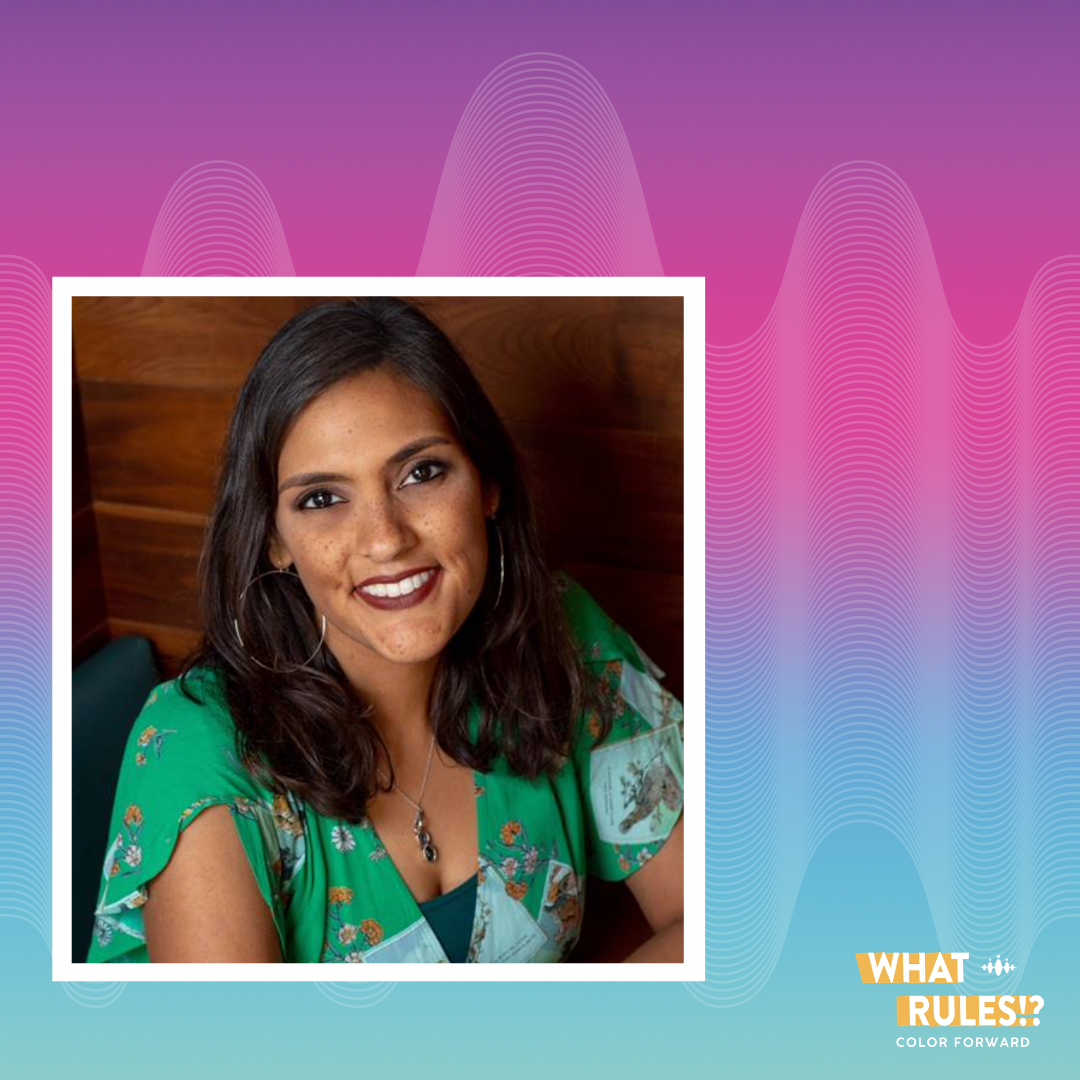
Having been raised predominantly by her single mother, Shruti Kothari is no stranger to breaking the rules. Not only has she defied cultural norms to find success in the business world, but she’s continually perfected the art of risk-taking by putting herself out there in the name of bettering her community.
Episode Transcript
Alisa Manjarrez: Hello, everyone. Welcome to What Rules. I am here with my cohost Rosa Santos. Merary couldn’t join us today, but we are doing this without her because we’re all about breaking the rules and we can do whatever we want.
Joining us today is Shruti Kothari. She leads the industry initiatives at Blue Shield and also is the founder of Women of Community. She is all about advancing women of color in the healthcare industry. We met each other on Instagram, because I saw that you were highlighting all these amazing women.
Shruti Kothari: Yeah. You were the first person… I launched in December, and I was like, is this real? Is this a real thing? And then when you reached out to me wanting to chat with me and learn more about Women of Community, I was like, this is a real thing. I’m doing it.
Alisa Manjarrez: Yeah, so cool.
Rosa Santos: It’s fantastic to find other women who really have the same passion, values and goals around how we can actually create community in elevating voices, really supporting each other. So I love that we found where our shared passions are.
We’ve been on air now for a little while, and we came to realize, throughout the course of our podcast, that for a lot of us in order to really breakthrough and be successful, draft our own paths and so forth we, and then in engaging in conversations with these other very successful women, we realized that a lot of what they’ve done and a lot of what we’ve done has been really pushing through some rules that probably were kinds of imposed to us given the context in which we live and, or perform, or are part of. So hence the “What Rules” of our new and renewed platform. So that’s what we want to talk to you about. It’s really about that, it’s in your experience and in the endeavor that you’ve taken on, what do you think about this concept of having to break rules in order to succeed?
Shruti Kothari: I’ve broken a lot of rules, like, I’m Indian, I grew up in a family where my father passed away when I was young and I was predominantly raised by my single non-college educated mother, and the pathway in which to achieve any mobility was like marriage. And that is how, as a woman, you basically become secure financially, all the different things. And I did not buy into that from a very early age. And also I saw the example of my mother and my dad passed away and, you know, she was working hourly jobs and really struggling to make ends meet.
So it wasn’t a good example for me. And so anyways, one of the first kind of rules I broke was in my own culture and as soon as I graduated undergrad, I remember my cousins being like so you’re going to get married soon, right? And I was like, Why would I get married soon? And who am I getting married to?
Like, I’m literally not dating anybody. And so, I’m working as a health educator. I’m going to work for two years and then I’m going to go to grad school because I’ll have saved money.
Like I had like my plan. That is a simple plan. That’s like a normal plan for most people, but it’s just, for me, I had to break some societal norms in my own family and my own culture.
Like I took on this debt, went to school and I can never get a job now, but I ended up getting a job in home care, home health, hospice, home-based palliative care for Kaiser Permanente. And everyone was like, What? Like, you’re not working on the inpatient side? This is 11 years ago now when home care was not a thing and people thought like it was very inpatient focused and healthcare, and first of all, like home care has blown up in the healthcare space. Like it is where everything is moving. And I went with the direction that I thought was right for me. Which is like my advice to everyone in breaking rules, if what people are trying to tell you doesn’t feel right for you don’t do it, like break the rules, do something different.
Alisa Manjarrez: One of the things I hear you saying is that you took risk over and over and over again. So you took a risk by not listening to your family. I really think that you get better at taking risks with practice and maybe, Rosa, you know something about this too. That’s what I hear you saying, you took a risk in college, you took a risk in grad school, you took a risk in the industry you’re going into and then in the type of role, and it’s just over and over and over. You built that muscle and we haven’t even gotten to now, right, in your story, but now you’re just doing more things. It’s just who you are.
Shruti Kothari: And that’s so hard to do, especially when you are a woman of color. When you have immigrant parents or when you were the first to go to college the dream is having a stable job. When you come from a privileged background, like in the entrepreneurial world, the dream is being a founder, having your own company, you leave the stable job, you leave the Googles, you leave the Kaiser Permanente’s to go start your own thing.
[cue music]
After George Floyd was murdered there were a lot of tweets of black lives matter in solidarity with the black community. But when you looked at a lot of these venture funds and who they were investing in, where they had power and who they could support in a real way, they weren’t doing it. Their portfolios were predominantly white males with a sprinkling of white women, basically.
And nobody ever talks about color. Like people of color, like why aren’t people of color there. And so even to talk about these topics was like a faux pas, and I made a video series, an advocacy series, highlighting black founders, and that was a risk I had to take, because the venture community was not openly talking about that quite yet.
Alisa Manjarrez: What made you feel like this was something that you needed to do? Like, you saw a problem, right? And then what was that process like for you to say, I need to do something about this?
Shruti Kothari: Oh my God. It was such an anger swirl within me, to be honest. So for, for, for three and a half years, I worked in venture and since day one, I was like, there are no people of color. Like, this is so hypocritical. Like you can’t say black lives matter. You can’t say you support, you know, the black community when you’re literally doing nothing in your seat of privilege and power to change it. So it was really anger. Honestly, it was anger at the system. I was just tired of having these conversations with people and then feeling like there was a lot of hypocrisy. I did not know what was going to happen with it. I thought I could make it and put it out into the world and maybe two people would watch it but it got shared a lot.
And two of the founders that interviewed said that they believe they were able to close their next round of funding in part, because of the attention that series generated. And I thought I might get fired, to be honest. So I took off work and I was like, I’m going to do this. And then I’m going to make it clear when I posted that look, I did this on my free time. This has nothing to do with my role. But it was a risk. It was a risk. My poor mother, I put her through all my stages. She’s the very opposite of me. She’s really scared to take risks. And I mean, I understand it, given her background, but she was just like, why are you doing this? Like, what if you get fired? Is that worth it? And so, it was totally worth it.
[music stops]
Rosa Santos: From this end, what I see, Shruti, and just having read about you and seeing what you’re doing, you’re a very driven woman, right? And we know that we have some other fellow women that are not necessarily as driven or they’re very embroiled into truly trying to figure out, right, what that next move is. Can you tell us that process? What happens for you when you do, when you, you decide to go on and take those risks?
Shruti Kothari: I wish I could tell you that I was more structured and strategic about it. I think your assessment that I am driven is very accurate. Another thing is I’m very passionate. And so the things in which I become passionate about is just, it’s consuming. It’s like all consuming until I do something about it. And the things in which you’re seeing, like the change in career or the advocacy series are all because I felt something so real within me that it wasn’t working, whatever I was doing, wasn’t working and I needed to do something different.
And that’s all I could think about. It’s all I could dream about. And I need to figure out, like, it’s not clear, the pathway forward, of like then how do you manifest that into something, but that I think requires a lot of trust in yourself and your abilities to figure out then how do you execute on something to alleviate some of that swirl?
The narrative that you see of, Wow, women of color really show up for their communities. We saw it during the election. We saw it in healthcare during the pandemic. When there was this narrative of, we have to get vulnerable populations, communities that have mistrust in our healthcare system to get out and get the vaccination. A lot of that work came down to women of color in these communities, but then you look at the data and you look at how many of these women are in actual leadership positions in healthcare. The pay gap that exists, like words just don’t cut it.
Alisa Manjarrez: Yeah, I think you gave me that statistic that 30% of women in senior leadership in healthcare are women and only four are women of color.
Shruti Kothari: Yeah, that’s right. McKinsey does this annual report on women in healthcare. So again 30% white women in senior leadership positions, 4% women of color. I talked to some senior leaders in HR’s at very big healthcare companies, and what they basically told me it was like, we have no problem recruiting women of color into the company, but there is a pipeline issue of senior leadership. One, it can either be like own biases of hiring managers in the actual pipeline, but two, sometimes it’s women of color actually wanting to take on some of the leadership roles.
And to me, that’s a representation problem. We need to hear the stories about what rules people had to break, what risks they had to take. We need to hear the stories about how it’s hard and how they’re juggling everything. Those stories aren’t really elevated as much.
If I hear one more story of the white male privileged founder quitting his Google job because he had an idea on a napkin and then he raised 20 million, like overnight. Like if I like, if I hear that story one more time, I swear to God, like…
Alisa Manjarrez: I’m really interested in this idea of pipeline and I want to hear from you, Rosa, because this is like your world and talent management. Like what do you see as far as like the barriers that women are facing?
Rosa Santos: I think there’s a double fold. On the one hand, there is the weight, what I mean by the weight is, where do we gravitate to provide more weight to what story, to what kinds of performance, to how someone shows up versus some others.
And I think there’s some intrinsic bias in that labeling of what has the most weight. Automatically I think we exclude women from that pipeline. For all the reasons that we’re talking here. I think there is also some of us don’t put ourselves forward, don’t speak up, don’t raise our hand, don’t say, I want that job. I want to be considered for that job, right? Some of us put our heads down, do all this work and juggle all these things, but we don’t actually say it, that’s the job that I want. And here’s all the people that I need to go tell, here’s all the people that I need to get on my side so they know that I am worthy and I have what it takes to get to that position, right? Third thing is, an organizational risk. I think organizations are challenged to take risks when it comes to people. So in a way it’s a little bit, it’s like, Hm, we’ll do more of what we know versus taking the risk on a profile that we know nothing about.
So those risks of putting people, unless they are forced, because the data is saying X. And you’ve committed to showing something else. And therefore then is when they’re going to take the risk. There’s no accountability. I think organizations as a, I don’t know, an entity, we can call it that way. I think the risk tolerance on profiles that they are not accustomed to. they are not taking the risks. Now, underpinning everything else, I think there is no, and we all know this, right, from all the research and the current reality and the consumer reality of both healthcare, but any consumer out there, guess what, that consumer happens to be brown. And he will continue to grow, being even more brown in the future. Our consumers are very smart and they’re not going to go to a healthcare system where they cannot find a doctor that looks like them or speaks like them or understands where they come from, right?
So I think that’s what is going to push that pipeline to be a bit more full. And I want to think the shorter future, because otherwise those companies who do not do that will cease to exist in my opinion.
Shruti Kothari: I completely agree with you. Women of color are not getting what they need from the existing, big players. And now the big players have these really pretty big threats to their business, right? Like if people don’t understand this and don’t get on it and understand why it’s important, they will die in the marketplace. And they say that by 2060, the majority of the population in the US will be women of color, essentially. So that’s a big deal.
Alisa Manjarrez: That’s in 40 years. It’s not that far away.
Shruti Kothari: God willing, that’s in our lifetime, right?
[cue music]
I should also mention, you know, Women of Community, like it started as the same thing where I was going to do a video advocacy project on it, and then I had some amazing women in my own life who were like, if you’re going to do this again, you need to make it a thing, make it an organization, do more with it. Because like the steam that black founders had, like you could’ve done so much with it and you were very passionate about this. So we now like, five months in, do a video series. We have a newsletter, we do events. We’ve done two events so far. We have over 1,800 in our community across Instagram, LinkedIn and our email distribution, which is like, I never thought that that would be a thing.
Alisa Manjarrez: Congratulations, that’s amazing.
Shruti Kothari: Thank you.
Yeah. And we do advocacy campaigns. So we do social media advocacy campaigns. And we often partner with local artists. For example, one of my favorite ones is WoC Monday motivation, where we partner with this artist, Behold Creators in Oakland, and we just wrapped up our first series. We did the photo shoot for a second series, and it’ll be dropping soon, but they’re women of color in all various stages of their career and healthcare. And then we get a voiceover from them of like, what motivates them to work for the health of their community.
And it’s just such a beautifully done campaign. And not only is that happening, but you, you get these messages from people of like how much these stories mean. And like you get like, oh God, I remember one of them, we posted it and I like didn’t look for like two hours. And I went back and there were like, 300 likes and like 50 comments. And I was like, this is amazing. Like, this is very, very cool. People should follow women of community on LinkedIn and on Instagram, it’s @ women of community.
[music stops]
Alisa Manjarrez: When we think about emotions of the women that we talk to, it varies. There’s women who are tired, there’s women who are angry, there’s women who are numb, and there’s women who are passionate and excited and have all the energy. So, depending on where people are at in their emotional swirls, what encouragement do you have for those people who are like, I want to get involved and do something about this?
Shruti Kothari: My advice would be to really lean into that uncomfortable feeling that you’re having and to start to like actually sit down and brainstorm of like, what are you upset about? What are you feeling numb about? What are you feeling tired about? And like what do you think that you could do, and you might not know? It could just be like, I don’t know. I just like, like literally for Women of Community, it was like, I don’t know. I just want to elevate some stories of people that I think are bad-ass that all these people are saying, these women don’t exist that are innovators or whatever, but they do, and I’m going to go find them and I’m going to elevate their stories. Like can be so, so simple. You don’t need to feel like over-complicate it and start a movement. And so I just think lean into that, really embrace that feeling that you’re having and write like what is it that’s making you feel that way? And what do you feel like, what skill do you have that you think you can contribute in any small sort of way to help advance? If you are having these feelings that you definitely have something to share with the world, you definitely have a skill. And even if you get some no’s, you will find people who will appreciate you. And so just keep at it, essentially.
Alisa Manjarrez: That’s one of the reasons why we’re all here, it’s to elevate women doing awesome things, but it’s also to encourage the women who are out there, who feel the same way and who are like, I want to support. Rosa, I want to turn this over to you. I’m gonna play around here, What are some things that you see in Shruti that you think that other women can take away from this conversation?
Rosa Santos: I love that, that you just asked that because I was thinking about it in terms of like, oh, I need to take notes. I think there is something about the passion in wanting to help others and really this notion of community that we talk a lot in Color Forward. It’s really about… it’s not just about yourself, but also what you can do to others and with others to really support and create that community.
And I think there’s something about the listening, just listening as to what, what motivates you to move yourself forward? I love that you said Shruti about, for me it’s anger. It is, how do I channel this emotion into something positive to create something positive in the world that is going to help others move forward?
Alisa Manjarrez: I have one final question to end us here, I want to know your go-to pumped me up song. When you need to light that flame.
Shruti Kothari: I love it. Oh my gosh. Only one? Okay. Okay. Okay. Oh, I did not know this was going to be a question because I would have absolutely prepared for this one. Because this is a great question. You know what, actually lately is so weird, I don’t know why, but, Jason Derula, Take Me Dancing has recently been one of my pumps.
I go through phases of pump me up songs, like where I just become obsessed with one song and I like put it on repeat. I’m so glad people can’t see my like, my activity on Spotify, because it’d be like, what is wrong with this woman? But that’s it, like that song makes me want to get up, like when there’s dirty dishes that I just don’t want to get up and do, or getting up in the morning and getting ready and it’s like a slow day, I put that song on and it really gets me.
[cue outro theme music]
Alisa Manjarrez: I love that. Okay. We’ll link it in the show notes for anyone who wants to hear the song too and get pumped up.
Shruti Kothari: Oh my gosh, I wish I had like a more like inspirational song than that. But it’s great. Thank you guys for doing this work. I love the Color Forward. I love what you guys are doing. And I just think there can’t be more stories of people out there and the rules that they had to break and the risks and we, we definitely just need more representation all around. So thank you for the work that you put into this.
Alisa Manjarrez: Want to know how breaking the rules can help you level up your career game? Search What Rules podcast on any social media platform and join our members only group on LinkedIn where we discuss rule breaking strategies for multicultural women. What Rules is a production of Color Forward. The show is produced by me, Alisa Manjarrez with editing and fabulous sound design by Mathr de Leon. Visit colorforward.com for more stories, events and of course all the episodes of What Rules.